
The Book of Jobs. Steve Jobs smelled so foul that none of his co-workers at Atari in the seventies would work with him.
Entreating him to shower was usually futile; he’d inevitably claim that his strict vegan diet had rid him of body odor, thus absolving him of the need for standard hygiene habits. Later, friends would theorize that he had been exercising what would prove a limitless capacity for sustained and gratuitous lying that came to be nicknamed the “reality distortion field.” Jobs originally learned the “reality distortion field” from Bob Friedland, an enterprising hippie he met by chance one day when he returned early to his dorm room and found Friedland having sex with Jobs’ girlfriend. Bob was four years older than Steve, and had taken two years off to serve a prison sentence for LSD trafficking. Like Steve, Bob would eventually become a billionaire, just in the mining business. The Ultimate Steve Jobs Collection. All about Steve Jobs.com. Into The Wild: Lost Conversations From Steve Jobs' Best Years.
All illustrations drawn on iPad by Jorge Colombo If Steve Jobs's life were staged as an opera, it would be a tragedy in three acts.
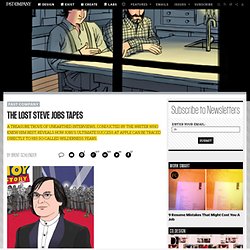
And the titles would go something like this: Act I--The Founding of Apple Computer and the Invention of the PC Industry; Act II--The Wilderness Years; and Act III--A Triumphant Return and Tragic Demise. The first act would be a piquant comedy about the brashness of genius and the audacity of youth, abruptly turning ominous when our young hero is cast out of his own kingdom.
The closing act would plumb the profound irony of a balding and domesticated high-tech rock star coming back to transform Apple far beyond even his own lofty expectations, only to fall mortally ill and then slowly, excruciatingly wither away, even as his original creation miraculously bulks up into the biggest digital dynamo of them all. Why Steve Jobs cried. Steve wept. And unlike Jesus, who famously wept over the death of Lazarus and the fate of Jerusalem, Jobs cried over just about everything. He cried at the beginning of Apple after Woz's father pushed his son to take more ownership of the company because he thought Jobs wasn't doing much work. Jobs went over to Woz's home and bawled his eyes out. Woz kept him on. Steve Jobs on programming, craftsmanship, software, and the Web. In 1995, Steve Jobs gave a rare interview to Robert Cringely for a PBS special called Triumph of the Nerds to talk about the genesis of the personal computer.
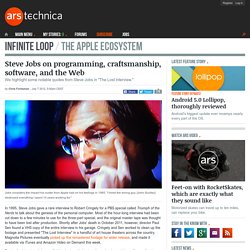
Most of the hour-long interview had been cut down to a few minutes to use for the three-part special, and the original master tape was thought to have been lost after production. Shortly after Jobs' death in October 2011, however, director Paul Sen found a VHS copy of the entire interview in his garage. Cringely and Sen worked to clean up the footage and presented "The Lost Interview" in a handful of art house theaters across the country.
Magnolia Pictures eventually picked up the remastered footage for wider release, and made it available via iTunes and Amazon Video on Demand this week. Steve Jobs Was Obsessed With His Market Cap. The Man Who Inspired Jobs. News Desk: Steve Jobs: “Technology Alone Is Not Enough” Editors’ Note: Details from this post appeared in similar form in a July, 2011, piece by Jonah Lehrer for Wired magazine, U.K.
We regret the duplication of material. On January 30, 1986, shortly after he was forced out of Apple Computer (and years before his return), Steve Jobs bought a small computer manufacturer named Pixar from George Lucas, the director of Star Wars. While the Pixar team had produced a few impressive animated shorts for marketing purposes—“The Adventures of Andre and Wally B” is widely credited with spurring Hollywood’s interest in digital animation—Jobs was most interested in the Pixar Image Computer, a $125,000 machine capable of generating complex graphic visualizations. Unfortunately, the expensive computers were a commercial flop.
Jobs was forced to extend a personal line of credit to Pixar, which lost more than $8.3 million in 1990 alone. Inside NeXT: Steve Jobs documentary video. The Next Web has a fascinating link to a video documentary about Steve Jobs's time at NeXT that gives you some further insight into how he worked, and his determined and sometime volatile personality.
The NeXT episode was filmed by John Nathan for a TV series called Entrepreneurs produced by WETA in Washington D.C. Some of the most interesting sections are Jobs pressing Joanna Hoffman at the 11 minute mark. Hoffman was one of the original members of the Mac team. His interaction with staff about delays in shipping at 15:33 is also a peek into the Steve Jobs worldview. You can watch the video clip below. Jobs introduced the NeXT computer in 1988 after he left Apple. Steve Jobs and NeXT: Rare PBS Documentary circa 1986. By Maria Popova A startup sentiment sandwich from the master chef, or why “reality distortion” helps sales but hurts design.
In 1985, shortly after being fired from Apple, Steve Jobs founded NeXT, the somewhat short-lived but revolutionary company focused on higher education and business services. It was there that Jobs honed his visionary approach to computing and design, and crystalized his lens of priorities — the very qualities that made him not only a cultural icon but also a personal hero. This fascinating PBS documentary, titled The Entrepreneurs and filmed in 1986, offers a rare glimpse of Jobs’ original vision with NeXT, from his aspirations for higher education and simulated learning environments to his decision-making process on price point and product features to his approach to company culture and motivational morale. Whether NeXT can be a viable business is something only time will tell. Quotes from Steve Jobs Lost Interview. I had the pleasure of catching the opening night showing of Robert X.
Cringely's rediscovered TV interview with Steve Jobs in 1995. In the interview Steve mused about what makes companies and products great so I jotted down a lot of his insights. Here's a few of my favorites. Note this was typed hastily on an iPad in a crowded theater so wording is probably not exact. Steve Jobs. American entrepreneur and co-founder of Apple Inc.
Steven Paul Jobs (; February 24, 1955 – October 5, 2011) was an American business magnate, industrial designer, investor, and media proprietor. He was the chairman, chief executive officer (CEO), and co-founder of Apple Inc., the chairman and majority shareholder of Pixar, a member of The Walt Disney Company's board of directors following its acquisition of Pixar, and the founder, chairman, and CEO of NeXT. Steve Jobs Quotes. Steve Jobs: 5 Things We Miss About Steve Jobs. Today marks one year since Steve Jobs died.
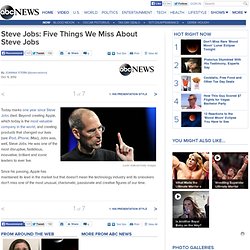
Beyond creating Apple, which today is the most valuable company in the world, and creating products that changed our lives (see iPod, iPhone, iMac), Jobs was, well, Steve Jobs. He was one of the most disruptive, fastidious, innovative, brilliant and iconic leaders to ever live. Since his passing, Apple has maintained its lead in the market but that doesn't mean the technology industry and its onlookers don't miss one of the most unusual, charismatic, passionate and creative figures of our time. Any tech journalist and/or former Apple press event attendee will agree: Sitting in the audience at an Apple keynote is different without Jobs on stage. His showmanship was unmatched and he introduced new products unlike any other.
There's not much to say about this one: black turtleneck and jeans. "It's not the public's job to know what it wants. " The man was quotable. "We want to put a great computer in a book you can carry around with you. " Steve Jobs Describes the iPad 27 Years Before its Release (Audio) Matthew Panzarino of TheNextWeb shares new details of a speech delivered by Steve Jobs in 1983 at the Center for Design Innovation.
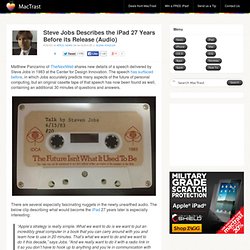
The speech has surfaced before, in which Jobs accurately predicts many aspects of the future of personal computing, but an original casette tape of that speech has now been found as well, containing an additional 30 minutes of questions and answers. There are several especially fascinating nuggets in the newly unearthed audio. The below clip describing what would become the iPad 27 years later is especially interesting: “Apple’s strategy is really simple.
What we want to do is we want to put an incredibly great computer in a book that you can carry around with you and learn how to use in 20 minutes. The clip is just filled with fascinatine excepts, such as this one predicting the future of computer networking: Why We'll Never Stop Talking About Steve Jobs. Steve Jobs is our era’s Edison, Ford or Tesla. Illustration by Simon Lutrin Let’s talk about Steve Jobs. I know, I know. It’s been a year since his death. What is there possibly left to say about him, and why are so many people still saying it? What we really owe to Steve Jobs. Apple Computer co-founder and CEO Steve Jobs introduces the all-new flat-panel iMac computer during his keynote speech at the MacWorld Expo in January 2002. Simon Garfield: New iPhone was introduced without Steve Jobs He says one of Jobs' great accomplishments was popularization of typefacesSuddenly consumers could express themselves through choice of fonts, he saysGarfield: Jobs has been an enduring tech inspiration Editor's note: Simon Garfield is the author of "JUST MY TYPE: A Book About Fonts", published by Gotham Books, a member of Penguin Group USA.
London (CNN) -- With all the tributes to Steve Jobs, one thing tends to get forgotten: the man helped us write. Jobs was the first to give us a real choice of fonts, and thus the ability to express ourselves digitally with emotion, clarity and variety. He made Type Gods of us all. What Steve Jobs taught us about failure. College dropout. Fired tech executive. Unsuccessful businessman. Steve Jobs will always be best known for his incredible success in guiding Apple Inc. and transforming the entire consumer computer and phone industry. But he’ll also be remembered fondly as the poster child for how making mistakes — and even failing — can sometimes end up being the best thing that ever happens to you. Jobs passed away Wednesday after suffering for years from health problems, likely stemming from a battle with cancer.
His death came after he was forced to step down from his position as chief executive of Apple because of the ongoing health problems. By the time he turned the reins of the company over to his second in command, Tim Cook, Jobs had become one of the business world’s greatest comeback kids. Steve Jobs’s Real Genius. Not long after Steve Jobs got married, in 1991, he moved with his wife to a nineteen-thirties, Cotswolds-style house in old Palo Alto. Jobs always found it difficult to furnish the places where he lived. His previous house had only a mattress, a table, and chairs. He needed things to be perfect, and it took time to figure out what perfect was. Steve Jobs’s Genius. Timeline: Steve Jobs' career. Steve Jobs Solved the Innovator's Dilemma - James Allworth. The Real Leadership Lessons of Steve Jobs. His saga is the entrepreneurial creation myth writ large: Steve Jobs cofounded Apple in his parents’ garage in 1976, was ousted in 1985, returned to rescue it from near bankruptcy in 1997, and by the time he died, in October 2011, had built it into the world’s most valuable company.
Along the way he helped to transform seven industries: personal computing, animated movies, music, phones, tablet computing, retail stores, and digital publishing. He thus belongs in the pantheon of America’s great innovators, along with Thomas Edison, Henry Ford, and Walt Disney. None of these men was a saint, but long after their personalities are forgotten, history will remember how they applied imagination to technology and business. “The people who are crazy enough to think they can change the world are the ones who do.” Time, Fortune announce tribute issues to Steve Jobs. Commemorative issues go on sale Nov. 15th. A Sister’s Eulogy for Steve Jobs. Sister on Steve Jobs's Last Words: "OH WOW. OH WOW. OH WOW." - Kara Swisher. Apple co-founder and Silicon Valley legend Steve Jobs lived a life that read like an epic novel, so it should be no surprise that his very last words on this temporal plane would be just as dramatic.
And they were: “OH WOW. OH WOW. OH WOW.” That’s according to his sister, Mona Simpson, whose moving eulogy was published in the New York Times today. Steve Jobs Quotes: The Ultimate Collection - Page 19 of 20.