
Photos. Photos. Photos. Free Technology for Teachers. IRRODL call for papers: Technology Enhanced Information Retrieval for Online Learning. Experience with New Tools and Infrastructures of Research: An Exploratory Study of Distance From, and Attitudes Toward, e‐Research - Prometheus - Volume 27, Issue 3. E‐Research initiatives have been launched around the world, but have they captured the imagination of researchers across the disciplines?
This paper reports on a web‐based survey designed to gauge awareness of and support for e‐Research initiatives. Early adoption and interest in e‐Research practices represent a wide range of methodological traditions, but those most interested in e‐Research tend to be among a cohort of more recent graduates of doctoral programmes. However, greater certainty and support is driven largely by proximity to e‐Research. This finding reinforces the value of efforts to engage more social scientists and other researchers in e‐Research, such as through demonstrations, training or other ways of providing hands‐on involvement. Doctoral and early career training might be the most fruitful arenas for engagement.
Keywords Related articles View all related articles. Freakonomics: What Went Wrong? Examination of a very popular popular-statistics series reveals avoidable errors Andrew Gelman, Kaiser Fung The nonfiction publishing phenomenon known as Freakonomics has passed its sixth anniversary.
The original book, which used ideas from statistics and economics to explore real-world problems, was an instant bestseller. By 2011, it had sold more than four million copies worldwide, and it has sprouted a franchise, which includes a bestselling sequel, SuperFreakonomics; an occasional column in the New York Times Magazine; a popular blog; and a documentary film. The word “freakonomics” has come to stand for a light-hearted and contrarian, yet rigorous and quantitative, way of looking at the world. #Change11 Human Learning. Like Button for Twitter. Is Design Thinking Missing From ADDIE? SumoMe Even though a crucial part of our jobs involve design, the prevailing instructional design models are based on systems thinking.
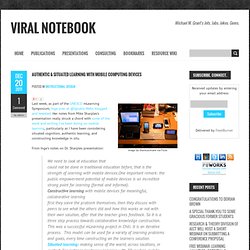
Systems thinking promotes an analytical or engineering type of mindset. But we also need an approach to help us synthesize, innovate and create. In many design fields today, people who are required to create on demand use a design thinking model for this purpose. Like Button for Twitter. Road Show Microsoft – Testing Program. Authentic & situated learning with mobile computing devices. Authentic & situated learning with mobile computing devices Image by thomcochrane via Flickr Last week, as part of the UNESCO mLearning Symposium, Inge over at @Ignatia Webs blogged and tweeted.
¿Cómo lograr excelentes maestros? El PLE de Aida, alumna de magisterio de la UBU. De la educación a distancia al e-learning. La conciencia que últimamente han cobrado las instituciones por capacitar a su personal así como la disminución de los gastos que dicha capacitación representa ha potenciado más el uso de este tipo de educación.
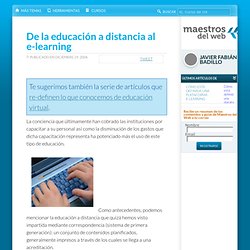
Como antecedentes, podemos mencionar la educación a distancia que quizá hemos visto impartida mediante correspondencia (sistema de primera generación): un conjunto de contenidos planificados, generalmente impresos a través de los cuales se llega a una acreditación. Globalization, Complexity and Change: Challenges for Chief Learning Officers (Part 3 of 3) How CLOs can keep up with the increasing rate of change Life is speeding up and change has become the rule rather than the exception.
It is said that one of our minutes is like one of our parents’ hours and one of our grandparents’ days. Although the rate of change varies across business areas, the trend is clear: It is accelerating. Here’s a Way to Make Your E-Learning Course Objectives Interesting » The Rapid eLearning Blog. Want a Great Looking E-Learning Course? Here’s a Simple Way to Get It. » The Rapid eLearning Blog. Physical Education by @cybraryman1. Introduction to Online Teaching and Learning - 12/15/2011. EventoTwitter.png (960x720 pixels) Las tablets en la Educación. EDUREDES - Educación Universitaria. Curating Information & Making Sense of Data Is a Key Skill for the Future [Research] UNESCO Launches Global Portal to Track Open Access. Image via Wikipedia The United Nations Educational, Scientific, and Cultural Organization (UNESCO) has launched a Global Open Access Portal (GOAP).
GOAP is an interesting website, designed to summarize the current status of open access to scientific information, especially from a regional and country-specific perspective. Key features include what UNESCO calls “critical assessments of major barriers to OA in each country; key organizations engaged in OA; and funding and deposit mandates.” UNESCO is clearly using the portal to promote OA, especially in developing countries, but most of the information is factual, not polemical. It might well be useful for market research purposes. The content appears to be more encyclopedic than journalistic, and there is a lot of it. There is however a certain amount of pro-OA rhetoric. There is also a listing of major OA repositories, categorized by what GOAP calls thematic areas, which are basically disciplines, including Arts and Humanities. Winning Student Presentation at CAC. Winning Student Presentation at CAC. CSU Resources Here are some resources you may find helpful from the workshop.
When you are in the classroom or teaching online, you may want to find new and interesting ways to engage students. Here is a course titled How to Increase Learner Engagement which provides ten great ideas for breaking away from the lecture and working toward engaging […] Continue Reading → A conversation with GamEffective The other day I had a chance to have a conversation with Roni Floman of GamEffective.
Continue Reading → Digital Learning, Education, eLearning, Improve Learning, Mobile Learning. To ensure learning transfer requires learning leaders to make specific provisions before an event starts.
If 10 CLOs were asked how best to increase the value of learning, almost all would say the same thing: Increase the amount of learning transfer in the workplace. However, if the same CLOs were asked about their own learning transfer success, they likely will express disappointment. The lack of learning transfer has been a long-standing issue in the learning community, and research on how to increase it is both complex and contradictory.
If CLOs followed typical advice, they could add hundreds of components to their learning programs, put an undue burden on learners, managers and training professionals and more than double the investment they make in each skill development effort, not to mention ruin their budgets. The Rule of Three: Practical and Effective There is a less costly approach to increase the desired learning transfer. The learning cycle and the power of asynchronous learning activities. When grappling with the concept of learning I often talk about the importance of reflection.
However, another key concept is asynchronicity (I’m not entirely sure that’s a word). I’ve reflected on this previously withinAsynchronous = Time and Space Learning. In that post I talked about how learning is more likely to occur when given time and space. I wanted to tease this out a bit more in relation to learning itself. Connectionism - Wikipedia, the free encyclopedia (una manera diferente de Aprendizaje) E-Learning-Inclusivo. About « WikiQuals. 70:20:10 by Charles Jennings. LMS – Before the Launch – 2. LMS – Before the Launch – 2. Gesture control. If you've ever been alone in a friend's living room and decide you want to watch some TV the big challenge is finding the correct remote control to get the thing started. It's even more fun when you've mislaid the control and are virtually helpless without it. But soon all this will be history and remote controls will be one more example of obsolete technology to tell your grandchildren about (see a list of other rapidly disappearing gadgets, Ten tech items you won't be needing anymore).
Gesture control is hot technology and will very soon be helping you link up with your TV, computer and mobile, as reported in a BBC article, Touchless smartphones and TVs could be on sale in 2012. Lectura dialógica — Early Childhood Community. On PLNs « That'SLife by Gavin Dudeney- with interesting comments as well. Diseño de una estrategia de e-learning 2.0: definición del PLE. Clive on Learning. Today at 7pm, Michael Allen, Julie Dirksen, Clark Quinn and Will Thalheimer, backed by a raft of other well-respected thinkers and practitioners in the field of workplace learning technologies will be launching the Serious eLearning Manifesto. This campaign is the result of many years of discussions, lamentations and grumblings about the state of e-learning.
It's time to do something about the problem before e-learning is discarded as a good idea that, in spite of 30 years of our best efforts, somehow never got to fulfil its potential. As usual, because this terminology means such different things to different people, I must clarify what sort of e-learning we're talking about here: the problem is with interactive, self-study materials accessed on a computer. We're not talking webinars, virtual classrooms, online video, social learning and all those other good things. OpenSimulator: School Quick Start Guide.
Cinco recomendaciones para ser docentes 2.0. Brooke Thompson : GiantMice.com TRANSMEDIA. Brooke Thompson : GiantMice.com. Proyecto de formación e-learning de Club de Caza ... y las artes adivinatorias. " La enseñanza de criterios y su defensa nunca consiste en su mera colocación ante la mente y en exponerlos tan claros corno sea posible. Se da por supuesto que los criterios tienen también una eficacia causal máxima. Esto hace muy difícil distinguir entre la fuerza lógica y el efecto material de un argumento.
Al igual que un perrillo amaestrado obedecerá a su amo sin importar lo confuso que él mismo esté, y sin importarte cuán urgente sea la necesidad de adoptar nuevos esquemas de conducta, del mismo modo un racionalista amaestrado será obediente a la imagen mental de su amo, se conformará a los criterios de argumentación que ha aprendido, se adherirá a esos criterios sin importar la confusión en la que se encuentre, y será completamente incapaz de darse cuenta de que aquello que él considera como la “voz de la razón” no es sino un post-efecto causal del entrenamiento que ha recibido. Feyerabend. Contra el método.
Quick Look: The Top 10 tech trends for 2012. MITx – Continuing Education online? Social business and enterprise usage: The lessons. Can Social Media Really Facilitate Learning? Social Media, it just trips off of the tongue doesn’t it? But what do we mean exactly by social media? Isn’t all media, by definition, social, in as much that it is intended for groups of people to consume, to inform to educate, persuade and convince? Now that may be the case but the two words now form an indissociable colocation, that encompasses the likes of Facebook, Twitter, MySpace, YouTube, and Linked-in to name but a few. The jury is still out on whether, in fact, these new technologies of the web 2.0 (or maybe web 3.0) generation can actually bring about any meaningful learning, but there are many that will defend to the death the notion that social media does just that.
Eduteka - Cómo seleccionar recursos educativos digitales. How to undermine Facebook. E-Learning-Inclusivo. The Blended PLC. Cc licensed ( BY NC SD ) flickr photo shared by courosa I have been thinking a lot about “Professional Learning Communities” (PLC) and how they can continue to develop in our schools to ensure we are continually growing to meet the needs of our students. I have always enjoyed Bill Ferriter’s work on this topic (definitely click on that link to see some great posts) who has some great ideas on how these need to continually progress and improve to serve our school communities. Possible Interview Questions for Teachers.
Inclusive elearning & juandoming. Using Google Docs ~ Cool Tools for 21st Century Learners. George Washington University Online High School. X-faq-1219.html#.Tu9zV9MBMqA. This set of FAQs accompanies MIT’s Dec. 19, 2011 announcement regarding MITx. Why is MIT doing this? MIT seeks through the development of MITx to improve education both on the MIT campus and around the world. ¿Qué es el mobile learning? Like Button for Twitter. Like Button for Twitter. Like Button for Twitter. Sesión formativa e-learning. Like Button for Twitter. IPAD, un nuevo concepto socio-educativo! Juandon. Geek, Friki !! Six Simple Ways to Use Cells for Learning. Cell phones are my favorite learning tool. You don't have to wait for them to turn on. Everyone knows how to use them. They're always with you and almost everybody has one making it easy to communicate, connect, and learn. Students love using their cell phones and while some view them as the enemy, others have learned to embrace these devices realizing what a powerful learning tool they are.
I love helping people use cell phones to learn so when students from Mr. Crowdsourced Predictions for Your 2012 Education Strategy. To wrap up 2011 and tee things up for 2012, I reached out to a number of colleagues at associations, learning technology firms, and other consulting firms across the sector to get their predictions (things they think will happen) and wishes (things they think ought to happen) in association education in 2012. In the first part of what follows, I have tried to weave all of the input into a cohesive narrative that spans five major themes: Following this narrative, I provide the full input from each person who participated. The E-learning Conceptual Framework. Authentic Learning with Jan Herrington.
Learning Objects Community - Objects of Interest. E-Learning—A Financial and Strategic Perspective (EDUCAUSE Quarterly) Trending Now: mLearning by @MayraAixaVillar #mLearning. Trending Now: mLearning by @MayraAixaVillar #mLearning. Like Button for Twitter. Ten Top tips for eLearning success, by Martin Baker. E-Learning-Inclusivo.
Gestión de derechos de autor en las plataformas de e-learning. Amazing Virtual Web 2.0 Choir by Eric Whitacre. Today I began searching Ted Talks for amazing lectures. I came across this “Eric Whitacre: A virtual choir 2,000 voices strong”. It is absolutely amazing! Learning Technology Learning: The learning cycle and the power of asynchronous learning activities. The learning cycle and the power of asynchronous learning activities. Entrevista – Práticas Pedagógicas em eLearning.