
L'égalitarisme, c'est pas ce que vous croyez. Feminist Disney, horticulturalcephalopod: A response to one of... Feminist Disney, Brave: The Movie that had "Feminism" in the Title of Practically Every Movie Review Ever Written About It. So How Did it Fare? Brutally Honest Disney Movie Posters Edited to Highlight Tropes and Stereotypes in Disney Films. Www.toutalego.com/2013/05/quand-disney-relooke-merida-facon-sexy.html. En 1938, il ne faisait pas bon être une femme chez Disney comme en témoigne cette lettre de rejet exhumée aujourd’hui sur Flickr.
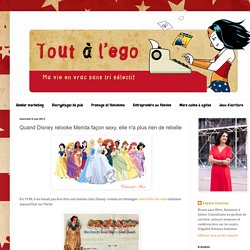
Mary V. Ford, qui avait écrit au studio d’animation pour connaître les critères d’admission à l’école Disney qui formait ses animateurs, avait ainsi reçu la réponse suivante : «Les filles ne travaillent pas du côté créatif pour préparer les dessins animés pour l’écran, car cette tâche est exclusivement réservée aux jeunes hommes. Pour cette raison, les candidatures des filles ne sont pas examinées pour l’école préparatoire. Le seul travail ouvert aux femmes consiste à tracer les dessins des personnages sur des feuilles de celluloïd avec de l’encre de Chine et de remplir l’espace entre les traits à la peinture de l’autre côté de la feuille en suivant les directions données.» Les femmes ne sont, heureusement plus, aujourd’hui cantonnées au coloriage chez Disney. Let's Re-Brand "Disney Princesses" as "Disney Heroines"
A piece of fan art and the particularities of French to English translation may have solved our Disney Princess problem: Feminist parents (and grandparents and aunts and uncles and siblings) often worry about their young girls getting sucked into Disney Princess culture, and not just because of the intimidating price tags at the Disney store.
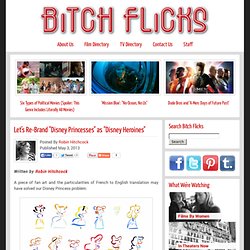
We don’t want our kids growing up with female role models solely labelled with the coveted status of “princess,” and therefore defined by their relationships with men (be they fathers or husbands), and admired largely for their status over others. It’s pretty much the last thing a feminist would want for their kids. However, criticism of Disney Princess culture often overlooks that Disney has created a battalion of strong female characters who are in fact fantastic role models for children, particularly since the dawn of the Disney Renaissance. These are characters we should want our kids to be obsessed with. Disney destroys Brave’s Merida with sexy makeover #NotBuyingIt.
From the Mary Sue: “On May 11th Brave‘s Merida will be officially crowned as the 11th Disney Princess, the impact of which is that Disney will be selling more stuff with her on it, I guess?
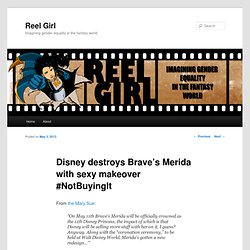
Anyway. Along with the “coronation ceremony,” to be held at Walt Disney World, Merida’s gotten a new redesign…” A great summary from Toward the Stars: Here’s one of my favorite pre-botox, pre-makeover Merida expressions. Pithy analysis from Peggy Orenstein on the eventual fate of way too many of Disney’s female characters: Because, in the end, it wasn’t about being brave after all. Strong Female Characters. Just shut up. The destructive culture of pretty pink princesses. Girls the world over often go through a "princess phase," enthralled with anything pink and pretty — most especially the Disney princesses.
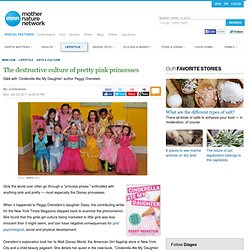
When it happened to Peggy Orenstein's daughter Daisy, the contributing writer for the New York Times Magazine stepped back to examine the phenomenon. She found that the girlie-girl culture being marketed to little girls was less innocent than it might seem, and can have negative consequences for girls' psychological, social and physical development. Orenstein's exploration took her to Walt Disney World, the American Girl flagship store in New York City and a child beauty pageant. She details her quest in the new book, "Cinderella Ate My Daughter: Dispatches from the Front Lines of the New Girlie-Girl Culture" (Harper Collins, Jan. 25). LiveScience: How did you get inspired to write the book? Saturday Vids: Advice From Cartoon Princesses. What’s Wrong With Cinderella?
Disney Princesses. This is my new Disney Princess series....after researching into them whilst I spent time in New York in 2010, I wanted to empower the princesses with the thought in mind that this would empower young girls.
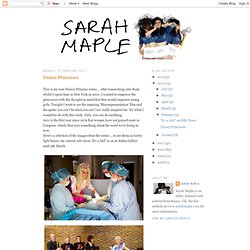
Tonight I went to see the amazing 'Missrepresentation' film and the quote 'you can't be what you can't see' really inspired me. It's what I wanted to do with this work. Girls, you can do anything. 2011 is the first year since 1979 that women have not gained seats in Congress. Surely that says something about the word we're living in now. Who’s Your Disney Spirit Animal? We all grew up with Disney films and have a slew of wonderful female role models to guide us through life’s tough road to our own very own happy ending.
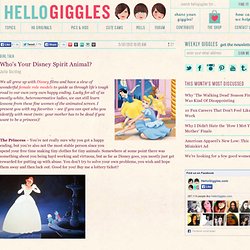
Lucky for all of us mostly-white, heteronormative ladies, we can still learn lessons from these fine women of the animated screen. I present you with my favorites – see if you can spot who you identify with most (note: your mother has to be dead if you want to be a princess)! The Princess – You’re not really sure why you got a happy ending, but you’re also not the most stable person since you spend your free time making tiny clothes for tiny animals.
Somewhere at some point there was something about you being hard working and virtuous, but as far as Disney goes, you mostly just get rewarded for putting up with abuse. You don’t try to solve your own problems, you wish and hope them away and then luck out. The Sushi Princess – You have zero self-respect and are kind of boy crazy, to the point of stalking. All images Ⓒ Disney, except Mrs. Princesses Disney féministes. ‘Brave’ turns Kelly Macdonald into a princess — and a pioneering Pixar female protagonist Pixar The animated 'Brave' stars Kelly Macdonald as Merida, a rebellious Scottish princess.
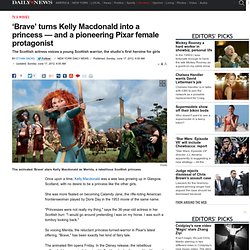
Once upon a time, Kelly Macdonald was a wee lass growing up in Glasgow, Scotland, with no desire to be a princess like the other girls. She was more fixated on becoming Calamity Jane, the rifle-toting American frontierswoman played by Doris Day in the 1953 movie of the same name. "Princesses were not really my thing," says the 36-year-old actress in her Scottish burr. "I would go around pretending I was on my horse. I was such a tomboy looking back. " So voicing Merida, the reluctant princess-turned-warrior in Pixar's latest offering, "Brave," has been exactly her kind of fairy tale. The animated film opens Friday. Seeking a way out, Merida turns to a witch in the forest (Julie Walters) for a spell that will force her mother to change, a task the sorceress takes a little too literally, with disastrous consequences.
Deborah Coleman/Pixar "We needed somebody who was going to fight back. " Ranked: Disney Princesses From Least To Most Feminist. It's hard to be liberated in a clamshell bikini.
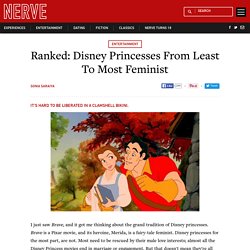
I just saw Brave, and it got me thinking about the grand tradition of Disney princesses. Brave is a Pixar movie, and its heroine, Merida, is a fairy-tale feminist. Disney princesses for the most part, are not. Most need to be rescued by their male love interests; almost all the Disney Princess movies end in marriage or engagement. But that doesn't mean they're all equally regressive. Now, I know ranking anything by perceived feminism is problematic, as your professor might put it, but go with me for the sake of discussion. 10. The early Disney films were all strange fables with beautiful scenery and women who made no choices for themselves; Sleeping Beauty is the apex of these. 9. Yeah, about all that sleeping… well, Snow White also conveniently falls asleep for much of this film, and waits to be rescued by a Charming (but otherwise featureless) prince. 8. Cinderella can't catch a break. 7.