
Herbs and Spices - description and how to use them. Seasonings, Herbs, Spices, Onions, Garlic, Peppers, Chiles. Click on the links above to learn how to use fresh herbs, dried herbs, spices, herb and spice blends to your advantage.
Take the time to experiment with garlic, dried chilies and fresh peppers and different kinds of onions, green onions, shallots, leeks and ramps. In time, your yearning for fat flavor will diminish as your tastebuds broaden for a whole new world of FLAVOR! There is no denying that fat adds flavor as well as cholesterol and calories. The clue to healthy eating and low fat cooking is how to offset that loss of flavor with seasonings when you cut the fat.
See some of the bright new seasoning ideas in our low fat recipes. Try your hand at gardening. Once you start cooking with fresh herbs, you will never want to use the dried varieties again. You think a baked potato is not good unless it has chives. And your favorite pasta dishes without fresh basil will just not compare, once you chop up some fresh basil to garnish your next pasta primavera or marinara. Tea Herbs Property Chart. List of Herbs Used for Tea. Herbal Tea Plants for the Garden. 2239 Echinacea Magnus (Echinacea purpurea) Perennial. 1998 Perennial Plant Winner.
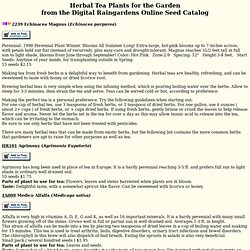
Blooms All Summer Long! Extra-large, hot-pink blooms up to 7 inches across, with petals held out flat (instead of recurved), plus easy-care and drought-tolerant. Magnus reaches 31/2 feet tall in full sun to light shade, blooms from June through September! Color: Hot Pink Zone:2-9 Spacing: 12" Height:3-4 feet. Making tea from fresh herbs is a delightful way to benefit from gardening. Brewing herbal teas is very simple when using the infusing method, which is pouring boiling water over the herbs. Making the perfect tea is a personal preference. There are many herbal teas that can be made from exotic herbs, but the following list contains the more common herbs that gardeners are apt to raise for other purposes as well as tea. HR101 Agrimony (Agrimonia Eupatoria) Agrimony has long been used in place of tea in Europe. 1A009 Medico Alfalfa (Medicago sativa) HR301 Angelica HR310 Anise (Pimpinella Anisum) How to Grow an Herbal Tea Garden: 11 steps (with pictures)
How to Grow an Herb Garden Indoors Year Round: 7 steps. Edit Article Edited by Jason Willkomm, Ben Rubenstein, Plantperson, Krystle and 20 others If you love fresh spaghetti sauce or pesto, then you've just got to have fresh basil and other herbs all year round!

A nice window garden getting at least 4 or 5 hours of direct light from a sunny window will give you something to pinch here and there. Gardens with mint, rosemary, bay leaf, savory, oregano, chervil, basil, and thyme are some of the easiest to grow this way. Ad Steps 1Provide adequate light. 7Use your herbs when they're ready. Warnings Do not get fertilizer on the leaves; you will be eating them.
How to Grow Herb Gardens from Seed: 5 steps (with pictures) List of Common Herbs - Herb Gardening. How To Make Your Own Herb Tea Blends. Mixing your own herbs for tea, is as easy as choosing the scents that appeal to you and blending up your favorite choices.
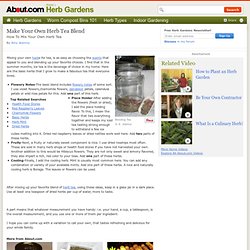
I find that in the summer months, ice tea is the beverage of choice in my home. Here are the basic herbs that I grow to make a fabulous tea that everyone loves. Flowery Notes-The basic blend includes flowery notes of some sort. I use violet flowers,chamomile flowers, dandelion petals, calendula petals or wild rose petals for this. Add one part of this herb. After mixing up your favorite blend of herb tea, using these ideas, keep in a glass jar in a dark place.
A part means that whatever measurement you have handy: i.e. your hand, a cup, a tablespoon, is the overall measurement, and you use one or more of them per ingredient. I hope you can come up with a variation to call your own, that tastes refreshing and delicious for your whole family. Herbal Remedies - Herbal Tea Remedies to heal common conditions. A Favorite for Tea Lovers Must Have Recipe Ebook!
Buy the Ebook Now. The Tea FAQ - The Definitive Guide to Tea - Tea Production. Leaves from the tea bush are generally harvested by hand, and as yet, there is no practical mechanical method of harvesting (it exists, but is only used in very low grade varieties due to the brutality of its operation on the leaves).

Harvesting is therefore a time consuming process. After harvesting, tea is further processed by two methods, depending on the quality of the leaves: Crush, Tear, Curl (CTC) CTC is a method reserved for lower quality leaves, and is an inexpensive mechanical process which reduces the leaves to tiny little grains, similar in principle to turning wood into sawdust. The leaves are allowed to sit out for a short period of time until they wither, whereupon they are torn apart inside a machine that compresses the leaves, shreds them, and reduces them into tiny pieces.
Orthodox Orthodox processing is a more time consuming, hand crafted methodology reserved for higher quality leaves. Share and Enjoy. The Tea FAQ - The Definitive Guide to Tea - What is Tea? Expert Tea Recommendations - Teas for coffee lovers, healthy skin, colds and more. Health. Coffee/Tea Accessories. Tea. Tea and Tea Culture. Nutrition.