
Plant-based fuel is cheap, easy, and ready to power your jet. One plant yields 3 clues to biofuel crops. IOWA STATE (US) — Knowing the function of three plant proteins could help scientists raise seed oil yield in crops, a potential windfall for the bioeconomy.

The analysis of gene activity by researchers at Iowa State University and determination of protein structures by scientists at the Salk Institute for Biological Sciences independently identified three related proteins that appear to be involved in fatty-acid metabolism. The researchers used thale cress (Arabidopsis thaliana) as the model plant. The research groups then joined forces to test this hypothesis, demonstrating a role of these proteins in regulating the amounts and types of fatty acids accumulated in plants. The researchers also showed that the action of the proteins is very sensitive to temperature and that this feature may play an important role in how plants mitigate temperature stress using fatty acids.
The discovery is published online in the journal Nature. 280na3. Direct Water Splitting Through Vibrating Piezoelectric Microfibers in Water - The Journal of Physical Chemistry Letters. † Department of Geoscience, and Materials Science Program ‡ Department of Mechanical Engineering, and Materials Science Program University of Wisconsin—Madison, 1215 W.

Dayton Street, Madison, Wisconsin 53706 J. Phys. DOI: 10.1021/jz100027t Publication Date (Web): March 2, 2010 Copyright © 2010 American Chemical Society Section: Abstract We propose a mechanism, a piezoelectrochemical effect for the direct conversion of mechanical energy to chemical energy. Citing Articles View all 11 citing articles. Scientist Develops Self-Sustaining Solar Reactor That Produces Clean Hydrogen Fuel. Hydrogen is a fuel that has seemingly limitless potential, but scientists have only been able to produce it from fossil fuels, like natural gas.

That is, until now. Japan left with one nuclear reactor after shutdown. 26 March 2012Last updated at 00:54 ET The Kashiwazaki-Kariwa power station is not currently in operation Japan has shut down another nuclear power station, bringing it a step closer to suspending atomic energy, following the Fukushima disaster.
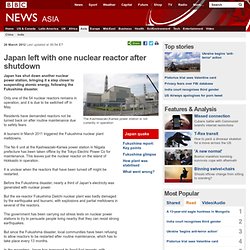
Only one of the 54 nuclear reactors remains in operation, and it is due to be switched off in May. All Scottish coal plants to use carbon capture by 2025. LONDON Mon Mar 5, 2012 2:00pm GMT LONDON (Reuters) - Scotland plans to fit all its existing coal-fired power plants with carbon capture and storage (CCS) technology by 2025 and require new coal stations to be fully equipped with CCS from the turn of the decade, the Scottish government said on Monday.

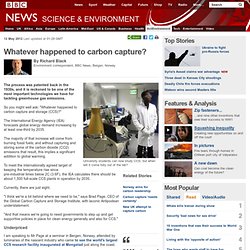
"A 'rolling review' of the technical and economic viability of CCS will take place by 2018, looking specifically at retro-fitting CCS to existing coal plants, with the likelihood of having existing plants retro-fitted by no later than 2025," the government said in a report about the future of Scotland's electricity generation. CCS is seen as a vital technology to help reduce carbon emissions from thermal power plants in order to achieve legally binding climate change targets, but the technology remains commercially unproven and costly to develop. "We know our target is technically achievable. Whatever happened to carbon capture? 12 May 2012Last updated at 01:29 GMT By Richard Black Environment correspondent, BBC News, Bergen, Norway University students can now study CCS; but when will it come fully out of the lab?
BP given consent for deep-water well North Uist west of Shetland. 22 March 2012Last updated at 17:04 ET BP has been exploring the deep waters west off Shetland since the 1970s Oil giant BP has been given consent to drill a controversial deep-water well west of Shetland.
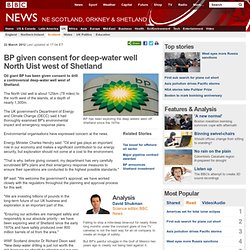
The North Uist well is about 125km (78 miles) to the north west of the islands, at a depth of nearly 1,300m. Oil price worries for Bank of England rate setters. 21 March 2012Last updated at 06:56 ET Bank of England policymakers expressed concern over rising oil prices Officials at the Bank of England say that rising oil prices present "clear risk" to the economy.

In minutes from the Monetary Policy Committee (MPC) meeting earlier this month, officials said that high oil prices could slow the global and UK recovery and drive up inflation. The minutes also show that MPC officials voted 7-2 to keep the quantitative easing (QE) asset purchase target at £325bn. US imposes solar duties on China because of subsidies. 21 March 2012Last updated at 06:36 GMT "There is a fair amount of China-bashing taking place," says William Hess of China Analytics The US has imposed duties on Chinese solar panel manufacturers after it said that they received unfair subsidies.

Chinese exporters into the US - including Suntech - will now face customs tariffs of between 2.9% and 4.73%, the Commerce Department said. In 2011, imports of solar cells from China into the US were valued at $3.1bn (£1.96bn), it added. The price of solar panels dropped more than 30% last year, mainly linked to cheaper panels made in China. Solar panel tariff appeal loss for government. 23 March 2012Last updated at 14:07 ET The government had said the subsidy cut would ensure the scheme carried on in the future The government has failed to get permission to appeal to the Supreme Court over its plan to cut subsidies for solar panels on homes.

The UK's highest court said it could not challenge a High Court ruling that blocked the halving of payments to households generating solar energy. Critics argued the plan to bring the lower rate in in December was too short notice and lacked proper consultation. The lower tariff will now apply to panels installed after 1 April. Turning Carbon Dioxide Into a Green Fuel. A research team is working on turning carbon dioxide into methanol to use later as a green fuel. The researchers from the Freiburg Materials Research Center (FMF), led by the chemist Prof. Dr. Ingo Krossing, have developed a new system that produces methanol from CO2 and hydrogen. 'Nanocable' Could Be Big Boon For Energy Storage. Thanks to a little serendipity, researchers at Rice University have created a tiny coaxial cable that is about a thousand times smaller than a human hair and has higher capacitance than previously reported microcapacitors.
The nanocable, which is described this week in Nature Communications, was produced with techniques pioneered in the nascent graphene research field and could be used to build next-generation energy-storagesystems. It could also find use in wiring up components of lab-on-a-chip processors, but its discovery is owed partly to chance. “We didn’t expect to create this when we started,” said study co-author Jun Lou, associate professor of mechanical engineering and materials science at Rice. “At the outset, we were just curious to see what would happen electrically and mechanically if we took small copper wires known as interconnects and covered them with a thin layer of carbon.”
Credit: Rice University. The Case of the Vegetarian Jet Engine: How GE Jet Engines Running on Vegetable Oil Mix Broke the Sound Barrier. How wireless charging could boost the electric car. Green Blog: Water into Hydrogen with Waste Energy using Piezoelectric crystal - New technology. With each passing day, scientists are coming out with unique solutions to lessen our dependence on fossil fuels. They are now thinking of turning stray forms of energy such as noise or random vibrations from the environment into useful form of energy.
They want to use piezoelectric effect for such purposes. Some materials produce electricity while undergoing mechanical stress.