
It's not just Popeye that gets the boost: Adding spinach to solar panels nearly triples their efficiency. By Eddie Wrenn Published: 14:26 GMT, 5 September 2012 | Updated: 14:26 GMT, 5 September 2012 Ask people what they know of spinach's energy-boosting powers, and most people will start talking about Popeye the Sailor Man.
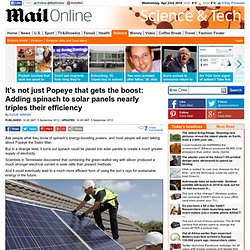
But in a strange twist, it turns out spinach could be placed into solar panels to create a much greater supply of electricity. Scientists in Tennessee discovered that combining the green-leafed veg with silicon produced a much stronger electrical current in solar cells than present methods. And it could eventually lead to a much more efficient form of using the sun’s rays for sustainable energy in the future.
Workmen install solar panels near Bodmin: new research suggests that a side-helping of spinach could help improve the efficiency of panels The team of biomolecular engineers and chemists used the photosynthetic protein in spinach - the vital ingredient that converts light into energy to make plants grow. Sediment behind dams makes them “hot spots” for emissions. With the “green” reputation of large hydroelectric dams already in question, scientists are reporting that millions of smaller dams on rivers around the world make an important contribution to the greenhouse gases linked to global climate change.

Their study, showing that more methane than previously believed bubbles out of the water behind small dams, appears in ACS’ journal Environmental Science & Technology. Andreas Maeck and colleagues point out that the large reservoirs of water behind the world’s 50,000 large dams are a known source of methane. Like carbon dioxide, methane is one of the greenhouse gases, which trap heat near Earth’s surface and contribute to global warming. Methane, however, has a warming effect 25 times more powerful than carbon dioxide. The methane comes from organic matter in the sediments that accumulate behind dams. Scientists Develop a Long-Lasting and Environmentally Friendly Battery Made From Wood. Photo via Shutterstock.

New Study on Offshore Wind Power in China. ‘Demand Response’ Programs Saved Crucial Electricity During Heat Wave. Scientists break record for thinnest light-absorber. July 18, 2013 Stanford scientists have built the thinnest, most efficient absorber of visible light on record, a nanosize structure that could lead to less-costly, more efficient, solar cells.
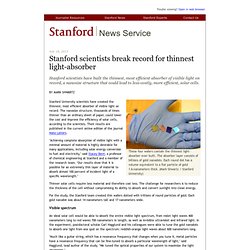
By Mark Shwartz These four wafers contain the thinnest light-absorber ever built. The absorber layer consists of billions of gold nanodots. Each round dot has a volume equivalent to a flat particle of gold 1.6-nanometers thick. Stanford University scientists have created the thinnest, most efficient absorber of visible light on record. "Achieving complete absorption of visible light with a minimal amount of material is highly desirable for many applications, including solar energy conversion to fuel and electricity," said Stacey Bent, a professor of chemical engineering at Stanford and a member of the research team.
Thinner solar cells require less material and therefore cost less. For the study, the Stanford team created thin wafers dotted with trillions of round particles of gold. Visible spectrum. Pocket Particle Accelerators Like This One Could Bring Safer Nuclear Power to Neighborhoods. A wee particle accelerator in the English countryside could be a harbinger of a safer, cleaner future of energy.
Specifically, nuclear energy, but not the type that has wrought havoc in Japan and controversy throughout Europe and the U.S. It would be based on thorium, a radioactive element that is much more abundant, and much more safe, than traditional sources of nuclear power. Some advocates believe small nuclear reactors powered by thorium could wean the world off coal and natural gas, and do it more safely than traditional nuclear. New Printable Antenna Can Harvest Ambient Energy To Power Small Electronics. A new ultra-wideband antenna printed on paper or plastic can harvest ambient energy, enabling wireless sensors to tap into electromagnetic currents in the air around them.
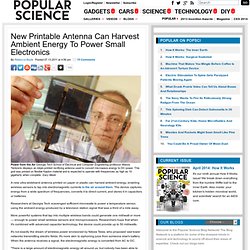
The device captures energy from a wide spectrum of frequencies, converts it to direct current, and stores it in capacitors or batteries. Researchers at Georgia Tech scavenged sufficient microwatts to power a temperature sensor, using the ambient energy produced by a television station signal that was a third of a mile away. More powerful systems that tap into multiple wireless bands could generate one milliwatt or more — enough to power small wireless sensors and microprocessors. Researchers hope that when it's combined with advanced capacitor technology, the device could provide up to 50 milliwatts. It's not exactly the dream of wireless power envisioned by Nikola Tesla, who proposed vast tower networks transmitting electric fields. [via Georgia Tech Research News] NASA Invests In Satellites That Beam Power Down to Earth. As spaceborne energy-harvesting schemes go, this one seems faintly possible — an array of curved mirrors directing sunlight toward solar cells, their energy production microwaved down to Earth.
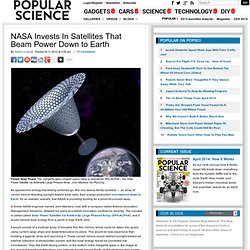
It's so realistic, actually, that NASA is providing funding for a proof-of-concept study. A former NASA engineer named John Mankins, now with a company called Artemis Innovation Management Solutions, detailed his plans at a NASA innovation conference recently. Could A Volcano Power America? In October, at the Deschutes National Forest in central Oregon, a team of scientists and engineers began pumping 11 million gallons of water underground, right near the caldera of the famed Newberry Volcano.

The Northwest weather was a cool 50 degrees most days, about the same temperature as the water the engineers drove, up to 375 gallons a minute, 10,000 feet into the ground. There, deep in the earth's crust, the temperature reaches more than 600 degrees. That's what the engineers were pumping for: If everything goes according to plan, a company called AltaRock Energy will suck the super-heated water from underground and use it to spin turbines and juice the area with renewable power.
Over the next two months, the engineers would keep pumping the water, as the weather started to turn. Snow gathered itself up tree trunks and the engineers' equipment, eventually forcing them to lower ground. But the technology isn't cheap. Susan Petty founded AltaRock Energy in 2007. This Man Wants To Power The World With Tornadoes. Deuterium DIY: Man Builds Homemade Nuclear Fusion Reactor in Brooklyn. Need a weekend project around the house?

Mark Suppes, web developer by day, has built his own nuclear fusion reactor in a Brooklyn workspace. It kind of makes that project car you've got rusting in the garage seem lame by comparison. Suppes' reactor – it's about the size of an air conditioning unit with some extra bells and whistles attached – isn't the answer to the world's energy problems, at least not yet. Teen Builds Basement Nuclear Reactor. Build a Homemade Nuclear ReactorCost: $3,500Time: 2 Years Itching for a challenging science project, two years ago Thiago Olson decided to build a small nuclear reactor.
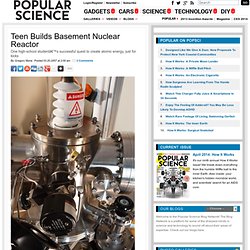
He had limited funds, limited space in his garage, and little engineering know-how. To build world’s largest nationwide network of EV fast-charging stations in the Netherlands. ABB wins contract for nationwide electric vehicle fast-charging infrastructure in the Netherlands bringing a charging station within 50 kilometers of all 16.7 million inhabitants Zurich, Switzerland, July 8, 2013 – ABB, the leading power and automation technology group, announced today that it has been selected by Fastned to supply chargers to more than 200 electric vehicle fast-charging stations in the Netherlands, bringing an EV fast charger within 50 kilometers of all of the country’s 16.7 million inhabitants. Each of the more than 200 Fastned stations along Dutch highways will be equipped with several multi-standards fast chargers, such as the 50 kilowatt (kW) Terra 52 and Terra 53 models, capable of charging electric vehicles in 15-30 minutes.
The first ABB Terra fast chargers are due to be delivered in September 2013. Flexible Glass Solar Cells Could Boost Effectiveness of Solar Shingles.