
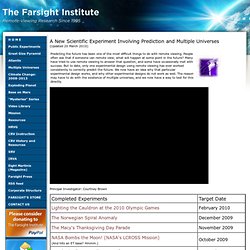
Brain's Hidden Sewers Revealed. Multiple Universes Project. A New Scientific Experiment Involving Prediction and Multiple Universes (Updated 20 March 2010)
Remote Viewing Institute Issues Grave Call to Mainstream Science. The Farsight Institute, a non-profit organization focused on the scientific application of remote viewing, recently released a challenge to mainstream science: organize a tightly controlled, publicly viewable scientific display of the phenomenon of remote viewing in return for mainstream recognition of the validity of the phenomenon itself.
And do it in the narrowing window of a vanishing 2012 timescape. Dr. Courtney Brown, an Atlanta-based professor who directs the Institute, has spearheaded the development of a novel Prometheus Protocol for conducting scientific Remote Viewing experiments. The Ethics of Unconsciousness. In February 1990, 26-year-old Terri Schiavo had a massive heart attack that left her with severe brain damage.
She fell into a coma for two-and-a-half months, after which she was diagnosed as being in a persistent vegetative state. She could not communicate, and her family members disagreed strongly about whether to remove her feeding tube and let her die or maintain nourishment in the hopes she might someday wake. 10 Mind-Blowing Facts About The Brain - Oddee.com (brain, genius...) The Brain Feels No Pain "Relax, this won't hurt a bit...
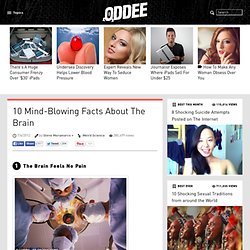
" There are no pain receptors in the brain. That's why surgeons can perform brain surgery on a patient why they are still awake. This helps them ensure that the delicate procedure doesn't screw up any vision or motor control functions – and also it looks really freaky. Why do we feel pain? Chilled-out mice hold key to new treatments for psychological disorders. “Don’t make me angry.

You wouldn’t like me when I’m angry,” the Hulk’s alter ego Bruce Banner famously said. Now researchers have made a discovery that might one day have implications for anyone considering Bruce as a potential house guest. The researchers have identified a brain receptor that malfunctions in overly hostile mice - a receptor that also exists in humans - and found a way to shut it down, offering the potential for the development of treatments for severe aggression. The breakthrough by Marco Bortolato and Jean Shih from the University of Southern California’s (USC) School of Pharmacy, working with colleagues in Italy, builds on previous work by Bortolato and Shih, in which they identified a specific gene disposition resulting in low levels of the enzyme monoamine oxidase A (MAO A). CogSpace - 3D Mind Map of Cognitive Science and Consciousness Studies. Brain and Behavior. People See Sexy Pictures of Women as Objects, Not People. Perfume ads, beer billboards, movie posters: everywhere you look, women’s sexualized bodies are on display.
A new study published in , a journal of the Association for Psychological Science , finds that both men and women see images of sexy women’s bodies as objects, while they see sexy-looking men as people. Sexual objectification has been well studied, but most of the research is about looking at the effects of this objectification. “What’s unclear is, we don’t actually know whether people at a basic level recognize sexualized females or sexualized males as objects,” says Philippe Bernard of Université libre de Bruxelles in Belgium. Bernard cowrote the new paper with Sarah Gervais, Jill Allen, Sophie Campomizzi, and Olivier Klein.
Psychological research has worked out that our brains see people and objects in different ways. Soldiers who desecrate the dead see themselves as hunters. Modern day soldiers who mutilate enemy corpses or take body-parts as trophies are usually thought to be suffering from the extreme stresses of battle.

But, research funded by the Economic and Social Research Council (ESRC) shows that this sort of misconduct has most often been carried out by fighters who viewed the enemy as racially different from themselves and used images of the hunt to describe their actions. "The roots of this behaviour lie not in individual psychological disorders," says Professor Simon Harrison who carried out the study, "but in a social history of racism and in military traditions that use hunting metaphors for war. Although this misconduct is very rare, it has persisted in predictable patterns since the European Enlightenment.
Personality Tests. Www.thersa.org/__data/assets/pdf_file/0006/553542/RSA-Transforming-Behaviour-Change.pdf. Thinking the Way Animals Do. By Temple Grandin, Ph.D.
Department of Animal Science Colorado State University Western Horseman, Nov. 1997, pp.140-145 (Updated January 2015) Temple Grandin is an assistant professor of animal science at Colorado State University. She is the author of the book Thinking in Pictures. As a person with autism, it is easy for me to understand how animals think because my thinking processes are like an animal's. The beautiful shapes of neurons. I had no idea that neurons came in such a beautiful diversity of shapes.
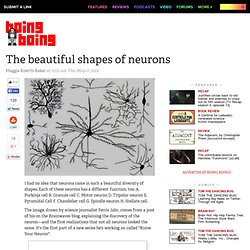
Each of these neurons has a different function, too: A. Purkinje cell B. Granule cell C. Motor neuron D. Tripolar neuron E. Lucid Dreaming Frequently Asked Questions Answered by The Lucidity Institute. Highly developed brains behind top performances. High performers have an astonishing integration of brain functioning (Photo: Bjørnar Kjensli) Brains of such performers function in a way that makes them have peak experiences.
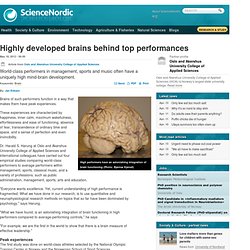
These experiences are characterized by happiness, inner calm, maximum wakefulness, effortlessness and ease of functioning, absence of fear, transcendence of ordinary time and space, and a sense of perfection and even invincibility. Dr. Harald S. Do Psychedelics Expand the Mind by Reducing Brain Activity? What would you see if you could look inside a hallucinating brain? Despite decades of scientific investigation, we still lack a clear understanding of how hallucinogenic drugs such as LSD (lysergic acid diethylamide), mescaline, and psilocybin (the main active ingredient in magic mushrooms) work in the brain. Modern science has demonstrated that hallucinogens activate receptors for serotonin, one of the brain’s key chemical messengers.
Specifically, of the 15 different serotonin receptors, the 2A subtype (5-HT2A), seems to be the one that produces profound alterations of thought and perception. It is uncertain, however, why activation of the 5-HT2A receptor by hallucinogens produces psychedelic effects, but many scientists believe that the effects are linked to increases in brain activity. The study in question was conducted by Dr. The findings reported by Dr.
Given those earlier findings, the fMRI data reported by Dr. What are the Benefits of Mind Uploading? Michael Anissimov April 13, 2012 Universal mind uploading, or universal uploading for short, is the concept (I'm not sure who originated it --if you know, say so in the comments), that the technology of mind uploading will eventually become universally adopted by all who can afford it, similar to the adoption of modern agriculture, hygiene, and permanent dwellings. The concept is rather infrequently discussed, due to a combination of 1) its supposedly speculative nature and 2) its "far future" time frame. Yet some futurists, such as myself, see the eventuality as plausible by as early as 2050. Still, even if two direct copies are made, the universe won't care -- you would have simply created two identical individuals with the same memories.
Hidden Epidemic: Tapeworms Living Inside People's Brains. Theodore Nash sees only a few dozen patients a year in his clinic at the National Institutes of Health in Bethesda, Maryland. That’s pretty small as medical practices go, but what his patients lack in number they make up for in the intensity of their symptoms. Some fall into comas. Some are paralyzed down one side of their body. Others can’t walk a straight line. Still others come to Nash partially blind, or with so much fluid in their brain that they need shunts implanted to relieve the pressure. BrainFacts.org Homepage.
Insights in Human Knowledge, From the Minds of Babies. By Thomas Lin and Tony Cenicola Erik Jacobs for The New York Times Elizabeth S. Spelke: A video interview with the Harvard cognitive psychologist on babies and the nature of human knowledge. The video clips featured simple Keith Haring-type characters jumping, sliding and dancing from one group to another. The researchers’ objective, as with half a dozen similar projects under way in the lab, was to explore what infants understand about social groups and social expectations. The Trust Molecule by Paul J. Zak. How Psychedelic Drugs Can Help Patients Face Death. Near death, explained - Neuroscience. In 1991, Atlanta-based singer and songwriter Pam Reynolds felt extremely dizzy, lost her ability to speak, and had difficulty moving her body. A CAT scan showed that she had a giant artery aneurysm—a grossly swollen blood vessel in the wall of her basilar artery, close to the brain stem.
If it burst, which could happen at any moment, it would kill her. But the standard surgery to drain and repair it might kill her too. With no other options, Pam turned to a last, desperate measure offered by neurosurgeon Robert Spetzler at the Barrow Neurological Institute in Phoenix, Arizona. New technology shown to minimize brain injuries. A new technique known as mechanical tissue resuscitation has been shown to reduce the cell deaths that result from brain injuries (Image via Shutterstock) When the brain receives a traumatic injury, irreversible damage occurs as the cells at the point of impact die.
Injured cells surrounding the area then release toxic substances, which cause the brain to swell. Program Dreams With Your iPhone. Violent computer games cleared by researchers. One of the games that the Swedish researchers have studied is ‘Lord of the Rings Online’. Consumerism and its antisocial effects can be turned on. Money doesn't buy happiness. 12 Coolest Facts About Dreams. Volunteers needed to test dream-controlling app. Volunteers are being sought to try out the Dream:ON iPhone app, which may allow users to determine what sort of dreams they have Image Gallery (2 images) Mapping The Brain’s Superhighways. Holding a gun makes you think others are too.
God helmet. The "God Helmet" refers to an experimental apparatus originally called the "Koren helmet" after its inventor Stanley Koren. Psychology studies relevant to everyday life from PsyBlog - StumbleUpon. Visions For All. Meeting the Almighty takes hallucinatory talent and training. Stephen Cave - Stayin' alive. Making Mouse Memories. In the movie Eternal Sunshine of the Spotless Mind, scientists erase troubling memories from Jim Carrey’s head.
In real life, scientists have done the opposite. By reactivating certain nerve cells, researchers make artificial memories pop into mice’s heads. The results, published in the March 23 Science and online March 22 in Nature, offer a deeper understanding of how the brain creates and uses memories. Sum of bilingual baby's ability equal to others › News in Science (ABC Science) Seeing in the Dark & SEEDMAGAZINE.COM. Mind Uploading: Brain Facts. Wirehead hedonism versus paradise-engineering. Love Deactivates Brain Areas For Fear, Planning, Critical Social Assessment. Researchers may have discovered how memories are encoded in the brain. NIMH · Eating Disorders. Brain Basics. Human Thought Controls Neurons in Brain.
Mixed Signals - synesthesia online. Neuroscience News - Neuroscience Research Neuroscience Labs Neuroscience Jobs Neuroscience Books Reviews Neuroscience Forums Social Network. Institute of Cognitive Neuroscience - StumbleUpon. List of cognitive biases.
The neurological power of metaphor. Sober up with LSD. Neuroscience of Music - How Music Enhances Learning - Neuroplasticity. Scientists claim brain memory code cracked. LSD Gets Another Look As Alcoholism Treatment : Shots - Health Blog. Heart disease drug 'combats racism' Eat more, move less and don’t gain weight by blocking a marijuana-like chemical in the brain. Possible Link Between Statin Use and Lower Depression Risk. A Quest to Understand How Memory Works. How marijuana impairs memory. Adolescent Brain Development and Life Without Parole. Sebastian Seung: A Neuroscientist Reverse-Engineering The Brain. Brain Cells Know Which Way You'll Bet. Futility Closet - StumbleUpon.
How to Memorize Anything. Links to hundreds of Psychology studies running on the internet. Index of free personality tests and intelligence tests - StumbleUpon. What Do Blind People See When They Dream? - DivineCaroline - StumbleUpon. Oliver Sacks: What hallucination reveals about our minds. The scientific argument for being emotional - Neuroscience. Can Gardening Help Troubled Minds Heal? : The Salt. Demystifying The Mind. Enriched With Information. Anatomy of the Great Adderall Drought. THE DRUG DOES WORK. How to increase serotonin in the human brain without drugs. Never too soon: Means to reduce violence may start in utero. New brain connections form in clusters during learning.
Focus on Brain Disorders - Bipolar Disorder - Introduction. When nerve meets muscle, biglycan seals the deal. Penn psychologists find 6- to 9-month-olds understand the meaning of many spoken words. What does English sound like to foreign ears? Sleeplessness Agitates The Brain. Left-handed? Different bodies, different minds. The biology of dreaming. FDA approves the treatment of brain tumors with electrical fields. Just Two Cells To Make Memories Last. Thinking About Mortality Changes How We Act. Conscious Entities. Vangelis Talks About The Role Of Music In Times Of Chaos. Scientists use brain activity analysis to reconstruct words heard by test subjects. BRAINMETA.COM - NEUROSCIENCE, CONSCIOUSNESS, BRAIN, MIND, MIND-BRAIN, NEUROINFORMATICS, BRAIN MAPS, BRAIN ATLASES. BRAINMAPS.ORG - BRAIN ATLAS, BRAIN MAPS, BRAIN STRUCTURE, NEUROINFORMATICS, BRAIN, STEREOTAXIC ATLAS, NEUROSCIENCE.