
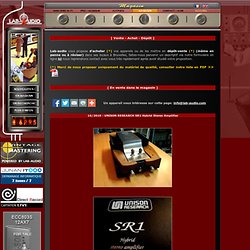
HiFi Archiv. Achat,vente,dépôt-vente,petites annonces,hi end hi-fi, pro-audio, amplis gt, synthés vintage. Tout matériel Haute-Fidélité ancien (période 1950 – 1975) particulièrement (mais pas uniquement) à lampes (tubes) : amplificateurs, préamplificateurs,tuners, platines, haut-parleurs, enceintes, etc… de préférence de grandes marques telles que FISHER, SCOTT, QUAD, LEAK, ROGERS, MARANTZ, GARRARD, THORENS, GOODMANS, ALTEC, JBL, ELECTROVOICE, REVOX etc… (liste non exhaustive)
BeoSystem 5500. Manufactured: 1986 - 1989 Designer: Jacob Jensen Colours: Aluminium, White Beosystem 5500 - raw power, civilised manners At first sight Beosystem 5500 looked almost too refined to be a musical powerhouse.
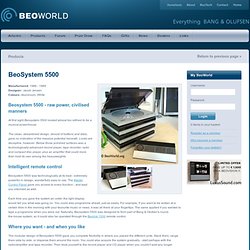
The clean, streamlined design, devoid of buttons and dials, gave no indication of the massive potential beneath. Looks are deceptive, however. Below those polished surfaces was a technologically-advanced record player, tape recorder, radio and compact disc player, plus an amplifier that could more than hold its own among the heavyweights. Intelligent remote control Beosystem 5500 was technologically at its best - extremely powerful in design, wonderfully easy to use. Each time you gave the system an order, the light display would tell you what was going on.
Where you want - and when you like The modular design of Beosystem 5500 gave you complete flexibility in where you placed the different units. Beosystem 5500 was made up of the following individual units: Beomaster 5500 Beogram CD5500. Forums - Phantom Productions Vintage Reel Tape Recorder Online Collection and Museum. Audio and Video.
AudioScope. Quadral Vulkan MK 2 for sale. Nakamichi TX-1000 on thevintageknob.org. Preliminary Pretty rare - almost Invisibilia status.
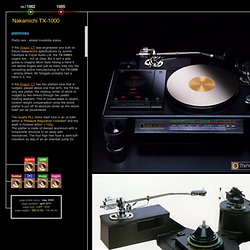
If the Dragon CT was engineered and built on Etsuro Nakamichi's specifications by Junichi Okumura at Fujiya Audio Ltd, the TX-1000's origins are... not so clear. But it isn't a wild guess to imagine Micro Seiki having a hand if not twelve fingers and just as many toes into the consulting and/or manufacturing of the TX-1000 - among others. Mr Teragaki probably had a hand in it, too. If the Dragon CT has two platters (one that is nudged, placed above one that isn't), the TX has only one platter, the rotating center of which is nudged by two motors through two plastic rotating washers.
The Quartz PLL motor itself runs in an oil bath within a "Pressure Regulation Chamber" and the shaft is finished within 1/100µ. To perfect the "multi-sourced" parts and engineering, an optional VS-100 vacuum stabilizer coud be ordered. A very interesting review (with music in mind) is available here. A real TX-1000 here. Nakamichi Dragon CT on thevintageknob.org. Nakamichi DRAGON on thevintageknob.org. At least, this one is well remembered :) The usual debate surrounding the original DRAGON isn't as interesting as what this monster did represent in 1983 : it was the most one could do without actually altering the Compact Cassette format's physical structure like the ELCASET did (ie. open-reel in a cassette) or Luxman's X-3K prototype should have done by completely pulling the tape out of the cassette's shell thus removing any rotating movements from the tape.
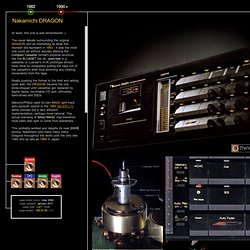
Really pushing the format to the limit and selling quite well, the DRAGON became the one show-stopper until cassettes got replaced by digital tapes, recordable CD and, ultimately, hard-drives and SSDs. Marantz/Philips used its own MAAC split-track auto-azimuth control in the 1983 SD-930 : same concept but a very different implementation, perhaps more rational. The actual licensing of NAAC/MAAC may therefore have been also split or come from elsewhere... HiFi-Do McIntosh/JBL/audio-technica/Jeff Rowland/Accuphase. HiFi-Do McIntosh/JBL/audio-technica/Jeff Rowland/Accuphase. 4430/35. The 4430 and 4435 Bi-Radial Studio Monitors were amongst the most successful professional loudspeakers ever produced by JBL.
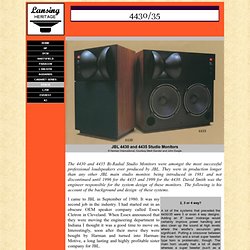
They were in production longer than any other JBL main studio monitor, being introduced in 1981 and not discontinued until 1996 for the 4435 and 1999 for the 4430. David Smith was the engineer responsible for the system design of these monitors. The following is his account of the background and design of these systems. I came to JBL in September of 1980. It was my second job in the industry. At the time JBL had a good line of studio monitors including the 4350, the 4343 and the 4315 (a product I much admired). Don Keele had just gotten his constant directivity horn design software going. Marantz Music Link Series - DutchAudioClassics.nl. The Marantz Music Link series was designed with a specific goal in mind: To provide absolutetly state-of-the-art-sonic performance in a rarely seen design package noted for both its advanced construction and its understated beauty.

Judging from highly positive reactions to the Marantz Music Link Series by audiophiles both internationally and on American shores, Marantz has achieved their goal. The Vintage Knob - Online vintage audio museum, forum and image bank. Pioneer RT-909 on thevintageknob.org. Zoekertjes van en voor vintage audio liefhebbers.