
Godless Utopia sur Twitter : "We let religion run the world once: It's called the Dark Ages for a reason #atheist #god... Godless_mom : Why does it not say anywhere ... A Highlight and Note by Noel Poler from Godless: How an Evangelical Preacher Became One of America's Leading Atheists. Quotes About Atheism (323 quotes) - StumbleUpon. “Stood in firelight, sweltering.
Bloodstain on chest like map of violent new continent. Felt cleansed. Felt dark planet turn under my feet and knew what cats know that makes them scream like babies in night. Looked at sky through smoke heavy with human fat and God was not there. The cold, suffocating dark goes on forever and we are alone. Existence is random. Was Rorschach. Does that answer your Questions, Doctor?” Study Explores Distrust Of Atheists By Believers. Distrust is the central motivating factor behind why religious people dislike atheists, according to a new study led by University of British Columbia psychologists.
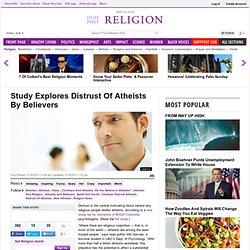
(Read the full study.) “Where there are religious majorities -– that is, in most of the world –- atheists are among the least trusted people,” says lead author Will Gervais, a doctoral student in UBC’s Dept. of Psychology. “With more than half a billion atheists worldwide, this prejudice has the potential to affect a substantial number of people.” While reasons behind antagonism toward atheists have not been fully explored, the study –- published in the current online issue of Journal of Personality and Social Psychology -– is among the first explorations of the social psychological processes underlying anti-atheist sentiments. “This antipathy is striking, as atheists are not a coherent, visible or powerful social group,” says Gervais, who co-authored the study with UBC Associate Prof. Paul Brandeis Raushenbush: When an Atheist Dies: Religious Reflections on Christopher Hitchens' Death. What happens to an atheist when he dies?
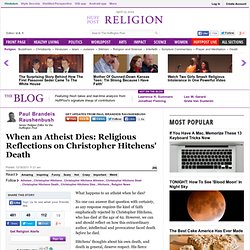
No one can answer that question with certainty, as any response requires the kind of faith emphatically rejected by Christopher Hitchens, who has died at the age of 62. However, we can and should reflect on how this extraordinary author, intellectual and provocateur faced death before he died. Hitchens' thoughts about his own death, and death in general, deserve respect. His fierce atheism was determined to yank our thoughts away from any future place and time after we die, back to the world that is present to us in this very moment.
Take, for example, this arresting passage written by Ayaan Hirsi Ali* from the book Hitchens edited called The Portable Atheist: Death is certain, replacing both the siren-song of Paradise and the dread of Hell. This emphasis on the present may feel incomplete to some. Hitchens' approach to death also demonstrated the value he placed on rationality and the life of the mind. Aristotles Muse: Atheist/Agnostic Products: Zazzle.com Store. Ordenar: ¡Gracias!

No vamos a mostrar este producto otra vez! Hundreds of Proofs of God痴 Existence. NOTE: For real proofs of the nonexistence of any god, see "Why Atheism?
" For other evidence, go to Atheists of Silicon Valley debate page . Hundreds of Proofs of God’s Existence Formerly: Over Three Hundred Proofs of God’s Existence Originally adapted from a forum on the Internet Infidels . TRANSCENDENTAL ARGUMENT, a.k.a. . (1) If reason exists then God exists. (2) Reason exists. (3) Therefore, God exists.
COSMOLOGICAL ARGUMENT, a.k.a. . (1) If I say something must have a cause, it has a cause. (2) I say the universe must have a cause. (3) Therefore, the universe has a cause. Boiled.jpg from venganza.org. Paul Brandeis Raushenbush: When an Atheist Dies: Religious Reflections on Christopher Hitchens' Death. I Am An Atheist: 16 Things Atheists Need Christians to Know. Why Atheism? Just about everyone is an atheist when it comes to other gods — the gods that other people believe in or that nobody believes in anymore.

I’m an atheist about all gods because there's no reliable evidence for any god, or even for Jesus. There is also extensive evidence that Jesus and all gods are fictional characters — myths created mainly by people who had little understanding of how our universe operates. We all like myths and other stories, but we don't have to believe them. Let’s start with a quick experiment.
You can grab three coins and actually do the experiment, or just do a thought experiment. Drop one coin and watch it fall. If you were to the release third coin, what do you think would happen? Our understanding of the world around us, and our abilities to predict what will happen are based on naturalism — the basis of science. To be explicit, modern science relies on methodological naturalism.
In “Cosmos” Neil deGrasse Tyson explained the basic rules of science.