
Neuroscience Experiments: Human Version 2.0 Video. Our mind habitat in the infoverse JPEG, 1086x768 pixels) The Future of Intelligence. Cadell Last, Adam Ford By Cadell Last Human intelligence, like everything related to biological systems, is an evolving phenomenon.
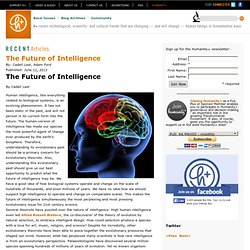
It has not been static in the past, and will not persist in its current form into the future. Why the Global Brain needs a Therapist. The idea that the world itself could be considered an overarching form of mind can trace its roots deep into the religious longings of pantheism- the idea that the universe itself is God, or the closest thing we will ever find to our conception of God.
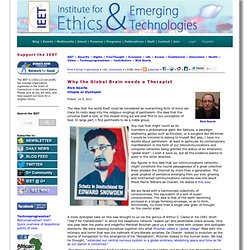
In large part, I find pantheists to be a noble group. Any club that might count as its members a philosophical giant like Spinoza, a paradigm shattering genius such as Einstein, or a songbird like Whitman I would be honored to belong to myself. SEMANTIC FUNCTIONS THEORY The Language of Collective Intelligence. Minding the Planet: From Semantic Web to Global Mind. Draft 1.1 for Review (integrates some fixes from readers) Nova Spivack (www.mindingtheplanet.net) This article presents some thoughts about the future of intelligence on Earth.
In particular, I discuss the similarities between the Internet and the brain, and how I believe the emerging Semantic Web will make this similarity even greater. The Semantic Web enables the formal communication of a higher level of language -- metalanguage. Metalanguage is language about language -- language that encodes knowledge about how to interpret and use information. Metalanguages – particularly semantic metalanguages for encoding relationships between information and systems of concepts – enable a new layer of communication and processing.
The Global Brain, the Semantic Web, the Singularity and 360-2020 consciousness to create the Web of WE: socially-voiced co-creation - un knol de 刘Twain. Video Introduction F irstly, thank you for your interest and I hope readers will contribute their own considered analysis and gut intuitions here intelligently, regardless of whether or not they agree with these postulations and the presentation of them. Secondly, I’m looking forward to our interactions and building upon this model together. Thirdly, I have the flu whilst I write this so my own brain may not be optimally functioning! Nevertheless, I promised a knowledge share and here it is. This post is an initiating conversation in a continuum of “negotiations of intellect” (discourse) I’m engaging in with others interested in the subject matter, as well as within myself. It is not intended to be the definitive, static or absolute end-game version, nor indeed the academic / geek version.
I decided to start this posting today, 26 November, on my father's birthday. Six Global Theories of Mythology: Part Six – Myths express the Unconscious Human Mind. The Human Mind The Sixth Global Theory – Myths reflect Man’s Unconscious Mind After the intensity of the progression of mythological theories in their investigation into the psychology, values, phenomenology, history and rituals of any particular civilisation or society, the Psychoanalytical Theory of myths was inevitable.
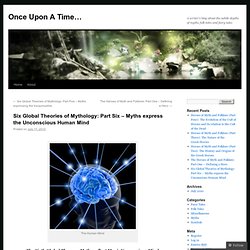
Freud’s ‘Interpretation of Dreams’ investigated the link between the language of dreams and mythological symbols based on the tribal belief that dreams and myths arise from the same reality. Freud (1856 – 1939) believed in a transhistorical and biological conception of mankind and furthermore that myth expressed repressed desires. The Omega Point [Jason Silva] The Omega Point and Life in the Universe. How long can life survive in the universe?
Can it evolve forever, or will the third law of Thermodynamics lead to universal heat death? Apparently there might be some ways around this fate, if intelligent life is sufficiently clever and tenacious. Essentially life has to adapt as the universe grows older, changing itself to be able to survive when the stars grow cold. If the universe is open, there will be plenty of time to work in, but energy will become very scarce. Dyson has shown that a finite amount of energy is enough to guarantee infinite survival if it is spent sufficiently slowly (this is called the Dyson scenario ).
On the other hand, if the universe is closed, it will recollapse into a Big Crunch after a finite time, becoming hotter and hotter. Sections. The Hivemind Singularity - Alan Jacobs. In a near-future science fiction novel, human intelligence evolves into a hivemind that makes people the violent cells of a collective being. Slime mold network formation (Science). How Much Longer Until Humanity Becomes A Hive Mind? A Metathinking Manifesto. The significant problems we face today cannot be solved at the same level of thinking we were at when we created them. – Einstein For several years now, I’ve been studying the intersection of technology, culture and communication, the impacts of social media, the relationship between creativity, innovation and design, and the potential of various futures.
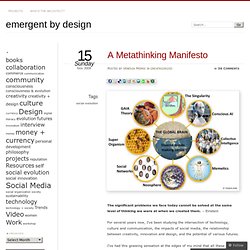
I’ve had this gnawing sensation at the edges of my mind that all these areas were held together by a common thread, but I couldn’t put my finger on the connection. My intention is that by taking this out of the incubation stage in my head and putting it into words, it will become clarified and provide some value. First off, let me lay out a framework . My ideas are based on 3 main concepts: * Social media is fundamentally changing the human experience. * The world is increasing in complexity. * We are experiencing accelerating change. Pathway to the Global Brain (part 2/5): Waking Up. Our evolution If you share this, please use the hashtags #GlobalBrain and/or #LongReads The Global Brain is a concept representing the hypothesized emergence of a higher-level distributed intelligence caused by human-machine communication networks on the Internet.
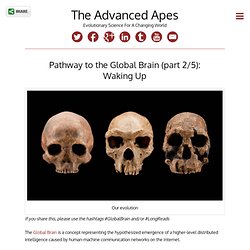
Leading research and model-building on this phenomenon is occurring at the Global Brain Institute in Belgium. The following blog series is in preparation for my Ph.D. work on the Global Brain. I would like to create a new perspective on our evolutionary history which combines evolutionary anthropology and cybernetics. Are search engines and the Internet hurting human memory? The following is excerpted from Clive Thompson’s book Smarter Than You Think: How Technology Is Changing Our Minds for the Better, out now from the Penguin Press.
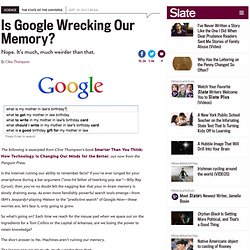
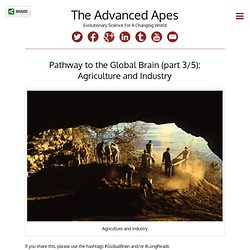
Is the Internet ruining our ability to remember facts? If you’ve ever lunged for your smartphone during a bar argument (“one-hit father of twerking pop star”—Billy Ray Cyrus!) , then you’ve no doubt felt the nagging fear that your in-brain memory is slowly draining away. As even more fiendishly powerful search tools emerge—from IBM’s Jeopardy! -playing Watson to the “predictive search” of Google Now—these worries are, let’s face it, only going to grow. Pathway to the Global Brain (part 3/5): Agriculture and Industry. Agriculture and Industry If you share this, please use the hashtags #GlobalBrain and/or #LongReads.
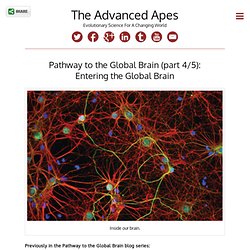
Pathway to the Global Brain (part 4/5): Entering the Global Brain. Inside our brain.
Previously in the Pathway to the Global Brain blog series: (Part 1/5): Introduction to Cybernetics (Part 2/5): Waking Up (Part 3/5): Agriculture and Industry. 8 Steps...(T.G) Pathway to the Global Brain (part 1/5): Introduction to Cybernetics. What is the nature of intelligence? If you share this, please use the hashtags #GlobalBrain and/or #LongReads The Global Brain is a concept representing the hypothesized emergence of a higher-level distributed intelligence caused by human-machine communication networks on the Internet. Leading research and model-building on this phenomenon is occurring at the Global Brain Institute in Belgium. The following blog series is in preparation for my Ph.D. work on the Global Brain. I would like to create a new perspective on our evolutionary history which combines evolutionary anthropology and cybernetics. What Is The Global Brain?
The Internet: You Are Here The Global Brain may sound like something out of a 21st century science fiction novel. But it is actually a concept that first emerged in the social and biological sciences during the late 19th century. A few evolutionary and social theorists were realizing that the entire human system was itself behaving. There were interesting underlying patterns that seemed to be structured and self-organizing in an analogous way to a biological organism. In a sense, a few scientists started to view our species less in terms of individuals, groups, cities, or nations, and more in terms of a superorganism. Why Our Infant Global Brain is Helping the Best Ideas to Rise to the Top. Posted on Saturday, August 3, 2013 in Content Marketing For some time I’ve been trying to pin down exactly what is happening as we each spend more and more time online.
Is the Internet evolving into a Global Brain? To be published in: R. How to Build a Global Brain. Proposal for a World Brain Institute and Development of a Global Game. Birth of the global mind. Reference: World Brain Institute & Global Game. Emerging Planetary Mind. Deb Roy: The birth of a word. Bluefin Labs. Thinkbase: Mapping the World's Brain. A_12_p_con_3a.jpg (Image JPEG, 549x502 pixels) Universe Grows Like A Brain. A Brain Cell is the Same as the Universe. Le cerveau bayésien. 14 juin 2008 par Jean-Paul Baquiast.
Superintelligence. A superintelligence, hyperintelligence, or superhuman intelligence is a hypothetical agent that possesses intelligence far surpassing that of the brightest and most gifted human minds. ‘’Superintelligence’’ may also refer to the form or degree of intelligence possessed by such an agent. Technological forecasters and researchers disagree about when human intelligence is likely to be surpassed. Some argue that advances in artificial intelligence (AI) will probably result in general reasoning systems that lack human cognitive limitations.
Daniel Wolpert: The real reason for brains. Théorie des intelligences multiples. Dossier : de l'IA faible à l'IA forte, par Jean-Claude Baquiast et Christohe Jacquemin. Imagination Engines Inc. Deepak Chopra: The Mideast Protests, Social Networks & the Global Brain. Noogenesis. The Coming Noosphere: from the social web to the social mind. Web-of-knowledge-clean-JPEG.jpg. METAMAPS.CC and the Global Brain. C.F.O.I.R. Conceptual Framework for Online Identity Roles. Curation: How the Global Brain Evolves. World Brain. H.G. Wells, Wikipedia and the World Brain Matrix. The Global Brain.docx - Metamaps.cc & the Global Brain 1-25-13.pdf.
Casmodel.gif (Image GIF, 723x507 pixels) Metaman. The Work of Jonathan Harris. Listen to Wikipedia. 6 questions with...Jonathan Harris. 931010.Metaman.review.html. Adapting to a Highly Automated World. Dendrite Forest Book Review: METAMAN.