
Khatanga, Russia. Khatanga's post office The name Khatanga means "large water" in the local Evenki language.
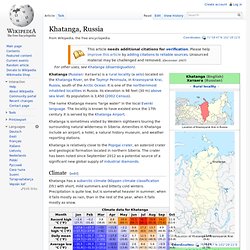
Orenburg. Norilsk. Geography[edit] Norilsk is the world's northernmost city with more than 100,000 inhabitants and the second largest city (after Murmansk) inside the Arctic Circle.
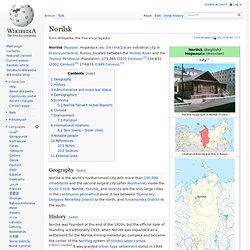
Oymyakon. Oymyakon (Russian: Оймяко́н, Sakha: Өймөкөөн, Öymököön) is a rural locality (a selo) in Oymyakonsky District of the Sakha Republic, Russia, located along the Indigirka River, 30 kilometers (19 mi) northwest of Tomtor on the Kolyma Highway.
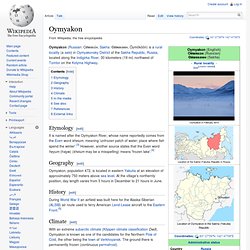
Etymology[edit] It is named after the Oymyakon River, whose name reportedly comes from the Even word kheium, meaning 'unfrozen patch of water; place where fish spend the winter'.[3] However, another source states that the Even word heyum (hэjум) (kheium may be a misspelling) means 'frozen lake'.[4] Geography[edit] Oymyakon, population 472, is located in eastern Yakutia at an elevation of approximately 750 meters above sea level. At the village's northernly position, day length varies from 3 hours in December to 21 hours in June. Yakutsk. Yakutsk is a major port on the Lena River.
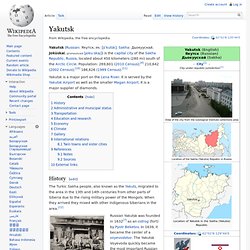
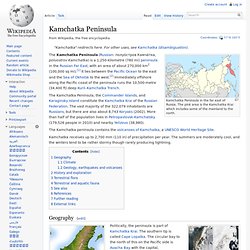
It is served by the Yakutsk Airport as well as the smaller Magan Airport. It is a major supplier of diamonds. Kamchatka Peninsula. Coordinates:
Petropavlovsk-Kamchatsky. Geography[edit] The city is situated on high hills and surrounded by volcanoes.
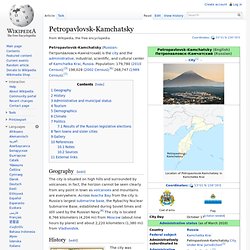
In fact, the horizon cannot be seen clearly from any point in town as volcanoes and mountains are everywhere. Vladivostok. Novosibirsk. Irkutsk. History[edit] Irkutsk Castle in 1735 In the early 19th century, many Russian artists, officers, and nobles were sent into exile in Siberia for their part in the Decembrist revolt against Tsar Nicholas I.
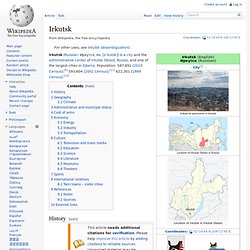
Irkutsk became the major center of intellectual and social life for these exiles, and much of the city's cultural heritage comes from them; many of their wooden houses, adorned with ornate, hand-carved decorations, survive today, in stark contrast with the standard Soviet apartment blocks that surround them. Epiphany Cathedral and central Irkutsk in 1865. Omsk. Omsk (Russian: Омск, IPA: [omsk]) is a city and the administrative center of Omsk Oblast, Russia, located in southwestern Siberia 2,236 kilometers (1,389 mi)[8] from Moscow.
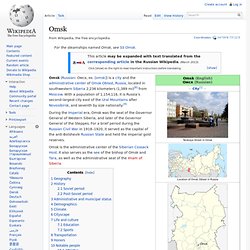
With a population of 1,154,116, it is Russia's second-largest city east of the Ural Mountains after Novosibirsk, and seventh by size nationally.[4] During the Imperial era, Omsk was the seat of the Governor General of Western Siberia, and later of the Governor General of the Steppes. For a brief period during the Russian Civil War in 1918–1920, it served as the capital of the anti-Bolshevik Russian State and held the imperial gold reserves. Vorkuta. History[edit] It had its origin in one of the more notorious forced labor camps of the Gulag which was established in 1932.
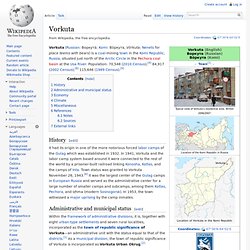
In 1941, Vorkuta and the labor camp system based around it were connected to the rest of the world by a prisoner-built railroad linking Konosha, Kotlas, and the camps of Inta. Murmansk. Central part of Murmansk History[edit] Aerial view of Murmansk, 1936 In the winter of 1917 the British North Russia Squadron under Rear Admiral Thomas Kemp was established at Murmansk.[13]
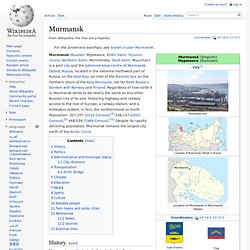
Tiksi. Etymology[edit] The name Tiksi means "a moorage place" in the Sakha language. Arkhangelsk. History[edit] Early history[edit] The area where Arkhangelsk is situated was known to the Vikings as Bjarmaland. Ohthere of Hålogaland told from his travels circa 890 of an area by a river and the White Sea with many buildings. This was probably the place later known as Arkhangelsk. [citation needed] According to Snorri Sturluson, there was a Viking raid on this area in 1027, led by Thorir Hund. In 1989, an unusually impressive silver treasure was found by the mouth of Dvina, right next to present-day Arkhangelsk.
Most of the findings were made up by a total of 1.6 kilograms (3.5 lb) of silver, many of them coins. It is hard to place this find historically until further research is completed. Saint Petersburg. In Russian literature, informal documents, and discourse, the word "Saint" (Russian: Санкт) is usually omitted, leaving "Petersburg" (Russian: Петербург). In casual conversation Russians may drop the "burg" (Russian: бург) as well, referring to it as "Piter" (Russian: Питер). Saint Petersburg was founded by Tsar Peter the Great on May 27 [O.S. 16] 1703. Between 1713–1728 and 1732–1918, Saint Petersburg was the imperial capital of Russia. In 1918 the central government bodies moved from Saint Petersburg (then named Petrograd) to Moscow.[11] It is Russia's 2nd largest city after Moscow with 5 million inhabitants (2012) and the fourth most populated federal subject.[6] Saint Petersburg is a major European cultural center, and also an important Russian port on the Baltic Sea.
The city was built by conscripted peasants from all over Russia; a number of Swedish prisoners of war were also involved in some years[18] under the supervision of Alexander Menshikov. Siberia. Coordinates: Siberia (/saɪˈbɪəriə/; Russian: Сиби́рь, tr. Trans-Siberian Railway. The Trans-Siberian Railway (TSR, Russian: Транссибирская магистраль Transsibirskaya Magistral') is a network of railways connecting Moscow with the Russian Far East and the East Sea.[1] With a length of 9,289 km, it is the longest railway line in the world.
There are connecting branch lines into Mongolia, China and North Korea. It has been connecting Moscow with Vladivostok since 1916 and is still being expanded. Siberia travel guide. Despite its reputation, Siberia is not just about cold snow! Siberia (Russian: Сиби́рь see-BEER’) is a region in Russia.