
Shifting to 21st Century Thinking » Theory. The theories-or ‘big ideas’-that are behind the shift to 21st century learning are a key feature of this website. All practice is informed by theory–whether or not the practitioner is consciously aware of this. Educational practice is no exception. Twentieth century ways of doing things in education are informed by a mixture of different theories–theories about learning, knowledge, personhood, justice/equality, and the purpose of schooling. All educational practitioners ‘know’ these theories–at a very deep, but not always conscious level.
They have been enculturated in them as part of the process of growing up in society (including going to school), and as part of the process of becoming a teacher, a researcher, or an education policy maker. A change in context–such as the shift to 21st century learning–requires a change in people’s view of ‘how things are’. Thus it is important for practitioners to understand the big ideas that are behind the shift to 21st century learning. UK Innovative Schools case study Intro Video. Born to Learn ~ You are Born to Learn.
Instructional strategies. Curriculum. Teaching Channel: Videos, Lesson Plans and Other Resources for Teachers. 100 Best YouTube Videos for Teachers – Classroom 2.0. Infinite Thinking Machine - The Infinite Thinking Machine. Writing DBQs. The Content Imperatives: Tools To Create Gifted Lessons. Earlier in this series, you met the eleven dimensions of depth and complexity.
Today you’ll be introduced to another set of rigor-increasing, engagement-enhancing thinking tools known as the content imperatives, also developed by Sandra Kaplan. Disclaimer: Naturally, the best place to learn to use these tools is through a training or a book by the creator. Purpose Much like depth and complexity, the content imperatives are thinking tools designed to dig deeper into content. They provide a simple way to differentiate curriculum and increase complexity for gifted learners. Resources Although less well-known than depth and complexity, there is still some great information on the web to enhance your understanding of the content imperatives.
Try It With Popcorn Again, we’ll examine the rather bland topic of popcorn using the content imperatives to add interest and rigor: What are the origins of popcorn? Apply To Your Curriculum What are the parallels between addition and multiplication? Incorporating Depth and Complexity Icons Into Gifted Lessons. Bloom’s Taxonomy: The 21st Century Version. So much have been written about Bloom’s taxonomy; one click in a search engine will flood your page with hundreds of articles all of which revolve around this taxonomy.
Only few are those who have tried to customize it to fit in the 21st century educational paradigm. As a fan of Bloom’s pedagogy and being a classroom practitioner, I always look for new ways to improve my learning and teaching, and honestly speaking , if you are a teacher/ educator and still do not understand Bloom’s taxonomy then you are missing out on a great educational resource. The following article is a summary and a fruit of my long painstaking research in the field of Bloom’s taxonomy. The purpose is to help teachers grow professionally and provide them with a solid informational background on how to better understand and apply Bloom’s taxonomy in classrooms in the light of the new technological advances and innovations. 1 – The cognitive : The intellectual or knowledge based domain consisted of 6 levels . Blooms taxonomy and apps. Bloom's Digital Taxonomy.
Bloomin' Apps. This page gathers all of the Bloomin' Apps projects in one place.Each image has clickable hotspots and includes suggestions for iPad, Android, Google and online tools and applications to support each of the levels of Bloom's Revised Taxonomy.I have created a page to allow you to share your favorite online tool, iOS, or Android app with others.
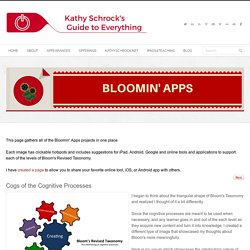
Cogs of the Cognitive Processes I began to think about the triangular shape of Bloom's Taxonomy and realized I thought of it a bit differently.Since the cognitive processes are meant to be used when necessary, and any learner goes in and out of the each level as they acquire new content and turn it into knowledge, I created a different type of image that showcased my thoughts about Bloom's more meaningfully.Here is my visual which showcases the interlocking nature of the cognitive processes or, simply, the "Cogs of the Cognitive Processes".
IPAD APPS TO SUPPORT BLOOM'S REVISED TAXONOMYassembled by Kathy Schrock
Reproducibles. <div class="noscript"><div class="noscript-inner"><p><strong>JavaScript seem to be disabled in your browser.
</strong></p><p>You must have JavaScript enabled in your browser to utilize the functionality of this website. </p></div></div> Information for Canadian Customers Reproducibles & Study Guides Free tools to use and share. ... to develop Intercultural Competence. National Center for Cultural Competence.