
The Great War. World War One - Footage. Images. World War II. The Great War . Timeline . Pre-1914. Medal of Honor Recipients - World War I. World War IMedal of Honor Recipients Listed alphabetically: Note: An asterisk in the citation indicatesthat the award was given posthumously.
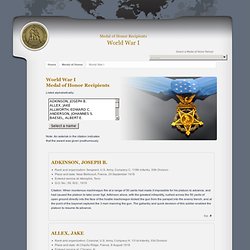
Rank and organization: Sergeant, U.S. Army, Company C, 119th Infantry, 30th Division Place and date: Near Bellicourt, France, 29 September 1918 Entered service at: Memphis, Tenn G.O. No.: 59, W.D., 1919 Citation: When murderous machinegun fire at a range of 50 yards had made it impossible for his platoon to advance, and had caused the platoon to take cover Sgt. Rank and organization: Corporal, U.S. Citation: At a critical point in the action, when all the officers with his platoon had become casualties, Cpl.
Rank and organization: Captain, U.S. Citation: While his company was crossing the Meuse River and canal at a bridgehead opposite Clery-le-Petit, the bridge over the canal was destroyed by shell fire and Capt. World War II in Europe Timeline. Jump to: 1939 - 1940 - 1941 - 1942 - 1943 - 1944 - 1945 1918 November 11 - World War I ends with German defeat. 1919 April 28 - League of Nations founded.
June 28 - Signing of the Treaty of Versailles. 1921 July 29 - Adolf Hitler becomes leader of National Socialist (Nazi) Party. 1923 November 8/9 - Hitler's Beer Hall Putsch. 1925 July 18 - Hitler's book "Mein Kampf" published. 1926 September 8 - Germany admitted to League of Nations. 1929 October 29 - Stock Market on Wall Street crashes. 1930 September 14 - Germans elect Nazis making them the 2nd largest political party in Germany. 1932 November 8 - Franklin Roosevelt elected President of the United States. 1933 January 30 - Adolf Hitler becomes Chancellor of Germany. World War I Time Table. Internet Modern History Sourcebook: World War I. Halsall Home | Ancient History Sourcebook | Medieval Sourcebook | Modern History Course Other History Sourcebooks: African | East Asian | Indian | Islamic | Jewish | LGBT | Women's | Global | Science See Main Page for a guide to all contents of all sections.
WEB World War I: Trenches on the Web . It is best to start at the Library Page [At worldwar1.com] Covers many aspects of the war, with efforts at interactive presentation. WEB The World War I Document Archive [At BYU] has hundreds of documents. WEB Balkan History Documents, 1456-1997 [At Mt. WEB Steven W. Sir William Eton: A Survey of the Turkish Empire , 1799 [At This Site] Demetra Vaka: Aïshé Hanoum , c. 1888 [At this Site] Life of a Turkish woman. Colonel L. du Couret: Justice in Arabia , c. 1890 [At this Site] Julia Pardoe: The Dancing Dervishes , 1902 [At this Site] Dr.
The Young Turks: Proclamation for the Ottoman Empire , 1908 [At this Site] Old Serbian Tales: Marko and the Turks , c. 1450 [At this Site] World War I. Propaganda Posters. Each of the nations which participated in World War One from 1914-18 used propaganda posters not only as a means of justifying involvement to their own populace, but also as a means of procuring men, money and resources to sustain the military campaign.

In countries such as Britain the use of propaganda posters was readily understandable: in 1914 she only possessed a professional army and did not have in place a policy of national service, as was standard in other major nations such as France and Germany. Yet while the use of posters proved initially successful in Britain the numbers required for active service at the Front were such as to ultimately require the introduction of conscription. Nevertheless recruitment posters remained in use for the duration of the war - as was indeed the case in most other countries including France, Germany and Italy. However wartime posters were not solely used to recruit men to the military cause. The Great War Web Site. World War I. About World War I. About World War I "Total War I: The Great War" by John Bourne The First World War was truly ‘the Great War’.
Its origins were complex. Its scale was vast. Its conduct was intense. The war was a global conflict. The war began in the Balkan cockpit of competing nationalisms and ancient ethnic rivalries. The underlying causes of these events have been intensively researched and debated. Fears were more important than ambitions. The Austrians feared for the survival of their multi-racial Empire if they did not confront the threat of Serb nationalism and Panslavism. Women in World War One. Spark Notes World War I (1914–1919) World War 1 Timeline 1914-1919 - Worldwar-1.net.
World War I Document Archive.