First War War Poetry
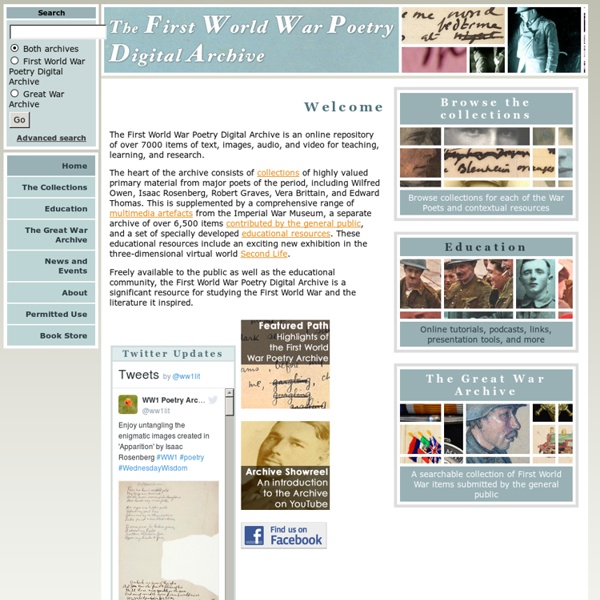
The First World War Poetry Digital Archive is an online repository of over 7000 items of text, images, audio, and video for teaching, learning, and research. The heart of the archive consists of collections of highly valued primary material from major poets of the period, including Wilfred Owen, Isaac Rosenberg, Robert Graves, Vera Brittain, and Edward Thomas. This is supplemented by a comprehensive range of multimedia artefacts from the Imperial War Museum, a separate archive of over 6,500 items contributed by the general public, and a set of specially developed educational resources. Freely available to the public as well as the educational community, the First World War Poetry Digital Archive is a significant resource for studying the First World War and the literature it inspired. The Great War Archive was highly commended at the Times Higher Educational Awards 2008 for 'Outstanding ICT Initiative'
Related: World War One
WWI Battlefields
The Great War Archive (University of Oxford)
Dec 25. The Christmas Truce Sergeant Bernard Brookes was a signaller who spent ten months in Flanders in the beginning of the War before he suffered shellshock and was invalided out of active service. During his convalescence he wrote up the notes he had made during his service, giving a personal, unsentimental account of the appalling conditions in the trenches as well as humorous exploits on and off duty.Here are two short extracts relating to the famous Christmas Truce 1914: 24 December 1914: "An officer went out (after we had stood at our posts with rifles loaded in case of treachery) and arrangements were made that between 10.00am and noon, and from 2.00pm to 4.00pm tomorrow, intercourse between the Germs [sic] and ourselves should take place. You can read more of Sergeant Bernard Brookes’s story on the Europeana 1914-1918 site.
Digital Collection - NZ
You are here: Home > Digital Collection > Wars & conflict Heritage Digital Collection Home The Canterbury Aviation (N.Z.) A brief history by Henry Wigram recounting the beginnings of the Canterbury Aviation Company. The Canterbury (New Zealand) Aviation Co. Details of services and training offered by the company following World War I. Christchurch War Memorial: Bridge of Remembrance The history and symbolic features of the Bridge of Remembrance opened By Viscount Jellicoe of Scapa, on Armistice Day, November 11, 1924. City of Christchurch, N.Z. : peace celebrations Programme of Christchurch peace celebrations, held on 19-21 July 1919 to mark the end of World War I. Cecil Malthus: World War I papers [letters, telegrams, documents] A collection of Malthus letters has been digitised and made available online by Christchurch City Libraries. Diggers’ poems A small collection of poems by returned soldiers published after World War I. Ephemera A selection of public notices. Gallipoli papers H.H. The Kiwi
History - World Wars: Shell Shock during World War One
The Long, Long Trail - UK
BBC Schools - Life in the trenches
31 October 2014Last updated at 15:07 Two British soldiers standing in a flooded communication trench during World War One On the Western Front, the war was fought in trenches. Trenches were long, narrow ditches dug into the ground where soldiers lived all day and night. There were many lines of German trenches on one side and many lines of Allied trenches on the other. In the middle, was no man's land, so-called because it did not belong to either army. Rest Soldiers in the trenches did not get much sleep. Dirty trenches The trenches could be very muddy and smelly.
European stories & official histories
BBC Schools - Trench food
18 February 2014Last updated at 17:06 British soldiers eating hot rations in the Ancre Valley during the Battle of the Somme, October 1916 Maconochie's meat stew advertisement Even though food was very short in Britain during World War One, families often sent parcels to their fathers and brothers fighting at the front. At the beginning of the war, soldiers got just over one pound of meat, the same amount in bread and eight ounces of vegetables each day. Some soldiers worked in field kitchens which were set up just behind the trenches to cook meals for the soldiers who were fighting. By 1917 the official ration for the average British 'Tommy' was much smaller. 'Maconchie's meat stew' and hard biscuits was a meal that many soldiers ate. 18 February 2014Last updated at 17:06 British soldiers eating hot rations in the Ancre Valley during the Battle of the Somme, October 1916 Maconochie's meat stew advertisement By 1917 the official ration for the average British 'Tommy' was much smaller.
Related: