
3-D printing on way to becoming affordable. Originally published December 26, 2011 at 8:00 PM | Page modified December 27, 2011 at 12:26 PM University of Washington professor Mark Ganter sees the future, and it's printing apple pies.
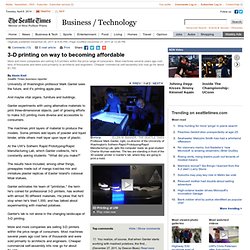
And maybe vital organs, furniture and buildings. Ganter experiments with using alternative materials to print three-dimensional objects, part of growing efforts to make 3-D printing more diverse and accessible to consumers. The machines print layers of material to produce the models. Some printers add layers of powder and liquid binder, while others melt layer upon layer of plastic. At the UW's Solheim Rapid Prototyping/Rapid Manufacturing Lab, which Ganter codirects, he's constantly asking students: "What did you make? " The results have included, among other things, pineapples made out of mango iced-tea mix and miniature plaster replicas of Easter Island's colossal Moai statues, Ganter's lab is not alone in the changing landscape of 3-D printing.
Ganter is a regular at the space. 3-D Reality - Hawaii Features - Honolulu Star-Advertiser. POSTED: 01:30 a.m.
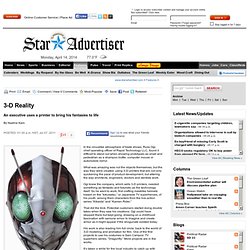
HST, Jul 07, 2011 Among Russ Ogi’s 3-D creations are samurai and Japanese superhero accessories. HOW IT’S DONE 1. ZPrint 3-D printer software takes virtual computer data, slices it into layers and sends it to 3-D printer. 2. Interior of the 3-D printer as it draws each layer created by the software, including full photographic color. 3.
In the circuslike atmosphere of trade shows, Russ Ogi, chief operating officer of Rapid Technology LLC, found it difficult to stand out when showing prototypes as small and pedestrian as a shampoo bottle, computer mouse or automobile mirror. What was amazing was not the objects themselves, but the way they were created, using 3-D printers that are not only quickening the pace of product development, but altering the way architects, engineers, doctors and dentists work. Ogi knew the company, which sells 3-D printers, needed something as fantastic and futuristic as the technology itself. That did the trick. MakerBot goes big with Replicator 3D printer.
MakerBot Industries MakerBot Industries is excited to announce the launch of its latest product, The MakerBot Replicator™, which will debut at CES in Las Vegas, NV on Tuesday, January 10th.
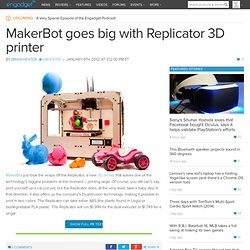
The MakerBot Replicator™ is the ultimate personal 3D printer, with MakerBot Dualstrusion™ (2-color printing) and a bigger printing footprint, giving you the superpower to print things BIG! Assembled in Brooklyn by skilled technicians, the MakerBot Replicator™ is ready within minutes to start printing right out of the box. At $1749 for a single extruder and $1999 for a dual extruder, The MakerBot Replicator™ is an affordable, open source 3D printer that is compact enough to sit on your desktop. With a build envelope that's roughly the size of a loaf of bread, The MakerBot Replicator™ gives you the power to go big. The MakerBot Replicator™ is ideal for personalized manufacturing, providing a new way to make the things you want and need.
The MakerBot Replicator™ is the tool from tomorrow, today. Portal 2 Makes Us Want a 3D Printer. So Bad. 3D-printed Mario Kart turtle shells race to rescue American economy. Fused Filament Printing with Water-Soluble Support. Veteran Thingiverse user Tony Buser has printed a model (intended to be an approximation of the fractal Hilbert curve) using polyvinyl alcohol (PVA) as a support material.
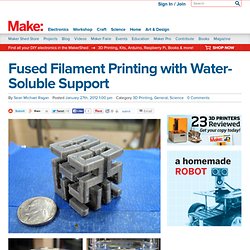
Once everything is printed and cooled, the PVA is dissolved away in a glass of water, leaving only the polylactic acid (PLA) model. This technique, when perfected, should allow RepRap-style FFF printers to produce objects with overhanging parts that are currently very difficult, or impossible, for them to print. Tony used two of MakerBot’s Mk7 extruders mounted on a Thing-o-Matic. Related. Cube™ - Cubify™ Your 3D design turns into reality with the 3D printing.