
Story Structure. Instant Grammar Check - Online Proofreading. A Practical Guide To Critical Thinking. The Dramatic Arc.pdf. Kurt Vonnegut on the shapes of stories. 5 Ways to Get Rid of Your Damn Empty Modifiers. I discussed the need to get rid of empty emphatics when I gave you 8 words to seek and destroy in your writing, but just saying that you should get rid of a thing doesn't say much about the right way to do so.
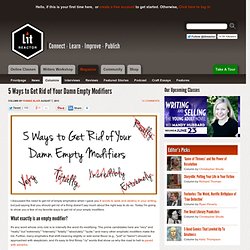
Today I'm going to show you a few of my favorite ways to get rid of your empty modifiers. What exactly is an empty modifier? It's any word whose only role is to intensify the word it's modifying. The prime candidates here are "very" and "really," but "extremely," "intensely," "totally," "absolutely," "quite," and many other emphatic modifiers make the list.
Further, many emphatics that shift meaning slightly or add some flavor (e.g., "just" or "damn") should be approached with skepticism, and it's easy to find flimsy "-ly" words that show us why the road to hell is paved with adverbs. 30 Incorrectly Used Words That Can Make You Look Bad. While I like to think I know a little about business writing, I often fall into a few word traps.
For example, "who" and "whom. " I rarely use "whom" when I should. A Level English Lang/ Lit. Cliche. Dr. Matt Might help: Dissertation tips. Dissertation Journey: Dr. Guy White. Writing Your Dissertation ??? Themes and Topics. Critical Thinking. Nerd Paradise. Posted on: 10 Cado 7:0 - 5.27.29 So you've procrastinated again.

You told yourself you wouldn't do this 2 months ago when your professor assigned you this. But you procrastinated anyway. Shame on you. It's due in a few hours. Pick a Topic. 25 Things You Should Know About Word Choice. 1.
A Series Of Word Choices Here’s why this matters: because both writing and storytelling comprise, at the most basic level, a series of word choices. Words are the building blocks of what we do. They are the atoms of our elements. Irregular verbs. Grammar, Punctuation & Style. Setting: Using Scene To Enrich Your Writing. In both fiction and nonfiction, the setting is the general background against which your story takes place—the physical location and time period, both of which influence your characters and plot.
So how can a creative writer use setting and scenery to further offset, augment, or reflect the action of the plot? Although we’re going to be exploring this issue in terms of fiction, these techniques work for nonfiction as well. These craft techniques work in all genres: poetry, stories, personal essays, memoir, and books. Suppose you’re writing a novel that is set in the Deep South in 1955 and your protagonist is an immigrant facing prejudice and roadblocks at every turn.
You’d have a completely different novel if your protagonist were a Texas cowboy who found himself in Mississippi at that particular time and place. Setting the stage for a short story or novel is a crucial part of engaging your reader. 25 Things Writers Should Stop Doing. I read this cool article last week — “30 Things To Stop Doing To Yourself” — and I thought, hey, heeeey, that’s interesting.
Writers might could use their own version of that. So, I started to cobble one together. Write or Die 2. Writing Essentials. The 200 Most Common Redundancies. Writing Tools. 100 Little Ways You Can Dramatically Improve Your Writing. Analysis. The unlearning: Horror and transformative theory. Mixed tenses. A Handbook of Rhetorical Devices. Robert A.
Harris Version Date: January 19, 2013 This book contains definitions and examples of more than sixty traditional rhetorical devices, (including rhetorical tropes and rhetorical figures) all of which can still be useful today to improve the effectiveness, clarity, and enjoyment of your writing. Note: This book was written in 1980, with some changes since. The devices presented are not in alphabetical order. To go directly to the discussion of a particular device, click on the name below. Rhetological Fallacies. Thou shalt not commit logical fallacies. Writing. TV Tropes. 100 Most beautiful words in the English language* Strunk, William, Jr. 1918. The Elements of Style.
School House Rock. Short Stories: 10 Tips for Creative Writers. The Seven Basic Plots. According to the British journalist and author Christopher Booker, there are only seven ‘storylines’ in the world.
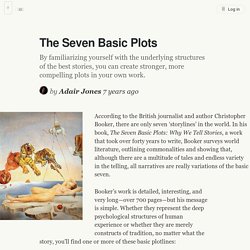
In his book, The Seven Basic Plots: Why We Tell Stories, a work that took over forty years to write, Booker surveys world literature, outlining commonalities and showing that, although there are a multitude of tales and endless variety in the telling, all narratives are really variations of the basic seven. Booker’s work is detailed, interesting, and very long—over 700 pages—but his message is simple. Whether they represent the deep psychological structures of human experience or whether they are merely constructs of tradition, no matter what the story, you’ll find one or more of these basic plotlines: Rags to Riches Someone who has seemed to the world quite commonplace is shown to have been hiding a second, more exceptional self within. Although it may seem reductive to restrict all narrative to these seven basic plots, it is actually quite instructive. EasyBib: Free Bibliography Maker - MLA, APA, Chicago citation styles. Write or Die by Dr Wicked.
English 50. Teaching Writing - Resource Topics. OWL. Coming Soon: A new look for our same great content! We're working hard this summer on a redesign of the Purdue OWL. Worry not! Our navigation menu and content will remain largely the same. If you are having trouble locating a specific resource, please visit the search page or the Site Map. The Online Writing Lab (OWL) at Purdue University houses writing resources and instructional material, and we provide these as a free service of the Writing Lab at Purdue.
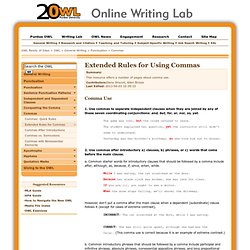
For more information about services for the Purdue University community, including one-to-one consultations, ESL conversation groups and workshops, please visit the Writing Lab site. Mission The Purdue University Writing Lab and Purdue Online Writing Lab (OWL) assist clients in their development as writers—no matter what their skill level—with on-campus consultations, online participation, and community engagement. Commas. Summary: This resource offers a number of pages about comma use.
Writing About Literature. Summary: This handout provides examples and description about writing papers in literature.
It discusses research topics, how to begin to research, how to use information, and formatting. Contributors:Mark Dollar, Purdue OWLLast Edited: 2011-10-19 02:27:10 What Makes a Good Literature Paper? Grammar. Common Themes in Literture. Index of Themes and Motifs. How To Publish a Book & Writing tips & Five steps to follow in writing a novel & How To Publish a Book - StumbleUpon. Writing a book is no easy task, it is a complex process which involves planning, discipline, and time. Rhetoric2. To go directly to the discussion of a particular device, click on the name below. If you know these already, go directly to the Self Test.
To learn about my book, Writing with Clarity and Style, see the Advertisement. GRAMMAR good bad + ugly! Tenses. The 3 Most Common Uses of Irony. Grammar 3. "The The Impotence of Proofreading," by TAYLOR MALI. Like_youknow. Taylor Mali performs "Any Language, Much Less English" The Clause. Teaching Adverbial and Adjective Clauses. Adjective and A List of Adjectives: EnchantedLearning. Advertisement. I Write Like. 5 editor’s secrets to help you write like a pro. Grammar Nazis. 5 situations where it's better to tell than show in your fiction.
Grammar. 45 ways to avoid using the word 'very'. Writers Write is your one-stop resource for writers. Use these 45 ways to avoid using the word ‘very’ to improve your writing. Writing Skills. English Tenses. Help! Punctuation & Syllabication.