
William James. William James. Be not afraid of life.
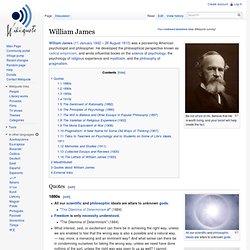
Believe that life is worth living, and your belief will help create the fact. William James (11 January 1842 – 26 August 1910) was a pioneering American psychologist and philosopher. He developed the philosophical perspective known as radical empiricism, and wrote influential books on the science of psychology, the psychology of religious experience and mysticism, and the philosophy of pragmatism. Quotes[edit] We are all ready to be savage in somecause. Pluralism lets things really exist in the each-form or distributively. 1880s[edit] Freedom is only necessity understood. " 1890s[edit] We are all ready to be savage in some cause. 1900s[edit] Instinct leads, intelligence does but follow.William James (1902) listed in: The William James Reader Vol I (2007). p.264A difference which makes no difference is no difference at all.William James, listed in: William James: the Essential Writings, edited by Bruce W. 1910s[edit]
Gifford Lecture Series - Lectures/Books. Biological Consciousness and the Experience of the Transcendent. 2.
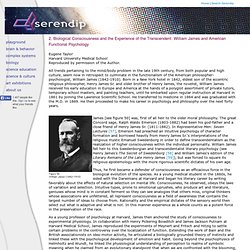
Biological Consciousness and the Experience of the Transcendent: William James and American Functional Psychology Eugene Taylor Harvard University Medical School Reproduced by permission of the Author. All trends pertaining to the mind/body problem in the late 19th century, from both popular and high culture, seem now in retrospect to culminate in the functionalism of the American philosopher-psychologist, William James (1842-1910). Consciousness: Table of Contents. James (1890) Chapter 10. Classics in the History of Psychology An internet resource developed by Christopher D.
Green York University, Toronto, Ontario (Return to index) James (1904) Taylor, E.: William James on Consciousness beyond the Margin. At the turn of the twentieth century, William James was America's most widely read philosopher.
In addition to being one of the founders of pragmatism, however, he was also a leading psychologist and author of the seminal work, The Principles of Psychology (1890). While scholars argue that James withdrew from the study of psychology after 1890, Eugene Taylor demonstrates convincingly that James remained preeminently a psychologist until his death in 1910. Taylor details James's contributions to experimental psychopathology, psychical research, and the psychology of religion. Moreover, Taylor's work shows that out of his scientific study of consciousness, James formulated a sophisticated metaphysics of radical empiricism. This book represents a major new contribution both to James scholarship and to the history of American psychology. Review: "While James did fight labels all his life, he also created labels for the niches from which he could do strategic work.
William James: The Psychology of Possibility. Wilhelm Wundt and William James. Wilhelm Wundt and William James are usually thought of as the fathers of psychology, as well as the founders of psychology’s first two great “schools.”
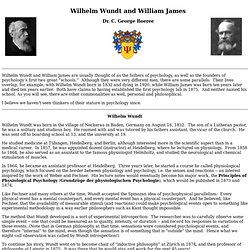
Although they were very different men, there are some parallels: Their lives overlap, for example, with Wilhelm Wundt born in 1832 and dying in 1920, while William James was born ten years later and died ten years earlier. Both have claims to having established the first psychology lab in 1875. And neither named his school. As you will see, there are other commonalities as well, personal and philosophical. I believe we haven't seen thinkers of their stature in psychology since. Wilhelm Wundt Wilhelm Wundt was born in the village of Neckerau in Baden, Germany on August 16, 1832.
He studied medicine at Tübingen, Heidelberg, and Berlin, although interested more in the scientific aspect than in a medical career. In 1864, he became an assistant professor at Heidelberg. The Stream of Consciousness. The Stream of Consciousness (1892) William James The first and foremost concrete fact which every one will affirm to belong to his inner experience is the fact that consciousness of some sort goes on. 'States of mind' succeed each other in him.
If we could say in English 'it thinks,' as we say 'it rains' or 'it blows,' we should be stating the fact most simply and with the minimum of assumption. As we cannot, we must simply say that thought goes on. ....How does it go on? 1) Every 'state' tends to be part of a personal consciousness. 2) Within each personal consciousness states are always changing. 3) Each personal consciousness is sensibly continuous. 4) It is interested in some parts of its object to the exclusion of others, and welcomes or rejects -- chooses from among them, in a word -- all the while.