
Santos Bonacci The Ancient Theology Occult Science Part 2. The Bible's Buried Secrets. ISLAM IN PROPHECY - Herb Kersten. Google. Greek. Greek Mythology. THEOI GREEK MYTHOLOGY, Exploring Mythology & the Greek Gods in C. Family tree of the Greek gods. Key: The essential Olympians' names are given in bold font.
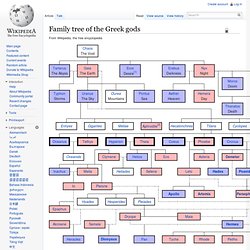
See also. Family tree of the Greek gods. Interactive Greek Gods Family Tree. Neverending Search for the Truth. The Founding Fathers Were NOT Christians. Joel Barlow (1754-1812) The Founding Fathers Were NOT Christians or Secular Humanists: a Refutation of Steven Morris by Lewis Loflin Steven Morris complains that the Religious Right is rewriting American history to bolster a political agenda.
Very true, but secular fundamentalists such as himself are doing the same thing. For secular fundies such as Morris, their low point came in 2004 with the re-election of George Bush. In fascinating article from The Nation entitled In God's Country (11/6/2006) secular fundamentalists lamented, ...the nine in ten Americans who have said they've never doubted the existence of God. Secular arrogance in believing that anyone who believes in God is somehow a backward, country bumpkin is a big part of their elitist mentality. Internet Sacred Text Archive Home. The Ancient World Web. April 1994 - July, 2005 The Ancient World Web is now closed.
Thank you to the people who contributed links, fixes, updates, technology suggestions, and to those who used (and loved) the site over the past eleven years. I've appreciated it very much, and enjoyed getting to know you. I'd like to send a special shout-out to Dawn Kirkland - the first person to stumble across the list of bookmarks I put on my website for my own convenience, and the first person to suggest a link I hadn't seen before. Shuttering the Ancient World Web was a difficult and sad decision for me. (That routine includes: hand-verifying links (to track down sites that have turned to porn, or are no longer what they once were), fighting hackers and spam, digging through the suggested links (98% of which are inappropriate), rooting out fraud (people will try all sorts of things to improve their ratings or site hit counts), and trying to keep abreast of the latest news and information to figure out what new sites to add.)
Classics Unveiled - Main Page. Theoi E-Texts Library of Classical Greek & Roman Literature. Godchecker.com - Your Guide To The Gods. Mythology with a twist! A Roman Ritual Template - ADF Neopagan Druidism. It has been a challenge to adapt ADF's standard liturgical formulae for a Roman hearth culture, and being the legalistic, formulaic Roman that I am, I need to accompany this article with certain disclaimers.
First of all, this is most certainly a work in progress; I'm working out the kinks as I go along, and this is only the tip of the iceberg. Secondly, I have drawn from sources as widely varying as Cato's De Agri Cultura to Ceiswr Serith's Pagan Book of Prayer. I am certainly open to suggestion, though I am not likely to begin studying haruspicy with real livers, nor am I likely to do an entire Roman rite extemporaneously. The middle ground between reconstruction and inspiration is where I stand :) As with most ADF rituals, we begin with a... SIRIUS. Fairy Tales Collection.com. Folktexts: A library of folktales, folklore, fairy tales, and my. Page 1 edited and/or translated by D.

L. Ashliman University of Pittsburgh © 1996-2020 Return to: Abducted by Aliens. Bald Stories: Folktales about Hairless Men. Cain and Abel. Aesopica: Aesop's Fables in English, Latin & Greek. From Andrew Lang's Fairy Books. The Varieties of Biblical Marriage. Multimedia journey through Inferno. Nature. Liber AL vel Legis. List of mythologies. This is a list of mythologies of the world, by culture and region.
Mythologies by region[edit] Africa[edit] Central Africa[edit] East Africa[edit] Myths and legends. Mythology. Myth and Legend from Ancient Times to the Space Age. The Art of Haruspicy. Nowadays, few of us slaughter our own livestock; it is done in a factory where we don't have to see it. Also, entrails are offensive to modern sensibilities and most of us would prefer not to examine them. Fortunately there is a form of haruspicy, called "ooscopy", that is quite compatible with the modern world. Ooscopy substitutes an egg for the sacrificial animal and inspection of the opened egg for examination of the entrails.
This works just as well as the ancient procedure, and perhaps better. Ancient haruspices didn't use it because you can't make a great public celebration out of the cracking of an egg. Mythology, folklore, and religion. Gods, Heroes, and Myth: Search. Mythology. Some (recent) approaches have rejected a conflict between the value of myth and rational thought, often viewing myths, rather than being merely inaccurate historical accounts, as expressions for understanding general psychological, cultural or societal truths.
Etymology[edit] The English term mythology predates the word myth by centuries.[5] It appeared in the 15th century,[7] borrowed whole from Middle French mythologie. The word mythology "exposition of myths" comes from Middle French mythologie, from Late Latin mythologia, from Greek μυθολογία mythologia "legendary lore, a telling of mythic legends; a legend, story, tale," from μῦθος mythos "myth" and -λογία -logia "study.
Sumerians. Sumerian Mythology FAQ. By Christopher Siren, 1992, 1994, 2000 cbsiren at alum dot mit dot edu This FAQ used to be posted on the third of every month to alt.mythology.
An older text copy of this FAQ is available via anonymous ftp pending *.answers approval at: rtfm.mit.edu at /pub/usenet/news.answers/mythology/sumer-faq last changes: July 27, 2000: complete revision including incorporating Kramer's Sumerian Mythology and Black & Green's God's Demons and Symbols of Ancient Mesopotamia. Adapa (Dan Sullivan) has constructed a more complete Sumerian-English dictionary at: (Restored! I have constructed a rudimentary Sumerian-English, English Sumerian glossary using Kramer's The Sumerians and Jacobsen's Treasures of Darkness, although parties interested in the Sumerian language may be better served at the prior two pages. note: This FAQ is partly based on an anthropology paper which I wrote in 1992, using some of the sources detailed below.
Contents: I. History The Uruk period, stretched from 3800 BCE to 3200 BCE. II. Epic of gilgamesh. ENUMA ELISH. Sacred-Texts Ancient Near East.
The Great Flood - Sumerian Version. Chinese mythology. Chinese mythology refers to those myths found in the historical geographic area of China: these include myths in Chinese and other languages, as transmitted by Han Chinese as well as other ethnic groups (of which fifty-six are officially recognized by the current administration of China).[1] Chinese mythology includes creation myths and legends, such as myths concerning the founding of Chinese culture and the Chinese state.
As in many cultures' mythologies, Chinese mythology has in the past been believed to be, at least in part, a factual recording of history. Thus, in the study of historical Chinese culture, many of the stories that have been told regarding characters and events which have been written or told of the distant past have a double tradition: one which presents a more historicized and one which presents a more mythological version.[2] Historians have written evidence of Chinese mythological symbolism from the 12th century BC in the Oracle bone script.
Major concepts[edit] Shan Hai Jing. Shanhaijing illustration of Nüwa Shanhaijing illustration of Nine-tailed Fox, companion of Xi Wangmu Authorship[edit] Overview[edit] Fengshen Yanyi. Fengshen Yanyi, also known as Fengshen Bang, or translated as The Investiture of the Gods, is a 16th-century Chinese novel and one of the major vernacular Chinese works in the shenmo genre written during the Ming Dynasty (1368–1644).[1] Consisting of 100 chapters, it was first published in book form around the 1550s.[1] Plot[edit] The novel is a romanticised retelling of the overthrow of King Zhou, the last ruler of the Shang Dynasty, by King Wu, who would establish the Zhou Dynasty in place of Shang. The story integrates oral and written tales of many Chinese mythological figures who are involved in the struggle as well. These figures include human heroes, immortals and various spirits (usually represented in avatar form like vixens, and pheasants, and sometimes inanimate objects such as a pipa).
Some well-known anecdotes[edit] Celtic mythology. Overview[edit] Though the Celtic world at its apex covered much of western and central Europe, it was not politically unified nor was there any substantial central source of cultural influence or homogeneity; as a result, there was a great deal of variation in local practices of Celtic religion (although certain motifs, for example the god Lugh, appear to have diffused throughout the Celtic world). Inscriptions of more than three hundred deities, often equated with their Roman counterparts, have survived, but of these most appear to have been genii locorum, local or tribal gods, and few were widely worshipped. However, from what has survived of Celtic mythology, it is possible to discern commonalities which hint at a more unified pantheon than is often given credit. Celtic Folklore. Sacred-texts home Legends and Sagas EnglandBuy CD-ROM Buy Books about Celtic Folklore Ireland Wales Scotland Brittany Cornwall Manx Fairies General Links.
Traditions and Hearthside Stories of West Cornwall, Vol. 1: Legends of the West-Country Giants: The Giants of Towednack. Nuada Airgetlám. Egyptian Mythology. Egyptian mythology: The Shabaka Stone - Memphite mythology Sekhmet and Ptah Osiris Excerpt. Ancient Egyptian religion. Gods of Ancient Egypt Main Menu. Many books have been written on religion in ancient Egypt. Myth of Osiris and Isis. The secrets hidden in the pyramids of Egypt (Harun Yahya) Mesopotamian religion. Gilgamesh. Epic of Gilgamesh. Essay: Storytelling, the Meaning of Life, and The Epic of Gilgamesh. Marduk. Japanese mythology. TAKENOUCHI DOCUMENTS - HIDDEN HISTORY OF MANKIND AND EARTH - Book II Preface.