
Music Theory Web. Writing Original And Interesting Chord Progressions. Part I. Interactive Circle of Fifths. The Interactive Circle of Fifths is a free online music theory tool designed to help musicians to interpret chord progressions, easily transpose music to a different key, compose new music, and understand key signatures, scales, and modes.
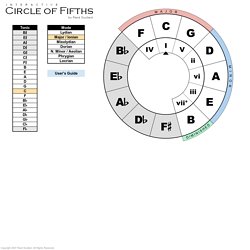
It goes beyond the limitations of a traditional, static diagram without sacrificing clarity and simplicity, and it includes an extensive User's Guide to help you discover all that it has to offer. AFFECTIVE KEY CHARACTERISTICS. Affective Musical Key Characteristics The association of musical keys with specific emotional or qualitative characteristic was fairly common prior to the 20th century.
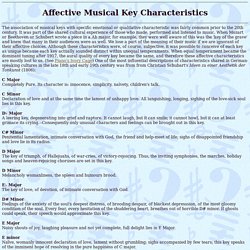
It was part of the shared cultural experience of those who made, performed and listened to music. When Mozart or Beethoven or Schubert wrote a piece in a Ab major, for example, they were well aware of this was the 'key of the grave' and knew that many in their audiences were as well. We lose a part of the meaning of their music if we are ignorant of their affective choices. 12 great free and open-source music making programs.
Who doesn’t love free software?

Still, you might be unaware that “free” doesn’t always mean free in the sense you might expect. There are important distinctions between what we call “freeware” and what is known as “free software”, “free and open source software” or “free, libre and open source software”. Sheet Music. Music Theory & Ear Training: Relative Pitch and Perfect Pitch Free Software. Teoria - Exercises. Seaquence. List of popular songs by key. Everyone's Mixtape. Print Free Staff Paper. Hooktheory.com. Print Free Staff Paper.
Furmanczyk Piano Academy. Music Text Composition Generator ( A free online music utility) The P22 Music Text Composition Generator allows any text to be converted into a musical composition.
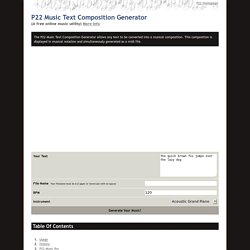
This composition is displayed in musical notation and simultaneously generated as a midi file. 1. Usage Type or copy any text into the Text Field. Give the file a unique name. A short text may be best at a slow pace (IE 10 BPM) whereas a longer text may prove more engaging at 1200 BP. In some browsers (Safari 2 or greater), the ability to play real time multi-tracking can allow for complex compositions. The generated musical text does not claim copyright nor imply any rights from the text used. 2. The P22 Music Composition Font was proposed in 1997 to the John Cage Trust as an accompaniment to the John Cage text font based on the handwriting of the composer. 3. P22 Music Pro is a unique font system that expands on the concept used in the Music Text Composition Generator.
The font used in the P22 MTCG is a basic version that closely follows the initial Cage inspired idea. 4. The magical mathematics of music. May 2005 The astronomer Galileo Galilei observed in 1623 that the entire universe "is written in the language of mathematics", and indeed it is remarkable the extent to which science and society are governed by mathematical ideas.
It is perhaps even more surprising that music, with all its passion and emotion, is also based upon mathematical relationships. Such musical notions as octaves, chords, scales, and keys can all be demystified and understood logically using simple mathematics. Pitch: Wave frequencies. Music Theory & Ear Training: Relative Pitch and Perfect Pitch Free Software. Madness - Muse : Now playing on Neverending Playlist. One Per Cent: Virtuoso cartoon pianist plays just like the real thing. Hal Hodson, technology reporter Watch a professional pianist play and you'll be struck at how effortlessly their hands skip across the keys.

Making an animated character do the same is much harder, so researchers from the University of California, Davis, have built an algorithm designed to make computer-generated hands tickle the ivories far more realistically. Their software auomatically generates a 3D animation of piano-playing hands based solely on inputted music. The software analyses a music file, then builds a pair of animated hands playing the song. Developed with colleagues by Davis computer scientist Yuanfeng Zhu, the system is based on the idea that virtuoso pianists will always move their hands in a way that relaxes their body and saves energy.
To achieve this using software, Zhu calculates the most efficient path for the 3D fingers to take over the keys. Music.swf (application/x-shockwave-flash Object) Roland Synthesizer JUNO. Andrew Furmanczyk Piano Academy. Learn How to Play Piano, Free Online Piano Lesson, A Friendly Place to learn piano. Piano Lessons. Teoría - Music Theory Web. Game Music: A genialidade musical de Koji Kondo. How Music Works. The Chord Guide: Pt III – Chord Progressions. Chord progressions are the canvas on which musicians paint their masterpieces, and it’s a canvas which is a piece of art in itself.

A chord progression can be subtle and in the background or it can be blatant and up front; it can be simple and catchy, or it can be technical and complex, it can stay in one key or it can change like the seasons. In any of these cases a chord progression is what drives the song as it literally shapes the music that accompanies it. Music Cognition Lab - Psychology Department - Tufts University. Teoría - Music Theory Web. Piano room: chords and scales. Chord Progressions in Tonal Music. Piano Chords and Scales made easy. Guides: How to Get Your Musical Creations Off Your DS. With a lack of Export feature for most music software on the handheld, we show you how to preserve and share your masterpieces DS-owning music enthusiasts have quite a few tools at their disposal for composing their latest and greatest, laying down that melody that came out of nowhere for use later or just plain old messing around with bleeps and bloops.

It’s great fun, but when you’ve spent a considerable amount of time on a piece in, say, Korg DS-10 or Rytmik, only to find yourself unable to get those tracks off your DS to share with others; well, that’s not a happy place to be. Free sheet music for piano. Sheet Music Archive downloadable sheet music plus free classical music score downloads for piano and more. Musipedia: Musipedia Melody Search Engine.
Music Animation Machine MIDI Player. Home | Site Map | Watch | FAQ | History | Store | Contact Read (or right-click to download) the latest (2010jan28) User Guide.
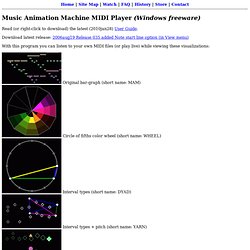
Download latest release: 2006aug19 Release 035 added Note start line option (in View menu) With this program you can listen to your own MIDI files (or play live) while viewing these visualizations: Original bar-graph (short name: MAM) Scales and emotions. See also a post about making chords from scales.
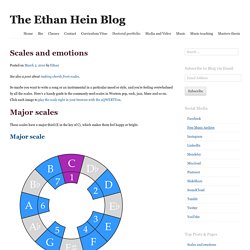
So maybe you want to write a song or an instrumental in a particular mood or style, and you’re feeling overwhelmed by all the scales. Here’s a handy guide to the commonly used scales in Western pop, rock, jazz, blues and so on. Click each image to play the scale right in your browser with the aQWERTYon. These scales have a major third (E in the key of C), which makes them feel happy or bright. Major scale Happy; can be majestic or sentimental when slow.
Mixolydian mode Bluesy, rock; can also be exotic/modal. Lydian mode Ethereal, dreamy, futuristic. Lydian dominant mode Also known as the overtone scale or acoustic scale, because it is close to the first seven pitches in the natural overtone series. Phrygian dominant mode Exotic, Middle Eastern, Jewish. Harmonic major scale Majestic, mysterious. Forums : Off-topic Discussion : Music Theory- The basics updated V7. Introduction Hello there, you may have seen me around The Escapist and most know me as The Rockerfly, I am a musician. Exercises. Start [Wiki Score] Introduction Welcome to Wiki::Score, a platform similar to the Wikipedia for cooperative editing of large scale music scores (eg. operas, symphonies, cantatas etc). Wiki::Score is a wiki which, using the ABC notation for music representation, is primarily intended for publishing modern editions of unknown works buried in music archives.
It has emerged from experience in the lab sessions of the Computing for Musicology course of the Music degree of the University of Minho. The basic principle is that of dividing a large score into a matrix of elementary music cells (eg. the flute part of the first movement of a particular symphony) so that many collaborators can work concurrently on the same source. Matrices have as many columns as sections in the work being edited (eg. an aria of an opera) and as many rows as parts (eg. the soprano part). Unhear it - get that damn song out of your head! Itay Talgam: Lead like the great conductors. Tod Machover and Dan Ellsey play new music. Vishal Vaid's hypnotic song. Benjamin Zander on music and passion. *HD* Piano Tutorial - How to play the hardest song of all time. #1 LEARN FREE MUSIC THEORY.