
Waste Prevention Guidelines - Environment. Methods to monitor and evaluate household wa... [Waste Manag Res. 2010. Measuring waste prevention. [Waste Manag. 2013. ETH Zurich Multimedia Portal: video, audio, podcast, webcast, live-streaming - ICT4S. Smart meter project is delayed. 10 May 2013Last updated at 08:33 ET Smart meters show customers how much gas and electricity is being used The introduction of energy smart meters in 30 million UK homes will be delayed for more than a year, the government has announced.
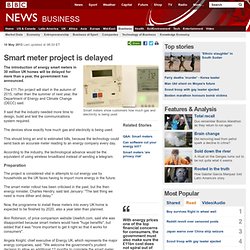
The £11.7bn project will start in the autumn of 2015, rather than the summer of next year, the Department of Energy and Climate Change (DECC) said. It said that the industry needed more time to design, build and test the communications system required. The devices show exactly how much gas and electricity is being used. Smart meters: a guide - Detailed guidance. The new meters Smart meters are the next generation of gas and electricity meters and they can offer a range of intelligent functions.
For example they can tell you how much energy you are using through a display in your home. Waste Electrical and Electronic Equipment (WEEE) Regulations: individual producer responsibility (IPR) in a UK context - Publications. Report exposes Pakistan’s e-waste recycling workers’ plight. Europe exporting electronic waste despite ban.
4 August 2010Last updated at 13:04 By Aidan Lewis BBC News, Rotterdam Old televisions and computers containing hazardous substances are still being exported from Europe despite a ban aimed at stopping the trade, which poisons workers at makeshift recycling plants in Africa and Asia.
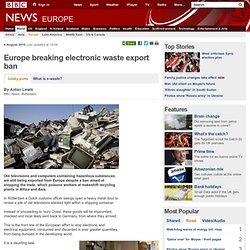
In Rotterdam a Dutch customs officer swings open a heavy metal door to reveal a pile of old televisions stacked tight within a shipping container. Instead of proceeding to Ivory Coast, these goods will be impounded, checked and most likely sent back to Germany, from where they arrived. UK e-waste illegally dumped in Ghana. One of the UK's leading waste and recycling companies has been linked to the growing underground trade in e-waste after campaigners uncovered evidence that broken television sets deposited at the firm's facilities were exported to Africa in contravention of regulations designed to stem the flow of electronic waste to developing countries, the Ecologist can reveal.
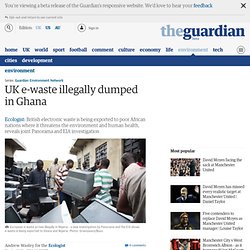
Merseyside-based Environment Waste Controls (EWC), whose clients are reported to include ASDA, Tesco, Barclays, the NHS and Network Rail, has admitted that electronic equipment from its amenity sites in South London ended up in West Africa after being exported by a third party company and says it has taken steps to prevent this happening in the future. Campaigners from the Environmental Investigation Agency (EIA) pinpoint the company in a report outlining Britain's role in the global e-waste trade, due to be published next week.
Re-Assignment of E-Waste Exploring New Livelihood from Waste Management. E-Waste is considered as one of the most difficult wastes to manage, not only to reuse and recycle them, but also to detoxicate and make them harmless to the environment.
This not only has an effect on the immediate environment, but a lot of valuable metals in E-Waste are getting wasted in landfills. Even recycling, reusing and extracting valuable metals from E-Waste requires special equipment and consumes a lot of energy, contradicting the very reason for effective management of resources. Zorpas AA. Measuring waste prevention. : (2013) European Commission - Science for Environment Policy. Mid-town miners: The hunt for urban treasure - environment - 05 June 2013. (Image: Peskimo) WHEN Mats Eklund goes metal prospecting he takes his life in his hands.

How Two College Pals Are Growing A Solution To Our Reliance On Plastic. Study Shows Restored Oyster Reef Worth Its Weight In Nutrients. Rates of nutrient removal among the highest ever recorded A study led by researcher Lisa Kellogg of the Virginia Institute of Marine Science shows that a restored oyster reef can remove up to 10 times more nitrogen from Chesapeake Bay waters than an unrestored area nearby, providing additional evidence that reef restoration can contribute to efforts to improve water quality in the nation’s largest estuary.
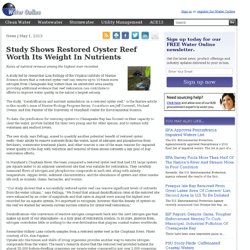
The study, “Denitrification and nutrient assimilation on a restored oyster reef,” is the feature article in this month’s issue of Marine Ecology Progress Series. Co-authors are Jeff Cornwell, Michael Owens, and Ken Paynter of the University of Maryland Center for Environmental Science. To date, the justification for restoring oysters to Chesapeake Bay has focused on their capacity to clear the water, provide habitat for their own young and for other species, and to sustain both watermen and seafood lovers. Solar-Powered Nanofilters Pump In Antibiotics To Clean Contaminated Water.
Using the same devious mechanism that enables some bacteria to shrug off powerful antibiotics, scientists have developed solar-powered nanofilters that remove antibiotics from the water in lakes and rivers twice as efficiently as the best existing technology.
Their report appears in ACS’ journalNanoLetters. David Wendell and Vikram Kapoor explain that antibiotics from toilets and other sources find their way into lakes and rivers, with traces appearing in 80 percent of waterways. Those antibiotics foster emergence of new antibiotic-resistant bacteria, while harming beneficial microbes in ways that can degrade aquatic environments and food chains. Non-toxic corn starch could replace cyanide in gold mines. A newly-developed process gives gold mines an alternative to using cyanide for extracting gold from ore (Photo: Shutterstock ) In the gold-mining process, the precious metal is often extracted from low-grade ore in a technique known as gold cyanidation.
As its name suggests, the process utilizes highly-poisonous cyanide, some of which ends up entering the environment in the mines’ tailings. Document details. Renewable Energy from Waste Material: An Interview with Dr. Stuart Wagland. By Kal Kaur Dr Stuart Wagland, Lecturer in Renewable Energy from Waste in the Department of Environmental Science and Technology at Cranfield University, talks to Kal Kaur, Editor at AZoCleantech about collecting renewable energy from waste material.
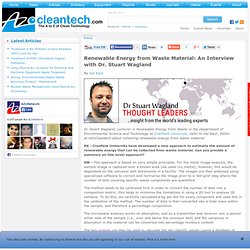
KK - Cranfield University have developed a new approach to estimate the amount of renewable energy that can be collected from waste material. Can you provide a summary on this novel approach? SW - This approach is based on very simple principles. For the initial image analysis, the sample image is captured over a known area (we used 1x1 metre); however, this would be dependent on the conveyor belt dimensions in a facility. A Self-Repairing Computer System Debuts After 15 Years Of Research ⚙ Co. A few years ago, Peter Bentley got stuck on a problem: No matter how hard he tried, he couldn’t get software to heal itself.

“We were trying to make them survive damage, show graceful degradation instead of just crashing, says the University College, London computer scientist, "or even reconfigure themselves to recover lost code. Conventional computers just couldn't do it.” In fact, the hardware and the software he was using at the time couldn’t even tolerate damage to a single bit; 99.9 percent of the time, the system would crash. 19-Year-Old Student Develops Ocean Cleanup Array That Could Remove 7,250,000 Tons Of Plastic From the World's Oceans.
19-year-old Boyan Slat has unveiled plans to create an Ocean Cleanup Array that could remove 7,250,000 tons of plastic waste from the world’s oceans. The device consists of an anchored network of floating booms and processing platforms that could be dispatched to garbage patches around the world. Instead of moving through the ocean, the array would span the radius of a garbage patch, acting as a giant funnel. The angle of the booms would force plastic in the direction of the platforms, where it would be separated from plankton, filtered and stored for recycling. At school, Boyan Slat launched a project that analyzed the size and amount of plastic particles in the ocean’s garbage patches. His final paper went on to win several prizes, including Best Technical Design 2012 at the Delft University of Technology. Slat went on to found The Ocean Cleanup Foundation, a non-profit organization which is responsible for the development of his proposed technologies.
. + Boyan Slat.