
Kim Dotcom on Mega, Baboom's ad-funded model and his album release. Kim Dotcom: the TPP 'proves' that Wall St and Hollywood own Obama. The secretive multinational trade agreement the Trans-Pacific Partnership (TPP) "proves" that Wall St and Hollywood own Obama, according to MegaUpload and Mega founder Kim Dotcom.
In part two of Wired.co.uk's interview with the infamous entrepreneur, we talk about international copyright law, NSA surveillance, Hollywood's "backward, outdated licensing model", Barack Obama and Dotcom's political ambitions. What do you see as the biggest threat to digital rights at the moment? The US government. What has been exposed by Edward Snowden is outrageous.
It's frightening that they can get away with so much wrongdoing. DoJ Secretly Granted Immunity to Companies that Participated in Monitoring Program. Attorney General Eric Holder.
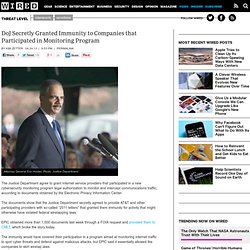
Photo: Justice Department The Justice Department agree to grant internet service providers that participated in a new cybersecurity monitoring program legal authorization to monitor and intercept communications traffic, according to documents obtained by the Electronic Privacy Information Center. The documents show that the Justice Department secretly agreed to provide AT&T and other participating providers with so-called “2511 letters” that granted them immunity for activity that might otherwise have violated federal wiretapping laws. EPIC obtained more than 1,000 documents last week through a FOIA request and provided them to CNET, which broke the story today. The immunity would have covered their participation in a program aimed at monitoring internet traffic to spot cyber threats and defend against malicious attacks, but EPIC said it essentially allowed the companies to skirt wiretap laws.
ACTA / SOPA / PIPA / COICA.
How Much Do Music and Movie Piracy Really Hurt the U.S. Economy? (Photo: Srikrishna K) Supporters of stronger intellectual property enforcement — such as those behind the proposed new Stop Online Piracy Act (SOPA) and Protect IP Act (PIPA) bills in Congress — argue that online piracy is a huge problem, one which costs the U.S. economy between $200 and $250 billion per year, and is responsible for the loss of 750,000 American jobs.
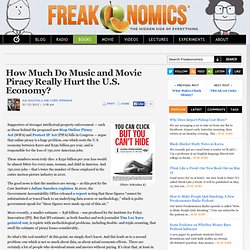
These numbers seem truly dire: a $250 billion per year loss would be almost $800 for every man, woman, and child in America. How Copyright Industries Con Congress. Intellectual Property: Observations on Efforts to Quantify the Economic Effects of Counterfeit and Pirated Goods. In October 2008, Congress passed the Prioritizing Resources and Organization for Intellectual Property Act of 2008 (PRO-IP Act), to improve the effectiveness of U.S. government efforts to protect intellectual property (IP) rights such as copyrights, patents, and trademarks.
The act also directed GAO to provide information on the quantification of the impacts of counterfeit and pirated goods. GAO (1) examined existing research on the effects of counterfeiting and piracy on consumers, industries, government, and the U.S. economy; and (2) identified insights gained from efforts to quantify the effects of counterfeiting and piracy on the U.S. economy.
GAO interviewed officials and subject matter experts from U.S. government agencies, industry associations, nongovernmental organizations, and academic institutions, and reviewed literature and studies quantifying or discussing the economic impacts of counterfeiting and piracy on the U.S. economy, industry, government, and consumers. Texas-Size Sophistry. The Institute for Policy Innovation has released a study on the costs of movie piracy.
It’s a truly remarkable exercise in hand-waving. We’ve written before about the shoddy methodology that copyright industries often use in studies purporting to show the costs of piracy. One of the most common tricks is to assume that every person who pirates a work would have otherwise purchased the work at full price–a clearly false assumption. Some infringers would have purchased the work if they’d been unable to get a pirated copy, but a lot of others would have simply done without it. Hence these estimates are invariably inflated, and any such study funded by the affected industry should be taken with a large grain of salt. But the Institute for Policy Innovation is a Texas think tank, and everything’s bigger in Texas.
SOPA. Dan Gillmor - Google+ - A Stop SOPA Phone App I've been planning to do an app like… Stopped they must be; on this all depends. The freedom, innovation, and economic opportunity that the Internet enables is in jeopardy.
Congress is considering legislation that will dramatically change your Internet experience and put an end to reddit and many other sites you use everyday. Internet experts, organizations, companies, entrepreneurs, legal experts, journalists, and individuals have repeatedly expressed how dangerous this bill is. If we do nothing, Congress will likely pass the Protect IP Act (in the Senate) or the Stop Online Piracy Act (in the House), and then the President will probably sign it into law. There are powerful forces trying to censor the Internet, and a few months ago many people thought this legislation would surely pass. However, there’s a new hope that we can defeat this dangerous legislation. STRIKE AGAINST SOPA.
These 61 Senators are refusing to meet with their constituents before the critical Jan 24 vote on PIPA/SOPA. Oh Reddit, can you call them? : politics. SOPA Sponsor Lamar Smith’s Campaign Website Violated Copyright Laws. Oh well this is certainly ripe: Texas Republican Rep.
Obama Administration responds to We the People petitions on SOPA and online piracy. Setting the Record Straight on SOPA: Some Evidence-Based Analysis. An Open Letter From Internet Engineers to the U.S. Congress. Today, a group of 83 prominent Internet inventors and engineers sent an open letter to members of the United States Congress, stating their opposition to the SOPA and PIPA Internet blacklist bills that are under consideration in the House and Senate respectively.
We, the undersigned, have played various parts in building a network called the Internet. We wrote and debugged the software; we defined the standards and protocols that talk over that network. Many of us invented parts of it. Don't Break the Internet. Two bills now pending in Congress—the PROTECT IP Act of 2011 (Protect IP) in the Senate and the Stop Online Piracy Act (SOPA) in the House—represent the latest legislative attempts to address a serious global problem: large-scale online copyright and trademark infringement.
Although the bills differ in certain respects, they share an underlying approach and an enforcement philosophy that pose grave constitutional problems and that could have potentially disastrous consequences for the stability and security of the Internet’s addressing system, for the principle of interconnectivity that has helped drive the Internet’s extraordinary growth, and for free expression. To begin with, the bills represent an unprecedented, legally sanctioned assault on the Internet’s critical technical infrastructure. Based upon nothing more than an application by a federal prosecutor alleging that a foreign website is “dedicated to infringing activities,” Protect IP authorizes courts to order all U.S. The Internet Blacklist vs. The Constitution. Last week, two leading Constitutional scholars offered detailed analyses of the Internet blacklist bills now pending in Congress, the Stop Online Piracy Act (SOPA) and Protect-IP, or PIPA.
Both scholars concluded that the proposed law could not pass muster under the U.S. Constitution. So you’d think that the new version of SOPA circulated this week would have resolved those concerns. You’d think wrong. SOPA & citizenship in a digital age. You could call Internet users “citizen lobbyists.” This week, in a post-Arab Spring sign of how participatory media – and its participants – are powerfully changing things, they successfully went head-to-head with some powerful forces and won. Christopher Dodd, the head of the film industry trade group that lobbied and failed to push through the Stop Online Piracy Act (along with the US Chamber of Commerce and the recording industry) said that “no Washington player can safely assume that a well-wired, heavily financed legislative program is safe from a sudden burst of Web-driven populism,” according to the New York Times.
“The startlingly speedy collapse of the antipiracy campaign by some of Washington’s savviest players … signaled deep changes in antipiracy lobbying in the future.” So it’s an understatement to say that it feels like this year will be a watershed, the way it has started out. “Citizen regulators” next What about our growing power? Related links. Life will suck if they censor the internet. Cumulative timeline of SOPA debate on Twitter. CISPA is Back: FAQ on What it is and Why it's Still Dangerous. UPDATE (4/22/13): The Cyber Intelligence Sharing and Protection Act (CISPA) has passed the House of Representatives with amendments. Every Representative Who Voted for CISPA, and How to Contact Them. TPP Creates Legal Incentives For ISPs To Police The Internet. What Is At Risk? Your Rights.
The draft chapter of the Trans-Pacific Partnership Agreement on Intellectual Property—as of its current leaked version [PDF], article 16—insists that signatories provide legal incentives for Internet Service Providers (ISPs) to privately enforce copyright protection rules. Secret Trans-Pacific Partnership Agreement (TPP) WikiLeaks Release of Secret Trans-Pacific Partnership Agreement (TPP) Advanced Intellectual Property Chapter for All 12 Nations with Negotiating Positions (August 30 2013 consolidated bracketed negotiating text) Article QQ.A.1: {Definitions} First Leaked TPP Chapter Evokes Memories of SOPA. The Trans-Pacific Partnership, an agreement aimed at deepening economic ties between the United States, Canada, New Zealand, Japan and eight other countries in the region, has been largely shrouded in secrecy.
KEI analysis of Wikileaks leak of TPP IPR text, from August 30, 2013. KEI Comments on the August 30, 2013 version of the TPP IP Chapter. US patent moves are 'profoundly bad' in leaked TPP treaty. The year's most controversial secret treaty just became very, very public. WikiLeaks has posted a full copy of the Trans-Pacific Partnership proposals from this August, revealing many provisions that have only been seen by a small group of lobbyists and heads of state. Nothing in the text has been definitively agreed to, but it offers a rare look into the state of a treaty that could lock in a broad range of rules about information access, patents, and consumer hardware. The TPP and the Fight for our Global Future (with tweets) · dymaxion. Guess Who’s Back? SOPA And ACTA Are Sneaking Into Law Behind Your Back. The Internet has won the fight. Is That Legal? — Big Brands and their Intellectual Property Woes: Michael Jordan, Disney, Apple, Target, & More. Big brands.
Intellectual property fights. A New Question of Internet Freedom. Pawel Supernak/European Pressphoto Agency In January, lawmakers in Poland held up masks to protest the ratifying of the Anti-Counterfeiting Trade Agreement. In the U.S. protests, Web sites including Wikipedia went dark Jan. 18, and more than seven million people signed Google’s online petition opposing the Stop Online Piracy Act and the Protect Intellectual Property Act. White House IP Czar Releases the 2011 Annual Report on Intellectual Property Enforcement. The Next SOPA/PIPA Battle: A Response to Five Arguments for Copyright Access and Internet Freedom. If you are one of the many people who sent an email, made a phone call, posted on facebook, or otherwise acted in the fight over SOPA and PIPA, your call to action may come again in the not so distant future. Yes, SOPA and PIPA in their original forms are “dead,” but the push to address copyright infringement is paramount for the movie, music, computer software, and other industries.
JotForm.com Gets Shut Down SOPA-Style. SOPA, PIPA, ACTA ; Censorship OR Protection; What's Your Side? Sopa / pipa - Page 2 - Dynamic Drive Forums. Poles protest bill on intellectual property rights. Ditch GoDaddy's SOPA-Loving Butt and Get a Better Web Host at a Discount. Film Academy Targets GoDaddy Founder As Legal Fight Heats Up (Exclusive) GoDaddy has NOT withdrawn its official congressional support for SOPA : technology.
Presented Without Comment: Every Single Company Supporting SOPA, the Awful Internet Censorship Law. Amidst SOPA and DMCA, Comedian Louis C.K. Speaks to Artists’ Relationship with Pirates. Jonathan Coulton Destroys The Rationale Behind The Megaupload Seizure With A Single Tweet; Follows Up With Epic Blog Post. American Censorship Day. Draconian Anti-Piracy Censorship Bill Passes Senate Committee. Revised 'Net censorship bill requires search engines to block sites, too. Silicon Valley Congresswoman: Web seizures trample due process (and break the law)