
L'astronomie en Outaouais. Une supernova découverte par hasard à proximité de notre galaxie. Le 21 janvier, des astronomes ont découvert une supernova dans la galaxie Messier 82, à seulement 12 millions d'années-lumière de nous.
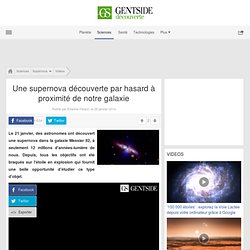
Depuis, tous les objectifs ont été braqués sur l'étoile en explosion qui fournit une belle opportunité d'étudier ce type d'objet. Avez-vous déjà partagé cet article? Partager sur Facebook Partager sur Twitter C'est un spectacle rare qui a été découvert non loin de notre galaxie. "Cette découverte est un coup de chance ! " En ajustant la position de l'instrument, le professeur l'a braqué sur la galaxie M82 dans la constellation de la Grande Ourse.
Un objet qui n'était pas là avant Ils ont ainsi constaté que cet objet n'y était pas auparavant. "Quand vous observez un objet céleste souvent, il devient très familier et, quand j’ai regardé l’image de Messier 82 que nous venions de prendre, j’ai tout de suite vu qu’il y avait quelque chose d’anormal", a commenté le professeur repris par le blog Autour du ciel sur lemonde.fr.
Une supernova de type Ia. Soleil : une spectaculaire éjection de masse coronale suivie d’aurores. Magnifique filament éjecté du Soleil le 29-30 septembre.
Moisson d’aurores polaires pour ce début de mois d’octobre. Magnifique filament de plasma se déployant au-dessus de la surface de notre étoile, le Soleil. Le phénoméne s’est produit entre le 29 et le 30 septembre 2013 et a été capté par les caméras des satellites d’observation solaire SDO (Solar Dynamic Observatory) et SoHO. L’éjection de masse coronale (Coronal Mass Ejection, CME) a expulsée dans l’espace des torrents de particules chargées à une vitesse moyenne de 900 km/s. La NASA a trouvé une autre Terre… 2 fois ! Vendredi 19 avril 2013 5 19 /04 /Avr /2013 10:48 Hier soir, la NASA a diffusé en direct sur sa chaîne une annonce d’une énorme importance.
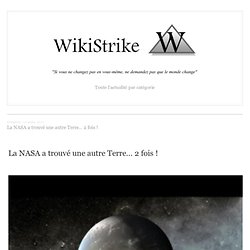
L’agence spatiale américaine a découvert des planètes candidates qui remplissent presque toutes les conditions nécessaires pour héberger la vie. Et selon William Borucki, le directeur scientifique du télescope Kepler, il s’agit des 2 meilleures planètes jamais découvertes. En décembre dernier, il y avait déjà eu beaucoup d’émotions en découvrant une planète potentiellement habitable dans le système solaire de Tau Ceti. The Most Astounding Fact - Neil deGrasse Tyson. Mon site personnel - Index. Un lac tropical détecté sur Titan. Grâce aux données collectées par Cassini, la NASA a découvert que Titan, une des lunes de Saturne, possédait un oasis grand comme le Grand Lac Salé de l’Utah.
Titan, une des lunes de Saturne, possède un lac de méthane liquide gigantesque et marécageux, situé à proximité de son équateur. C’est ce que révèle de nouvelles images fournies par le vaisseau Cassini de la NASA qui ont permis d'évaluer la taille de ce lac à quelque 2.400 kilomètres carrés. Le mois de la Lune bleue. Exceptionnellement, le mois d'août compte deux pleines Lune.
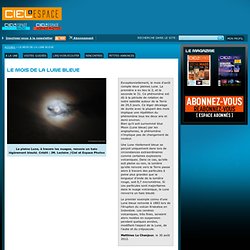
La première a eu lieu le 2, et la seconde le 31. Ce phénomène est dû à la période de rotation de notre satellite autour de la Terre de 29,5 jours. Ce léger décalage de durée avec la plupart des mois implique une répétition du phénomène tous les deux ans et demi environ.Bien qu'il soit surnommé blue Moon (Lune bleue) par les anglophones, le phénomène n'implique pas de changement de couleur. Bienvenue dans l'univers de l'Astronomie. NASA Lands Car-Size Rover Beside Martian Mountain. BX442, la grande galaxie spirale qui ne devrait pas exister. Il est représenté ici une vraie image de la grande galaxie spirale BX442 telle qu'elle était il y a 10,7 milliards d'années.
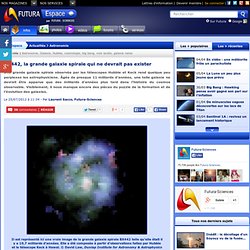
Elle a été composée à partir d'observations faites par Hubble et le télescope Keck à Hawaï. © David Law, Dunlap Institute for Astronomy & Astrophysics BX442, la grande galaxie spirale qui ne devrait pas exister - 2 Photos Un groupe d’astrophysiciens vient de publier dans Nature un article sur la découverte par Hubble de la galaxie BX442. C’est une grande galaxie spirale, comme il en existe de nos jours tout autour de la Voie lactée.
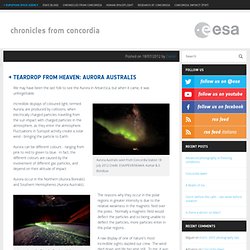
Teardrop from Heaven: Aurora Australis. Posted on 18/07/2012 by Daniel.
Trou noir : une dégustation d'étoile en direct. Fait rare, un trou noir dévore une étoile « en live » !
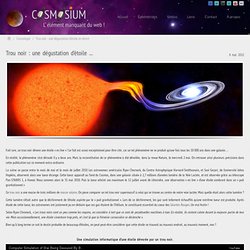
Le fait est assez exceptionnel pour être cité, car un tel phénomène ne se produit qu’une fois tous les 10 000 ans dans une galaxie… En réalité, le phénomène s’est déroulé il y a deux ans. Ciel et Espace. Galerie Photos - Photos de galaxies en collisions sur Futura-Sciences. Les mystères de Mercure dévoilées par la sonde Messenger. Une année après sa mise en orbite autours de Mercure, la sonde Messenger de la NASA, dévoile peu à peu des images inédites de la planète ainsi que des données permettant d’identifier sa structure et sa composition.
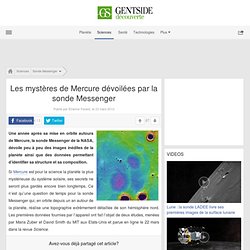
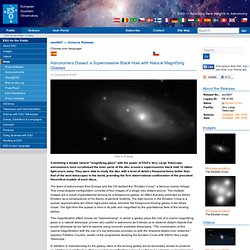
Si Mercure est pour la science la planète la plus mystérieuse du système solaire, ses secrets ne seront plus gardés encore bien longtemps. Ce n’est qu’une question de temps pour la sonde Messenger qui, en orbite depuis un an autour de la planète, réalise une topographie extrêmement détaillée de son hémisphère nord. Eso0847 - Astronomers Dissect a Supermassive Black Hole with Natural Magnifying Glasses. Eso0847 — Science Release 12 December 2008.
The White Mountain (extended) The Known Universe by AMNH. Breaking Point. The Aurora. Le Cosmographe. IC434 - Le Cheval de Noël. Goldpaint Photography. L'astronomie - Ciel des Hommes. About the Digital Universe. At the center of the 1 billion light-year grid is the Milky Way and our Sun.
Surrounding us are the multi-hued Tully galaxies and the blue sheets of the Sloan Digital Sky Survey that stretch out billions of light-years away. Since 1998, the American Museum of Natural History and the Hayden Planetarium have engaged in the three-dimensional mapping of the Universe. This cosmic cartography brings a new perspective to our place in the Universe and redefines our sense of home. From the Solar System out to the edge of the observable universe, the Digital Universe obtains data from scientists and organizations around the world and builds a consistent atlas where disparate data are in context with one another. The Digital Universe is distributed via free download and to planetariums around the world through our partnerships with several planetarium technology companies.
The free version offered on this site is a stripped down version of what you'll find in planetariums. Zooniverse - Real Science Online. Galaxy Zoo: Hubble. Moon Zoo. Solar Stormwatch. The Milky Way Project. Planet Hunters. Welcome to IceHunters.