
Sculpture. Apps. Photography. Book covers. Design. Museums & galleries. Artists. Portals. #DrawWithRob — Rob Biddulph. When the coronavirus pandemic quarantine period began in Spring/Summer 2020, I realised that lots of people were going to find themselves at home with their children for several weeks/months looking for things to do.
So I decided to post a draw-along video every Tuesday and Thursday that parents could watch with their kids and, hopefully, make some nice pictures. They have proved very popular, garnering millions of views across the world. On 21 May 2020 we broke the Guinness World Record for the largest online art lesson when 45,611 participants drew a whale with me.
10 Brilliant Female Artists of the Renaissance. In Renaissance Italy, most women from the upper classes had only two options in life – the marriage or the convent.
Therefore, this was not a very promising environment for women artists to emerge or thrive. In fact, it was incredibly difficult for women to become artists. They were unable to even receive formal art training, so they were either self-taught or taught by their fathers. Know the Artist: HILMA AF KLINT. Hokusai and the wave that swept the world - BBC Culture. Rising in the East It’s worth recalling that what brought Hokusai and other ukiyo-e printmakers to the attention of Monet, Degas, Cassatt, and Lautrec were trade deals, on uneven terms, between Japan and the West.
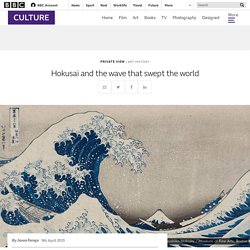
France and other industrial powers were thriving; Japan was in upheaval, as the shogunate gave way to the Meiji Restoration. BBC Four - Apples, Pears and Paint: How to Make a Still Life Painting. BBC Four - Museums in Quarantine, Series 1, Rembrandt. BBC Two - Antony Gormley: How Art Began. Introduction - 10,000 Year Clock. The full scale 10,000 Year Clock is now under construction.

While there is no completion date scheduled, we do plan to open it to the public once it is ready. The essay below by Long Now board member Kevin Kelly discusses what we hope the Clock will be once complete. My body isn't a temple, it's a canvas — ARTWORK BY RK. The Warmth of Other Suns: Stories of Global Displacement. The Warmth of Other Suns: Stories of Global Displacement will be open to visitors for extended hours on Friday, September 6, 13, and 20 from 5-8:30 pm.
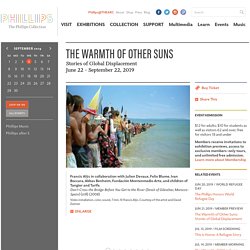
This D.C. exhibition should be seen by everyone concerned about the migrant crisis. —The Washington Post The Museum is the Refugee’s Home. Without exiles and émigrés there is no modern culture. A new show in Washington maps a century of art and displacement. Old-school painting meets cutting-edge animation: Loving Vincent is a rich visual feast. How the Traditional Japanese Art of Fish Printing Inspired a Modern Art Form. Naoki Hayashi’s first encounter with gyotaku—the traditional Japanese art of fish printing—was anything but traditional.
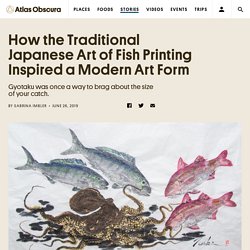
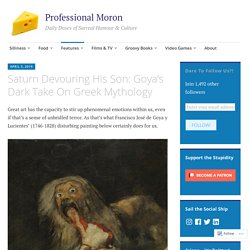
It was the early 1970s, and a few local families had taken their four-wheel drive vehicles out to some Oʻahu beaches to camp out and catch some fish. As an elementary-school kid, Hayashi’s job was to scale and gut the fish so there would be no mess at home. The adults were nearing the end of a successful day of fishing, meaning they were deep into a bucket of beer, sake, and soju. Saturn Devouring His Son: Goya’s Dark Take On Greek Mythology. Great art has the capacity to stir up phenomenal emotions within us, even if that’s a sense of unbridled terror.
Le vol du corbeau by Jean-Pierre Gibrat on artnet. Recently Digitized Journals Grant Visitors Access to Leonardo da Vinci’s Detailed Engineering Schematics and Musings. Ello Artist Invite: Fabrik Heroes 2019. I Was A Dark Star Always - Exhibition at John Hansard Gallery in Southampton. Japan live. A forgotten 200-year-old guide to color, redesigned for the internet. The nomenclature of colors we use today is really a machine language–numerical hex codes crafted to communicate with software on computers and printers. Before the age of CMYK and RBG, though, artists and scientists created their own languages for talking about and categorizing color. Picular. Text to Image. New Miniature Warning Signs and Other Humorous and Unexpected Interventions by Michael Pederson. Deepart.io - become a digital artist.
Ontroerend Goed. Super Satisfying Video of a Woodcarver Making ‘Fibonacci’ Spiral Shavings. COSMOS 2018 Hidden in Plain Sight - Abandon Normal Devices. Hidden in Plain Sight was a new data driven audio-visual work created for Jodrell Bank’s iconic Lovell Telescope.
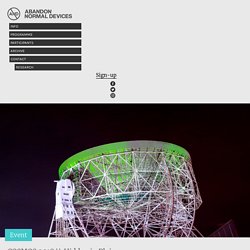
Developed by Addie Wagenknecht, it was the second work to be developed as part of COSMOS, premiering at bluedot festival 2018. A testament to a seemingly insatiable human appetite for exploration, structures such as the Lovell Telescope look monumental, but are in actuality just the tip of the iceberg sitting on top of great scientific endeavours. Telescopes all over the world gives rise to complex data, and the Lovell Telescope is no exception.
Sitting behind that immense structure is a vast array of data systems, networks and global infrastructure, processing and combining complex datasets to build pictures of cosmic activity. Through Hidden in Plain Sight we see the telescope as an object that extends beyond the physical structure, Wagenknecht plays with the notion of access to data and how infrastructure is designed to be ignored. How my astronomy data from the Lovell telescope was used to create an immersive light and sound show. As a scientist, I was recently involved in bringing my work to the big screen.
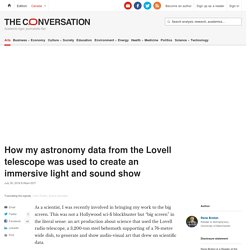
This was not a Hollywood sci-fi blockbuster but “big screen” in the literal sense: an art production about science that used the Lovell radio telescope, a 3,200-ton steel behemoth supporting of a 76-metre wide dish, to generate and show audio-visual art that drew on scientific data. I have been involved with numerous public engagement opportunities over the years: giving public lectures, visiting students in schools, interacting on social media, being interviewed about new discoveries. There is however another form of public engagement that I have come to experience in the past year, which I would probably never have considered if not for the fact that it came knocking at my door: connecting with an artist developing a piece inspired by the scientific work that my colleagues and I do.
Art meets science. How subversive artists made thrift shopping cool. National Thrift Shop Day (August 17) exists alongside other quirky holidays like Play Your Ukulele Day (February 2) and Rice Crispy Treat Day (September 18).
Though intended as a lighthearted celebration of an acceptable commercial habit, the process of making thrift stores hip involved unusual advocates. As I describe in my recent book “From Goodwill to Grunge,” thrift stores emerged in the late 19th century when Christian-run organizations adopted new models of philanthropy (and helped rehab the image of secondhand stores by dubbing their junk shops “thrift stores”). Color Problems: A Republished Tome Reveals the Color Wisdom and Poetics of 19th-Century Artist Emily Noyes Vanderpoel. Hilarious Matchboxes Depict Cats Making Questionable Decisions.
Events — X-Ray Audio. The X-Ray Audio Exhibtion will be at GARAGE MUSEUM OF CONTEMPORARY ART in Moscow in a site specific, expanded and locally researched instance of the show that has been touring internationally since January 2015, gaining media attention in the UK (with major features in The Guardian, on the BBC Today program, BBC Russia, BBC Ukraine BBC World amongst many others) The exhibition draws out the hidden accidental aesthetic of disposable street culture objects and raises them to the level of high-cultural artefacts. It evokes the era and circumstances in which they were created and tells a unique story in which music, forbidden culture, recycling, cold war politics and human endeavour intersect through original artefacts, projections, film and sound.
Gallery: The art and science of museum dioramas. “I build time machines,” says artist Aaron Delehanty. Actually, his specific day job is constructing dioramas — freeze-framed vignettes of animals and people in their habitats — and through them, he has transported museumgoers back to places such as southern China in 5500 BC and east Africa in 1896 (TEDxFlourCity Talk: Dioramas: part art, part science). “The intention of a diorama is to build a replica of a specific ecosystem and to do it with such precision that they become time capsules for that environment,” says Delehanty.
He studied studio art and painting at the Art Institute of Chicago and the San Francisco Art Institute before he got a job constructing dioramas for the Field Museum in Chicago. He made his first diorama, a depiction of five New York Native American tribes, when he was in 6th grade, but his work today is far from kids’ stuff (although he still sometimes uses popsicle sticks). He explains the history, research and craft that inform his work. Giant Dabs of Thick Oil Paint Captured as Hyperrealist Colored Pencil Drawings.
BBC Four - Art on the BBC: The Genius of Leonardo Da Vinci. Goya - Black Paintings. The Black Paintings (Spanish: Pinturas negras) is the name given to a group of fourteen paintings by Francisco Goya from the later years of his life, likely between 1819 and 1823. Titian - Bacchus and Ariadne. New Mesmerizing Oil and Graphite Portraits That Peer Into the Subject’s Inner Mind by Miles Johnston. Werner’s Nomenclature of Colours: a Pre-Photographic Guide for Artists and Naturalists. Search All the GIFs & Make Your Own Animated GIF. ASCII Art - Copy & Paste Dump. Wiggly Noodle People Appear to Disintegrate in a Bizarre New Animation by Ari Weinkle.
Blade Runner 2049 (Score) - Benjamin Wallfisch & Hans Zimmer. BBC Four - The Renaissance Unchained. Documenta 14. Polluted Water Popsicles: Faux Frozen Treats Highlight Taiwan’s Water Pollution Problem. Via @bebeelai. Download More than 2,500 Images of Vibrant Japanese Woodblock Prints and Drawings From the Library of Congress. Thanks to the Library of Congress, you can browse and download high-resolution copies of more than 2,500 Japanese woodblock prints and drawings from the library’s online collection. Sister Wendy American Collection - Episode 1 (The Art Institute of Chicago) - BBC Documentary. Fandom powered by Wikia. The Smiths - The Stories Behind All 27 Of Their Provocative Album And Single Sleeves - NME. Airplane nose art, bomber nose art, WWII nose art, nose art photographs, pin ups, subjects, artists, today's nose art.
LaBeouf, Rönkkö & Turner. Netsuke Cockerel - Wood Carving Magazine - woodworkersinstitute.com; Bob Jubb shows how to carve a stylised Japanese netsuke cockerel in easy steps Gallery. Welcome to The Labyrinth Builders. People for the Arts. Untitled. “The Raft of the Medusa” – Art A Fact. The Walled Off Hotel. Toronto Light Festival. Powerfully Moving Brush Strokes. UK-based contemporary painter Paul Wright creates incredibly intimate, yet somewhat abstract, oil paintings that draw the viewer in. Zentangle.
Photo to Oil Painting Converter - Oil painting photo effect online. Sending your request to Picture to People server ... Do You Know Where Your Thoughts Come From? Art UK. Series of robots and "new forms of life" using Theo Jansen mechanism - Blender Bullet SmallLuxGPU. Michael Gaumnitz : Paul Klee The Silence of the Angel (2005) Paul Klee: Triumph of a 'degenerate' 30 Amazing Neon Light Typography Designs. Pattern in Islamic Art. James Gillray: The Art of Caricature. Sir John Soane's Museum. THE ARGUS PROJECT. AnnoTate. 48 great examples of doodle art. The Cartoon Museum. Home - Dazzle Ships. Big Bang Data. Magritte Your World on the App Store. Marina Abramovic Institute. Bemusement Park. The William Heath Robinson Trust Website - Homepage. Lifesize mousetrap. Build your own Panda Mask by Wintercroft. An art, design, and visual culture blog.
NanoART 2015 - Nanosciences. Outsider art. I am looking for a place, for my mind. Frank Gehry : Architectural Digest. Patreon: Support the creators you love. BAROQUE.ME. 'Supersymmetry' art show puts you inside a particle accelerator. Art Subject Guide.