
History of religions. Taoism. Taoist rite at the Qingyanggong (Bronze Ram Temple) in Chengdu, Sichuan.
Taoism, or Daoism, is a philosophical, ethical, and religious tradition of Chinese origin that emphasizes living in harmony with the Tao (also romanized as Dao). The term Tao means "way", "path" or "principle", and can also be found in Chinese philosophies and religions other than Taoism. Christianity. Christianity is an Abrahamic religion that began as a Jewish sect in the mid-1st century.[9][10] Originating in the Levant region of the Middle East, it quickly spread to Syria, Mesopotamia, Asia Minor and Egypt. It grew in size and influence over a few centuries, and by the end of the 4th century had become the official state church of the Roman Empire, replacing other forms of religion practiced under Roman rule.[11] During the Middle Ages, most of the remainder of Europe was Christianized, and adherents were gained in the Middle East, North Africa, Ethiopia and parts of India.[12][13] Following the Age of Discovery, Christianity spread to the Americas, Australasia, sub-Saharan Africa, and the rest of the world through missionary work and colonization.[14][15][16] Christianity has played a prominent role in the shaping of Western civilization.[17][18][19][20][21] Beliefs Creeds Its main points include: Ten Commandments These are quotes from Deuteronomy 6:4 and Leviticus 19:18.
Shinto. Shinto priest and priestess.
Shinto (神道, Shintō?) , also kami-no-michi,[note 1] is the indigenous religion of Japan and the people of Japan.[2] It is defined as an action-centered religion,[3] focused on ritual practices to be carried out diligently, to establish a connection between present-day Japan and its ancient past.[4] Founded in 660 BC according to Japanese mythology,[5] Shinto practices were first recorded and codified in the written historical records of the Kojiki and Nihon Shoki in the 8th century. Still, these earliest Japanese writings do not refer to a unified "Shinto religion", but rather to a collection of native beliefs and mythology.[6] Shinto today is a term that applies to the religion of public shrines devoted to the worship of a multitude of gods (kami),[7] suited to various purposes such as war memorials and harvest festivals, and applies as well to various sectarian organizations.
According to Inoue (2003): Confucianism. Folk religion. Folk religion consists of ethnic or regional religious customs under the umbrella of a religion, but outside of official doctrine and practices.[1] Folk religion has been defined as "the totality of all those views and practices of religion that exist among the people apart from and alongside the strictly theological and liturgical forms of the official religion.

"[2] The term "folk religion" is generally held to encompass two related but separate subjects. Bahá'í Faith. The Bahá'í Faith (Arabic: بهائية Baha'iyyah) /bəˈhaɪ/[1] is a monotheistic religion emphasizing the spiritual unity of all humankind.[2] Three core principles establish a basis for Bahá'í teachings and doctrine: the unity of God, that there is only one God who is the source of all creation; the unity of religion, that all major religions have the same spiritual source and come from the same God; and the unity of humanity, that all humans have been created equal, and that diversity of race and culture are seen as worthy of appreciation and acceptance.[3] According to the Bahá'í Faith's teachings, the human purpose is to learn to know and love God through such methods as prayer, reflection and being of service to humanity.

The Bahá'í Faith was founded by Bahá'u'lláh in 19th-century Persia. Bahá'u'lláh was exiled for his teachings, from Persia to the Ottoman Empire, and died while officially still a prisoner. Etymology[edit] Rastafari movement. The Rastafari movement is an Abrahamic religion which developed in Jamaica in the 1930s, following the coronation of Haile Selassie I as King of Ethiopia in 1930.
Its adherents worship Haile Selassie I, emperor of Ethiopia (ruled 1930–1974), some as Jesus in his Second Advent, or as God the Father.[1] Members of the Rastafari way of life are known as Rastas, or the Rastafari. The way of life is sometimes referred to as "Rastafarianism", but this term is considered offensive by most Rastafari, who, being critical of "isms" (which they see as a typical part of "Babylon culture"), dislike being labelled as an "ism" themselves.[2] The name Rastafari is taken from Ras Tafari, the title (Ras) and first name (Tafari Makonnen) of Haile Selassie I before his coronation.
In Amharic, Ras, literally "head", is an Ethiopian title equivalent to prince or chief, while the personal given name Täfäri (teferi) means one who is respected or feared. Cao Dai. Symbol of Cao Dai The "Holy See" temple in Tây Ninh is the centre of the main Caodaist church.

The altar of ta Caodaist temple in Mỹ Tho. Caodaism or Caodaiism (Vietnamese: Đạo Cao Đài, "Way of the Highest Power"; Chinese: 高台教; pinyin: Gāotáijiào) is a monotheistic religion, officially established in the city of Tây Ninh in southern Vietnam, in 1926.[1] The full name of the religion is Đại Đạo Tam Kỳ Phổ Độ ("Great Way [of the] Third Time [of] Redemption").[1] Followers also call their religion Đạo Trời ("Way of God"). Caodaism has common roots and similarities with the Chinese Tiên Thiên Đạo doctrines and the Minh Đạo religions within Vietnamese Thanism.[2] Seicho-no-Ie. The logo of Seicho-no-ie Seicho-no-Ie, sometimes rendered Seicho-no Iye (生長の家 seichō-no ie [se.it͡ɕoː no i.e]), is a syncretic, monotheistic, New Thought religion/philosophy, one of the Shinshūkyō (or new religious movements) in Japan that have spread since the end of World War II.

It emphasizes gratitude for nature, the family, ancestors and, above all, religious faith in one universal God, inheriting its basic characteristics from Buddhism, Christianity and Shintoism. Seicho-no-Ie is the world's largest New Thought group.[1] The phrase means "House of Growth". By the end of 2010 it had over 1.6 million followers and 442 facilities, mostly located in Japan.[2] History[edit] In 1930, Dr.
Buddhism. Religion founded by the Buddha Buddhism (, ) is an Indian religion based on a series of original teachings attributed to Gautama Buddha.
It originated in ancient India as a Sramana tradition sometime between the 6th and 4th centuries BCE, spreading through much of Asia. Judaism. Judaism (from the Latin Iudaismus, derived from the Greek Ἰουδαϊσμός, and ultimately from the Hebrew יהודה, Yehudah, "Judah";[1][2] in Hebrew: יהדות, Yahadut, the distinctive characteristics of the Judean ethnos)[3] is the religion, philosophy and way of life of the Jewish people.[4] Judaism is a monotheistic religion, with the Torah as its foundational text (part of the larger text known as the Tanakh or Hebrew Bible), and supplemental oral tradition represented by later texts such as the Mishnah and the Talmud.
Judaism is considered by religious Jews to be the expression of the covenantal relationship God established with the Children of Israel.[5] Judaism includes a wide corpus of texts, practices, theological positions, and forms of organization. Judaism claims a historical continuity spanning more than 3,000 years. Unitarian Universalism. Unitarian Universalism[2][3][4] is a liberal religion characterized by a "free and responsible search for truth and meaning".[5][6] Unitarian Universalists do not share a creed but are unified by their shared search for spiritual growth.
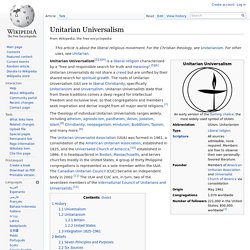
The roots of Unitarian Universalism (UU) are in liberal Christianity, specifically Unitarianism and Universalism. Unitarian Universalists state that from these traditions comes a deep regard for intellectual freedom and inclusive love, so that congregations and members seek inspiration and derive insight from all major world religions.[7] Sikhism. Sikhism, known in Punjabi as Sikhi,[note 1] (/ˈsiːkɨzəm/ or /ˈsɪkɨzəm/; Punjabi: ਸਿੱਖੀ, sikkhī, IPA: [ˈsɪkːʰiː]) is a monotheistic religion founded during the 15th century in the Punjab region of the Indian subcontinent, by Guru Nanak[3] and continued to progress through the ten successive Sikh gurus (the eleventh and last guru being the holy scripture Guru Granth Sahib.
The Guru Granth Sahib is a collection of the Sikh Gurus' writings that was compiled by the 5th Sikh Guru). It is the fifth-largest organized religion in the world, with approximately 30 million adherents.[4][5] Punjab, India is the only state in the world with a majority Sikh population. Adherents of Sikhism are known as Sikhs (students or disciples). According to Devinder Singh Chahal, "The word 'Sikhi' (commonly known as Gurmat) gave rise to the modern anglicized word 'Sikhism' for the modern world. Hinduism. Islam. Islam (/ˈɪslɑːm/;[note 1] Arabic: الإسلام, al-ʾIslām IPA: [ælʔɪsˈlæːm] ( )[note 2]) is a monotheistic and Abrahamic religion articulated by the Qur'an, an Islamic holy book considered by its adherents to be the verbatim word of God (Allāh), and for the vast majority of adherents, also by the teachings and normative example (called the Sunnah and composed of hadith) of Muhammad (c. 570–8 June 632 CE), considered by most of them to be the last prophet of God.
An adherent of Islam is called a Muslim. Most Muslims are of two denominations: Sunni (75–90%)[8] or Shia (10–20%).[9] About 13% of Muslims live in Indonesia,[10] the largest Muslim-majority country, 25% in South Asia,[10] 20% in the Middle East,[11] and 15% in Sub-Saharan Africa.[12] Sizable minorities are also found in Europe, China, Russia, and the Americas. Converts and immigrant communities are found in almost every part of the world (see Islam by country). Jainism. Jainism (/ˈdʒeɪnɪzəm/[1] or /ˈdʒaɪnɪzəm/[2]), traditionally known as Jin Sashana or Jain dharma (Sanskrit: जैन धर्म), is an Indian religion that prescribes a path of nonviolence (ahimsa) towards all living beings.
Practitioners believe that nonviolence and self-control are the means by which they can obtain liberation. Church of World Messianity. Tenrikyo. Cheondoism. Cheondoism, spelled Chondoism in North Korean sources[1] (Korean Cheondogyo; hanja 天道教; hangul 천도교; literally "Religion of the Heavenly Way"), is a 20th-century Korean religious movement, based on the 19th century Donghak Confucian movement founded by Choe Je-u and codified under Son Byeong-hui.[2] Cheondoism has its origins in the peasant rebellions which arose starting in 1812 during the Joseon Dynasty.
Wicca. This pentacle, worn as a pendant, depicts a pentagram, or five-pointed star, used as a symbol of Wicca by many adherents. Wicca is a diverse religion with no central authority or figure defining it. It is divided into various lineages and denominations, referred to as traditions, each with its own organisational structure and level of centralisation. Due to its decentralized nature, there is some disagreement over what actually constitutes Wicca. Some traditions, collectively referred to as British Traditional Wicca, strictly follow the initiatory lineage of Gardner and consider the term Wicca to apply only to such lineaged traditions, while other eclectic traditions do not. Terminology[edit] Sacred Texts: Buddhism. Sacred-texts home Journal Articles: Buddhism OCRT: Buddhism Buy CD-ROM Buy Books about Buddhism Modern works Southern Buddhism Northern Buddhism JatakaLinks. World Prayers - Meditations Index.
Buddhism and Buddhist schools. Rinzai school. The Rinzai school (臨済宗; Japanese: Rinzai-shū, Chinese: 临济宗 línjì zōng) is one of three sects of Zen in Japanese Buddhism (with Sōtō and Ōbaku). History[edit] Investigating the Mind. Neil deGrasse Tyson: Atheist or Agnostic? Meditation for beginners. The strange thing is that when I was 15, I meditated quite a bit. I was dealing with some anger issues (mostly anger about being a teenager in a not-challenging-enough school system whose friends had started to act in inexplicable ways) and I’m not sure how I learned about it, but I had a regular practice for almost a year. Meditation. Religion, World Religions, Comparative Religion - Just the facts on the world's religions. Religion and Ethics - Civilisations.
Society: Religion and Spirituality. Religion: Religions.
Absurdism. Søren Kierkegaard. Søren Aabye Kierkegaard (/ˈsɔrən ˈkɪərkəɡɑrd/ or /ˈkɪərkəɡɔr/; Danish: [ˈsɶːɐn ˈkiɐ̯ɡəɡɒːˀ] ( Philosophy of Søren Kierkegaard. The Myth of Sisyphus. Schism (religion) Cabal.