
Structuralism – Anthropology. Structuralism was predominately influenced by the schools of phenomenology and of Gestalt psychology, both of which were fostered in Germany between 1910 and the 1930s (Sturrock 2003: 47).

Phenomenology was a school of philosophical thought that attempted to give philosophy a rational, scientific basis. Principally, it was concerned with accurately describing consciousness and abolishing the gulf that had traditionally existed between subject and object of human thought. Consciousness, as they perceived, was always conscious of something, and that picture, that whole, cannot be separated from the object or the subject but is the relationship between them (Sturrock 2003: 50-51).
Phenomenology was made manifest in the works of Edmund Husserl, Martin Heidegger and Jean-Paul Sartre among others. Youtube. Electronic Books - Thomas Merton Center. Mary Gordon - On Thomas Merton.
Andre Gozier, OBS - 15 Days of Prayer with Thomas Merton.
Edward Said. Afrofuturism. Analytic Vs Continental. Cancel Culture. Death. 1 hour of David Lynch listening to rain, smoking and reflecting on art. Arendt. Wittgenstein. PHILOSOPHY - Hegel. Foucault. Sartre. How the humanities became the new enemy within. The strain of conservatism that has now taken up residence in Downing Street is tireless in its identification of enemies.
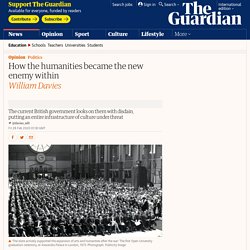
The BBC and Channel 4 were put on notice during the latter stages of the election campaign, and the government is now openly pursuing the termination of the BBC licence fee. Dominic Cummings’ long-harboured resentment towards civil service mandarins is driving Whitehall reform, imperilling its independence. The vanguard of rightwing thinktanks and newspapers is redoubling its attacks on universities, with a pitifully thin Policy Exchange report on the topic this week earning a Times headline decrying these “sneering” institutions.
Bourdieu - simple explanation. The Ideas of Socrates. Simone de Beauvoir Interview and photography. The interview took place in Miss de Beauvoir’s studio on the rue Schoëlcher in Montparnasse, a five-minute walk from Sartre’s apartment.
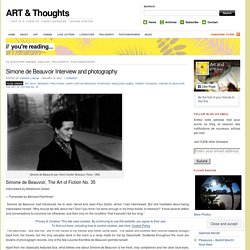
We worked in a large, sunny room which serves as her study and sitting room. Shelves are crammed with surprisingly uninteresting books. “The best ones,” she told me, “are in the hands of my friends and never come back.” The tables are covered with colorful objects brought back from her travels, but the only valuable work in the room is a lamp made for her by Giacometti. Buddhism. Social Theory Rewired. Cultural Capital While he didn’t consider himself a Marxist sociologist, the theories of Karl Marx heavily influenced Bourdieu’s thinking.
Marx’s influence is perhaps most evident in Bourdieu’s theory of cultural capital. Pocket: Log In.
Derrida. Bruno-latour.fr. Enlightenment. The truth, beauty, and power of punk - The Philosopher's Zone. Interview: Zygmunt Bauman: “Social media are a trap” Zygmunt Bauman has just celebrated his 90th birthday and taken two flights from his home in the northern British city of Leeds to get to an event in Burgos, northern Spain.
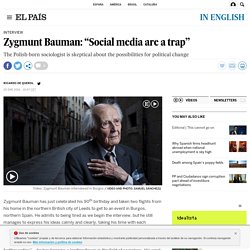
He admits to being tired as we begin the interview, but he still manages to express his ideas calmly and clearly, taking his time with each response because he hates giving simple answers to complex questions. Since developing his theory of liquid modernity in the late 1990s – which describes our age as one in which “all agreements are temporary, fleeting, and valid only until further notice” – he has become a leading figure in the field of sociology. His work on inequality and his critique of what he sees as the failure of politics to meet people’s expectations, along with a highly pessimistic view of the future of society, have been picked up by the so-called May 15 “Indignant” movement in Spain – although he has repeatedly highlighted its weaknesses.
QUESTION. You have described inequality as a “metastasis.” Q.
Heidegger. Stuart Elden: Confessio - berfrois. Legend of St Francis: 27.
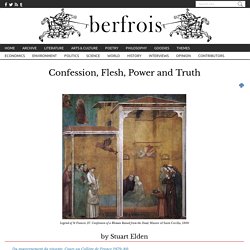
Confession of a Woman Raised from the Dead, Master of Saint Cecilia, 1300 by Stuart Elden Du gouvernement du vivants: Cours au Collège de France 1979-80, edited by Michel Sennelart, Paris: Gallimard/Seuil, 2012; translated by Graham Burchell as On the Government of the Living: Lectures at the Collège de France 1979-80, London: Palgrave, 448 pp. Mal faire, dire vrai: Le function de l’aveu en justice, edited by Fabienne Brion and Bernard E.
Harcourt, Louvain-la-Neuve, Presses Universitaires de Louvain, 2012; translated by Stephen W. Foucault promised various books on the relation between power, subjectivity and truth in his career. MINDFUL PLEASURES: Poetry after Auschwitz: What Adorno Really Said, and Where He Said It. Gore Vidal remarks somewhere upon the irony that George Santayana is remembered today only for his warning about forgetting.
(All who remember Santayana are doomed to repeat that those who do not remember history are doomed to repeat it.) Theodor Adorno seems to have suffered a similar fate, remembered by most nonspecialists only as a German gloom-meister who pronounced that after Auschwitz, poetry could no longer be written. Few realize that what Adorno actually wrote was more complex and subject to revision in his later work. Neoplatonism Shoring Against the Ruins. Will chimps soon have human rights? Tommy, 26, lives on a trailer lot in Gloversville, New York, with only a television for company.

Tommy is a chimpanzee, and if the organisation seeking to free him and move him to a sanctuary wins a lawsuit it filed today, the result could have implications for how we view – and treat – our closest animal relatives. Radical thinkers: Alain Badiou's Ethics - video. The poststructural anarchist. Todd May interviewed by Richard Marshall.
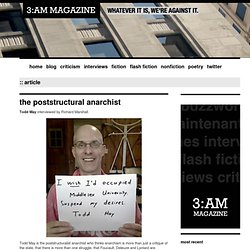
Todd May is the poststructuralist anarchist who thinks anarchism is more than just a critique of the state, that there is more than one struggle, that Foucault, Deleuze and Lyotard are important, that postructuralism is elusive, that anarchism is bottom-up and liberalism is top-down, that ‘how might one live?’ Is the down and dirty question, that Foucault’s thought will remain standing when the dust is settled, that what it means to be human is a matter of practices, that Ranciere gets him emotionally, that friendship offers a different model from neo-liberalism and that his conception is about resistance not cohesion.
High Five! 3:AM: What made you become a philosopher? MEGA Marx: Berfrois Interviews Jonathan Sperber. By Russell Bennetts Jonathan Sperber is a social historian and Curators’ Professor of History at the University of Missouri. His most recent publication is Karl Marx: A Nineteenth-Century Life. Russell Bennetts is the editor of Berfrois. Berfrois Was Karl Marx an anti-Semite? Creativity is rejected: Teachers and bosses don’t value out-of-the-box thinking. Illustration by Rob Donnelly In the United States we are raised to appreciate the accomplishments of inventors and thinkers—creative people whose ideas have transformed our world.
We celebrate the famously imaginative, the greatest artists and innovators from Van Gogh to Steve Jobs. Viewing the world creatively is supposed to be an asset, even a virtue. Online job boards burst with ads recruiting “idea people” and “out of the box” thinkers. How to Worry Less About Money. By Maria Popova What Goethe can teach us about cultivating a healthy relationship with our finances. The question of how people spend and earn money has been a cultural obsession since the dawn of economic history, but the psychology behind it is sometimes surprising and often riddled with various anxieties. ‘The World Until Yesterday,’ by Jared Diamond.
Excerpt: 'Struggle and Utopia at the End Times of Philosophy' by François Laruelle. Armageddon, Joseph Paul Pettit, 1852 From The End Times of Philosophy: The phrase “end times of philosophy” is not a new version of the “end of philosophy” or the “end of history,” themes which have become quite vulgar and nourish all hopes of revenge and powerlessness. Moreover, philosophy itself does not stop proclaiming its own death, admitting itself to be half dead and doing nothing but providing ammunition for its adversaries.
Upper Middle Brow. Gayatri Spivak. Jonathan Lear: A Lost Conception of Irony. Crow Indians, photograph by David F. Barry, c.1878 by Jonathan Lear. Truth’s Minimalism. Environmental Philosophy. Evil, part one: how can we think about evil? Philosophy since the Enlightenment, by Roger Jones. The French Technique. Ian James’ new book offers a compelling account of the most recent and interesting figures that constitute the actuality and singularity of the contemporary French philosophical landscape. Karl Popper, the enemy of certainty, part 3: rejecting politics as science. 'Karl Marx claimed that his system of political thought was predictive.' Peter Thompson. Charles Bukowski, Arthur C. Clarke, Annie Dillard, John Cage, and Others on the Meaning of Life.
By Maria Popova. Philosophy v science: which can answer the big questions of life? Agustín Fuentes: Humans Being. Michael Reedy. Ariel - John Cage's 4'33": Even silence needs rights clearance. Star of the Evening. Pinterest. Mrs. Pain by Rhoda Feng. From Fairy Tales about Animals, 1973. Facebook in the Age of Facebook. Screenshot of image search for Facebook’s “Like” button. What Money Can’t Buy: Michael Sandel On Market Moralism Run Amok.
Age of Ignorance by Charles Simic. Errol Morris. The Inner History of Devices. Stuart Hall. Nietszche.