
Universe. There are many competing theories about the ultimate fate of the universe.
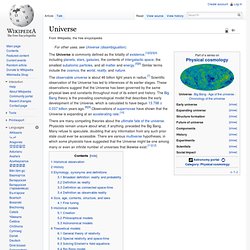
Physicists remain unsure about what, if anything, preceded the Big Bang. Many refuse to speculate, doubting that any information from any such prior state could ever be accessible. There are various multiverse hypotheses, in which some physicists have suggested that the Universe might be one among many or even an infinite number of universes that likewise exist.[11][12] Historical observation XDF size compared to the size of the Moon – several thousand galaxies, each consisting of billions of stars, are in this small view.
XDF (2012) view – each light speck is a galaxy – some of these are as old as 13.2 billion years[13] – the visible Universe is estimated to contain 200 billion galaxies. XDF image shows fully mature galaxies in the foreground plane – nearly mature galaxies from 5 to 9 billion years ago – protogalaxies, blazing with young stars, beyond 9 billion years. History Etymology, synonyms and definitions. Celestial Calendar at CalSky. Science Friday: Rockets, Planets, Stars & Bears…oh my. By Kayla Iacovino , Filed under: Science/Technology , trackback Welcome back to Science Friday!
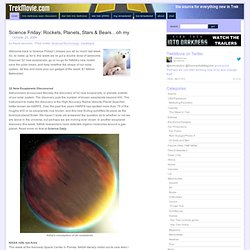
I missed you all so much last week. So, to make up for it, this week we’ve got a double dose of awesome. Discover 32 new exoplanets, go or no-go for NASA’s new rocket, save the polar bears, and help redefine the shape of our solar system. All this and more plus our gadget of the week: $1 Million Batmobile! 32 New Exoplanets Discovered Astronomers announced Monday the discovery of 32 new exoplanets, or planets outside of our solar system. Artist’s conception of an exoplanet. Space and NASA News – Universe and Deep Space Information. Science News. International Astronomical Union. Portal. Space Science. Windows to the Universe.
Space Wallpapers. Outer Space. Science of the Universe. Extra-Terrestrial Life. Dimensions. Space Simulations and Sky Charts. Quadrants of the Celestial Sphere (Constellations) Supergalactic Coordinate System. Galaxies. General Planetary Features. Stars. Big Bang. Early Universe. Universe Documentaries. Unified Fiel Theory. Astro-E2 mission. Home. Missions. Science and Space Facts, Science and Space, Human Body, Health, Earth, Human Disease - National Geographic. Space news and outer space articles from New Scientist - New Scientist Space. Cookies on the New Scientist website close Our website uses cookies, which are small text files that are widely used in order to make websites work more effectively.
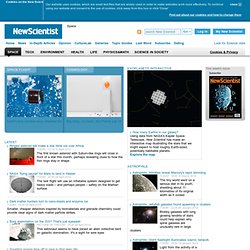
To continue using our website and consent to the use of cookies, click away from this box or click 'Close' Find out about our cookies and how to change them Space Log in Your login is case sensitive I have forgotten my password close My New Scientist Look for Science Jobs Earth's love handles keep satellites from falling Big bang, no boom: Did Planck pop inflation bubble? Ringed asteroid will make a star blink out over Africa TODAY: 12:19 10 April 2014 The first known asteroid with Saturn-like rings will cross in front of a star this month, perhaps revealing clues to how the thin rings stay in shape NASA 'flying saucer' for Mars to land in Hawaii TODAY: 20:46 09 April 2014 The test flight will use an inflatable system designed to get heavy loads – and perhaps people – safely on the Martian surface TODAY: 19:30 09 April 2014 Where am I?
Space, Outer Space Information, Universe Facts, News, Photos. Tdarnell's Channel. Through the Wormhole: Is There an Edge to the Universe? It is commonly theorized that the universe began with the Big Bang 13.7 billion years ago.
But since we can only see as far as light has traveled in that time, we can't actually make out the edge of the universe. Could it be that the universe is infinite? Is there any way to find out what the shape of the universe really is? Science News. An Atlas of The Universe. Missions. Missions The National Aeronautics and Space Act of 1958 (Space Act) established NASA as an aerospace research and development agency that sponsors and conducts flight missions to obtain data in furtherance of its objectives.
In NASA's Science Mission Directorate (SMD), flight missions range from suborbital projects—including balloons, sounding rockets, and airplanes—to interplanetary probes and flagship observatories. All investigations and missions selected and flown must respond to Agency goals and strategic objectives. Mission opportunities are open to all proposers, within fixed rules, via public announcement, and selections are based primarily on scientific and technical merit as evaluated by independent peer review. Foreign partners are frequent and valued participants in joint missions.
This page provides access to all SMD missions, with several options for viewing. *Sort missions by clicking the column headers. Through the Wormhole: How Does the Universe Work? With the help of massive machines called particle accelerators, scientists studied the subatomic realm and made discoveries about the forces that operate at that level.

But the search for a comprehensive explanation still continues. In particular, physicists have sought to find a way to reconcile Einstein's model of space-time, which seems to work best when applied to big objects like stars and galaxies, and the theory of quantum mechanics, which offers an explanation of electromagnetic and nuclear forces that makes sense of reality at the tiniest level. In recent years, some have proposed a novel solution called string theory, in which tiny particles are loops that vibrate like violin strings in a multidimensional space.
NASA Science. Exploring the Universe. Better Living Through Astronomy. Zooniverse - Home. Telescopes Help Discover Surprisingly Young Galaxy. NASA Telescopes Help Discover Surprisingly Young Galaxy PASADENA, Calif. -- Astronomers have uncovered one of the youngest galaxies in the distant universe, with stars that formed 13.5 billion years ago, a mere 200 million years after the Big Bang.
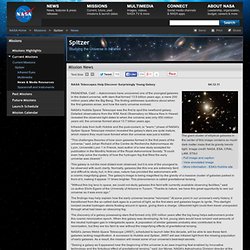
The finding addresses questions about when the first galaxies arose, and how the early universe evolved. NASA's Hubble Space Telescope was the first to spot the newfound galaxy. Detailed observations from the W.M. Keck Observatory on Mauna Kea in Hawaii revealed the observed light dates to when the universe was only 950 million years old; the universe formed about 13.7 billion years ago. WISE Delivers Millions of Galaxies, Stars, Asteroids.
Home.