
Heinrich Hertz: The Discovery of Radio Waves. The Discovery of Electromagnetic Radiation The most dramatic prediction of Maxwell's theory of electromagnetism, published in 1865, was the existence of electromagnetic waves moving at the speed of light, and the conclusion that light itself was just such a wave. This challenged experimentalists to generate and detect electromagnetic radiation using some form of electrical apparatus. The first clearly successful attempt was made by Heinrich Hertz in 1886. For his radio wave transmitter he used a high voltage induction coil, a condenser (capacitor, Leyden jar) and a spark gap - whose poles on either side are formed by spheres of 2 cm radius - to cause a spark discharge between the spark gap’s poles oscillating at a frequency determined by the values of the capacitor and the induction coil.
This first radio waves transmitter is basically, what we call today, an LC oscillator. To prove there really was radiation emitted, it had to be detected. Repeat Hertz’s Experiments Resources. Electromagnetic waves. At this point in the course we'll move into optics.

This might seem like a separate topic from electricity and magnetism, but optics is really a sub-topic of electricity and magnetism. This is because optics deals with the behavior of light, and light is one example of an electromagnetic wave. Light and other electromagnetic waves Light is not the only example of an electromagnetic wave.
Other electromagnetic waves include the microwaves you use to heat up leftovers for dinner, and the radio waves that are broadcast from radio stations. Speed of light in vacuum: c = 3.00 x 10⁸ m/s As we'll go into later in the course when we get to relativity, c is the ultimate speed limit in the universe. Circuit Simulator Applet. This is an electronic circuit simulator.
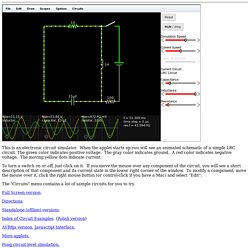
When the applet starts up you will see an animated schematic of a simple LRC circuit. The green color indicates positive voltage. The gray color indicates ground. A red color indicates negative voltage. The moving yellow dots indicate current. Contents. Members.iinet.net.au/~pterren/Can. Eddy current brake. An eddy current brake of a German ICE 3 in action.
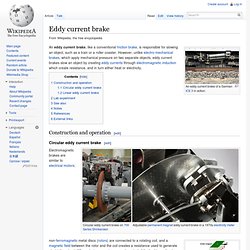
An eddy current brake, like a conventional friction brake, is responsible for slowing an object, such as a train or a roller coaster. However, unlike electro-mechanical brakes, which apply mechanical pressure on two separate objects, eddy current brakes slow an object by creating eddy currents through electromagnetic induction which create resistance, and in turn either heat or electricity. Construction and operation[edit] Circular eddy current brake[edit] Principle of the linear eddy current brake Japanese Shinkansen trains had employed circular eddy current brake system on trailer cars since 100 Series Shinkansen. Linear eddy current brake[edit] Transformers. In the photograph, note that the coil on the left has fewer coils than that at right (the insets show close-ups).
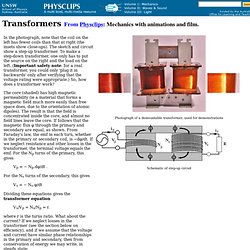
The sketch and circuit show a step-up transformer. To make a step-down transformer, one only has to put the source on the right and the load on the left. (Important safety note: for a real transformer, you could only 'plug it in backwards' only after verifying that the voltage rating were appropriate.) So, how does s transformer work? The core (shaded) has high magnetic permeability (ie a material that forms a magnetic field much more easily than free space does, due to the orientation of atomic dipoles). Vp = − Np.dφ/dt . VpIp = VsIs, whence Is/Ip = Np/Ns = 1/r. So you don't get something for nothing: if you increase the voltage, you decrease the current by at least the same factor.
CHEMISTRY & PHYSICS. Electronics Demonstrations. Virtual Library: CAD. CAD software is commonly used for drafting architectural and engineering drawings and for making technical illustrations of any kind.

If you are a professional associated with design or drafting or would just like to widen your knowledge about CAD applications, then you will find this section of informative and useful. CAD enables you to prepare fast and accurate drawings. It provides flexibility to change drawings with minimal effort. In recent years, many professionals have switched to CAD to enjoy the benefits of this precise and creative tool. Today, many educational institutions include CAD as part of their academic curriculum. Red, Blue, Green Laser Pointer and Torch Flashlight - Wicked Las. Electricity and Magnetism. Articles on "Electricity" Why three prongs?
Why do wall outlets have three holes? "Grounding" and safety. Right Angle CircuitryDo Lenz' Law and the Right Hand rule still work... after you've been turned INSIDE OUT by that greasy black Fog? "Static Electric" misconceptionsA list of things which gave me a warped view of Electrostatics. Once I recognized their existence, I was able to fight free of them. Speed of "Electricity"? Triboelectric Series If a cat gets trapped in a clothes dryer full of nylon pantyhose, which way do the electrons flow? Where does EM energy flow in a circuit? How Scientists Define the word "Electricity" Quotes from J.C.
Barriers to Understanding ElectricityTwenty misconceptions which prevented me from understanding simple electrical science as a student. "Static" Electricity is really just high voltage.Scuff on the rug, then measure your body voltage. Electricity mistakes and 'nitpicking' also How SHOULD we teach Electricity? The Electricity MapHow are batteries different than static cling?