
Japan’s reactor restarts plot uneven course. The Japanese government wants to accelerate restart of the two dozen reactors it expects regulators to deem safe.
Local opposition related to the nation’s largest power station is a stumbling block. Five of seven older units are likely to be decommissioned once financial arrangements are worked out between utilities and the government. Supreme Court of Japan rules against welfare for foreigners. Author: Trevor Ryan, University of Canberra Last month, the Supreme Court of Japan ruled that persons without Japanese nationality (that is foreigners) have no legal claim to benefits under the Public Assistance Act.
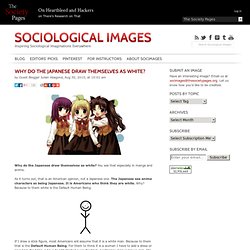
The case is an affront to the second and third generations of ethnic Chinese and Koreans in Japan who have chosen for practical and identity reasons not to renounce their nationality and naturalise as Japanese. For these and other tax-paying permanent residents, the case simply affirms the legality of a discriminatory statute. But, while it is a ‘stunning’ decision for some, a few points about the decision should be clarified. Why Do the Japanese Draw Themselves as White? By Guest Blogger Julian Abagond, Aug 30, 2010, at 10:01 am.
Ambassades contre dollars. Army Suspends Commander in Japan. Japanese Prime Minister Abe’s U-turn on the Murayama Statement. Author: Karl Gustafsson, Lund University On Wednesday 15 May, Japanese Prime Minister Shinzo Abe, who had earlier suggested that his Cabinet did not necessarily support the Murayama Statement of apology for Japan’s actions in World War II, clearly stated support for it: ‘My administration upholds the statement as a whole’.
Why did Abe do such an about-face? The Murayama Statement, issued by Japanese Prime Minister Tomiichi Murayama on 15 August 1995, was a clear apology to the victims of Japanese aggression in the war. σ1. Kazuyoshi Onishi (kazuyoshionishi) sur Twitter. Les chiens japonais ne mangeront plus de croquettes à la baleine. Manifestement soucieux d'éviter les polémiques, le spécialiste japonais de l'alimentation pour animaux domestiques Michinoku Farm a stoppé, mercredi 29 mai, la vente de produits pour chiens élaborés à partir de rorqual commun, une espèce menacée.
La commercialisation de ces produits à 3 780 yens (28,7 euros) les 500 g avait été dénoncée, la veille par l'ONG, japonaise Ikan. Japan's nuclear regulator to suspend Monju reactor - IPFM Blog - Pale Moon. Jusqu’où ira l’expérience japonaise? Les économistes se plaignent souvent de la difficulté qu'ils rencontrent à tester leurs théories, faute de pouvoir faire des expérimentations comme cela se pratique dans d'autres sciences.

Tester des théories économiques sur des populations entières, outre les questions éthiques que cela poserait, n'est pas très commode. Heureusement, de temps en temps, les électeurs votent pour un gouvernement prêt à se livrer à de telles expériences; c'est ce qui est en train de se passer au Japon, ou le premier ministre récemment élu Shinzo Abe, se lance dans un projet radical pour relancer l'économie japonaise.
Japon: simulation d'une attaque terroriste contre Fukushima - Japon. La police, l'armée et les gardes-côtes japonais effectuent depuis ce samedi 11 mai des exercices sans précédent, simulant une attaque terroriste contre la centrale accidentée de Fukushima.
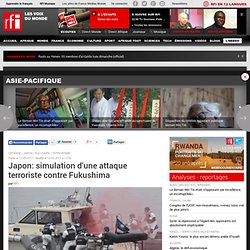
Ces manœuvres sur terre et mer ont lieu aux abords des deux complexes nucléaires de Fukushima. Avec notre correspondant à Tokyo, Frédéric Charles. Philippines - Japan relations. Japanese Schoolgirls Perform Superhuman Energy Attacks. Live Japon : l'amicale des anciens en ligne. Faraway stories that don’t make the paper. Le Japon achète des F-35. Un choix militaire ? industriel ? financier ? Non, politique ! The Japan Analyst - Blog community about Japan and Japanese culture. Japan Quake Map. Le Japon avait secrètement autorisé l'entrée d'armes nucléaires. Hiroko Tabuchi (HirokoTabuchi) Japan: Prepared and resilient. Japan and the future of nuclear power. Japan's post-earthquake nuclear problems have escalated, with major accidents at two or more nuclear reactors, which are the most serious since the Three Mile Island meltdown in 1979 and the Chernobyl accident in 1986.
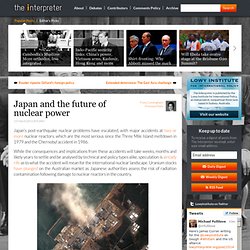
While the consequences and implications from these accidents will take weeks, months and likely years to settle and be analysed by technical and policy types alike, speculation is already rife as to what the accident will mean for the international nuclear landscape. Uranium stocks have plunged on the Australian market as Japanese authorities assess the risk of radiation contamination following damage to nuclear reactors in the country.
Some have suggested that the accident spells the end of the so-called 'nuclear renaissance', an increase in the uptake of nuclear energy surpassing its heyday in the 1980s, forecast on the basis of the large number of governments currently interested in nuclear power programs for the first time. Japan’s earthquake and its economic impact. Author: Peter Drysdale The economic aftershocks of the earthquake and tsunami which struck Japan on Friday are only slightly less difficult to fathom than the scale of the human tragedy and physical devastation.
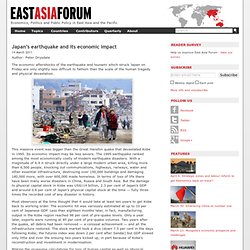
This massive event was bigger than the Great Hanshin quake that devastated Kobe in 1995. Its economic impact may be less severe. The 1995 earthquake ranked among the most economically costly of modern earthquake disasters. Don’t donate money to Japan. Individuals are doing it, banks are doing it — faced with the horrific news and pictures from Japan, everybody wants to do something, and the obvious thing to do is to donate money to some relief fund or other.
Please don’t. We went through this after the Haiti earthquake, and all of the arguments which applied there apply to Japan as well. Earmarking funds is a really good way of hobbling relief organizations and ensuring that they have to leave large piles of money unspent in one place while facing urgent needs in other places. And as Matthew Bishop and Michael Green said last year, we are all better at responding to human suffering caused by dramatic, telegenic emergencies than to the much greater loss of life from ongoing hunger, disease and conflict. Japanese politician defends use of sex slaves. Updated Tue 14 May 2013, 7:56am AEST One of Japan's rising political stars has sparked controversy by saying the use of wartime sex slaves was necessary for brave soldiers risking their lives.
It is believed thousands of women were forced to serve as Japanese army "comfort women" during World War II. Around three quarters of comfort women died, while many survivors were left scarred and infertile. Speaking to reporters, Osaka mayor Toru Hashimoto said Japan needed to reflect on and apologise for the massive pain it inflicted during the war.