
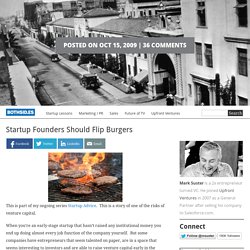
The 10 Lies and Misconceptions that Web Entrepreneurs tell. Startups 101: The Complete Mint Presentation. Popular Posts - @altgate. Startup Founders Should Flip Burgers. This is part of my ongoing series Startup Advice.
This is a story of one of the risks of venture capital. When you’re an early-stage startup that hasn’t raised any institutional money you end up doing almost every job function of the company yourself. But some companies have entrepreneurs that seem talented on paper, are in a space that seems interesting to investors and are able to raise venture capital early in the company’s existence. This can often happen when there is a good product built but no real customer adoption yet. This is what happened to me. When I founded my first company along with Brian Moran (whose idea it was) I had no real experience running startups. My company had raised a seed round of capital in late 1999 even before either of us were full time in the company (ominous side note: on the way to pitch our seed investor, Delta Partners, a man walking right in front of me died of a massive heart attack making me late to the meeting.
Founder Institute On Track To Graduate 300 Startups Per Year, Ex. A Compilation of the Web's Best Advice for Entrepreneurs. @venturehacks' (Venture Hacks) most favourited tweets. The Tech Terms Computer Dictionary. Organic Startup Ideas. April 2010 The best way to come up with startup ideas is to ask yourself the question: what do you wish someone would make for you?
There are two types of startup ideas: those that grow organically out of your own life, and those that you decide, from afar, are going to be necessary to some class of users other than you. Apple was the first type. Apple happened because Steve Wozniak wanted a computer. Unlike most people who wanted computers, he could design one, so he did. Our own startup, Viaweb, was of the second type. There is no sharp line between the two types of ideas, but the most successful startups seem to be closer to the Apple type than the Viaweb type. Organic ideas are generally preferable to the made up kind, but particularly so when the founders are young. Facing Heat From Facebook’s Like Button, Glue Ramps Up Social Re. Facebook’s new Like button was announced last week, which allows users to “Like” any piece of content on an outside site with one click.
Those likes are then transported back to Facebook and integrated into users’ profiles. This feature is expected to create a vast Facebook-centric recommendation network that transcends the social network, with CEO Mark Zuckerberg estimating over 1 billion likes on the first day of its launch. And it poses a serious threat to existing social recommendation services.
One of these is Glue, a social browsing assistant that shows ratings and recommendations of movies, books, restaurants, stocks, and other things as you surf the Web (via a browser plug-in). Today, Glue is launching new personalization features that use your past likes to help you pick your next favorite movie, album or book. Via its toolbar, Glue is also beginning to provide additional context to recommendations as you surf the web. Andrew Payne: Startup Equity For Employees. The re-heating of the venture funded tech market has pushed a heat up of the hiring market, and I'm getting more calls from friends asking for help understanding startup stock (equity) offers.
More than one friend has suggested writing the advice down, so here it is. If you're a founder or near-founder, your equity terms are likely defined by the funding terms negotiated with the investors. For a very good summary of investor terms, see Brad Feld's writeups on term sheet terms and Brad's book "Venture Deals" (2nd edition, Dec 2012). I've read many books on startup funding, and "Venture Deals" is a must-read. Even if you're not the one raising money, it gives a great backdrop on what's going on. Important disclaimer: I've got experience negotiating stock compensation packages from both sides of the table. Let's start with the basics: a share of stock represents fractional ownership in a company. The preference amount is usually (but not always) the amount invested. References.