background preloader

Science

Facebook Twitter

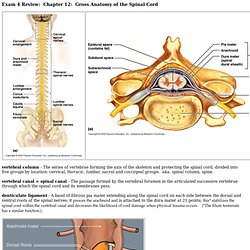
MIT Computer Science and Artificial Intelligence Laboratory | MIT CSAIL. CH 12 Gross Anatomy of the Spinal Cord. Exam 4 Review: Chapter 12: Gross Anatomy of the Spinal Cord vertebral column - The series of vertebrae forming the axis of the skeleton and protecting the spinal cord; divided into five groups by location: cervical, thoracic, lumbar, sacral and coccygeal groups. aka. spinal column, spine. vertebral canal = spinal canal - The passage formed by the vertebral foramen in the articulated successive vertebrae through which the spinal cord and its membranes pass. denticulate ligament - A band of fibrous pia mater extending along the spinal cord on each side between the dorsal and ventral roots of the spinal nerves; it pierces the arachnoid and is attached to the dura mater at 21 points; this* stabilizes the spinal cord within the vertebral canal and decreases the likelihood of cord damage when physical trauma occurs.

(*The filum terminale has a similar function.). List 11. 12. the protective coverings of the spinal cord from deep to superficial. Sketch and label 3. 4. 5. Virtue Ethics  Virtue ethics is a broad term for theories that emphasize the role of character and virtue in moral philosophy rather than either doing one’s duty or acting in order to bring about good consequences. A virtue ethicist is likely to give you this kind of moral advice: “Act as a virtuous person would act in your situation.”
Most virtue ethics theories take their inspiration from Aristotle who declared that a virtuous person is someone who has ideal character traits. These traits derive from natural internal tendencies, but need to be nurtured; however, once established, they will become stable. For example, a virtuous person is someone who is kind across many situations over a lifetime because that is her character and not because she wants to maximize utility or gain favors or simply do her duty.

Unlike deontological and consequentialist theories, theories of virtue ethics do not aim primarily to identify universal principles that can be applied in any moral situation. Table of Contents. Geneticists Create 'Bi-Fi'—The Biological Internet. What's the Latest Development? By engineering a parasitical virus, geneticists have taken the first steps toward creating a biological internet in which the body's processes can be improved by controlling the natural communication abilities of cells.
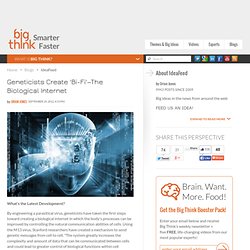
Using the M13 virus, Stanford researchers have created a mechanism to send genetic messages from cell to cell. "The system greatly increases the complexity and amount of data that can be communicated between cells and could lead to greater control of biological functions within cell communities. " What's the Big Idea? When the Internet was invented in the 1970s, hardly anyone knew what it might become. Photo credit: Shutterstock.com. SCIENCE! 101. Making Sense of Uncertainty · Resources. Why uncertainty is part of science The guide has brought together researchers working in some of the most significant, cutting edge fields.
They told us that if policy makers and the public are discouraged by the existence of uncertainty, we miss out on important discussions about the development of new drugs, taking action to mitigate the impact of natural hazards, how to respond to the changing climate and to pandemic threats. The guide discusses: The way scientists use uncertainty to express how confident they are about results.That uncertainty can be abused to undermine evidence or to suggest anything could be true: from alternative cancer treatments to anthropogenic CO2 not changing the atmosphere.Why uncertainty is not a barrier to taking action – decision makers usually look for a higher level of certainty for an operational decision (such as introducing body scanners in airports) than for a decision based on broader ideology or politics (such as reducing crime rates). Downloads. Making Sense of Uncertainty · Resources. THE WORLD QUESTION CENTER 2011— Page 14.

HAZEL ROSE MARKUS & ALANA CONNER Hazel Rose Markus is the Davis-Brack Professor of Behavioral Sciences at Stanford University. Co-author of Doing Race: 21 essays for the 21st century - Alana Conner is a science writer, cultural psychologist, and museum curator, The Tech Museum, San Jose, Calif. The Culture Cycle Pundits now invoke culture to explain all manner of tragedies and triumphs, from why a disturbed young man opens fire on a politician, to why African-American children struggle in school, to why the United States can't establish democracy in Iraq, to why Asian factories build better cars.
A quick click through a single morning's media, for example, yields the following catch: gun culture, Twitter culture, ethical culture, Arizona culture, always-on culture, winner-take-all culture, culture of violence, culture of fear, culture of sustainability, culture of corporate greed. Yet no one explains what, exactly, culture is, how it works, or how to change it for the better. Eric Weinstein may have found the answer to physics' biggest problems | Marcus du Sautoy | Science. Two years ago, a mathematician and physicist whom I've known for more than 20 years arranged to meet me in a bar in New York. What he was about to show me, he explained, were ideas that he'd been working on for the past two decades.
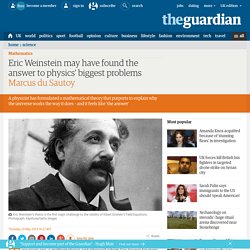
As he took me through the equations he had been formulating I began to see emerging before my eyes potential answers for many of the major problems in physics. It was an extremely exciting, daring proposal, but also mathematically so natural that one could not but feel that it smelled right. He has spent the past two years taking me through the ins and outs of his theory and that initial feeling that I was looking at "the answer" has not waned.

One of the things that particularly appeals to me about the theory is that symmetry, my own field of research, is a key ingredient. The particles described by the Standard Model – the stuff of nature that is revealed in accelerators such as the Large Hadron Collider – fall into three "generations". Science Communication at a Tipping Point | SpotOn. On April 30, COMPASS published a paper at PLOS Biology that shared our experiences in science communication over the past decade. We organized a blog carnival to broaden the conversation about motivations, challenges, and lessons learned. This post is a reflection on public and private responses to the ideas we presented, and an attempt to answer, “Where do we go from here?” I will never forget watching Jon Foley emphatically interrupt a discussion among young faculty with, “Your job is NOT to get tenure!
Your job is to change the world.” Yet things are changing. Science communication is at a tipping point. We support each other. In contrast to what @Dreadnought1906 said, I believe individuals do have the power to change systems. For example, think about how seriously engaging in science communication remains a challenge for so many scientists. Some of these can be addressed directly. To be clear, I am not arguing for unconditional cheerleading. 1) Thinking of celebrity as a solution. Wellcome Trust websites.

Evolution intelligence

Physicist Proposes New Way To Think About Intelligence. (ISNS) -- A single equation grounded in basic physics principles could describe intelligence and stimulate new insights in fields as diverse as finance and robotics, according to new research. Alexander Wissner-Gross, a physicist at Harvard University and the Massachusetts Institute of Technology, and Cameron Freer, a mathematician at the University of Hawaii at Manoa, developed an equation that they say describes many intelligent or cognitive behaviors, such as upright walking and tool use.
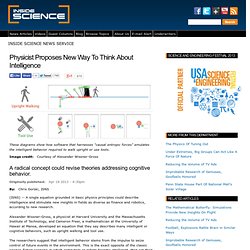
The researchers suggest that intelligent behavior stems from the impulse to seize control of future events in the environment. This is the exact opposite of the classic science-fiction scenario in which computers or robots become intelligent, then set their sights on taking over the world. "It's a provocative paper," said Simon DeDeo, a research fellow at the Santa Fe Institute, who studies biological and social systems. "It's not science as usual. "

Buddhism &

Science Blogging – a river. ScienceSeeker | Science News Aggregator. ScienceOnline. Untitled. News & Video: The Innovation Debate 2012. Singularity Hub | The Future Is Here Today…Robotics, Genetics, AI, Longevity, The Brain… Humanizing Technology Prize: The Nominees (Human Relationships) | Special Series. As We May Think: A 1945 Essay on Information Overload, "Curation," and Open-Access Science. By Maria Popova “There is a new profession of trail blazers, those who find delight in the task of establishing useful trails through the enormous mass of the common record.” Tim O’Reilly recently admonished that unless we embrace open access over copyright, we’ll never get science policy right. The sentiment, which I believe applies to more than science, reminded me of an eloquent 1945 essay by Vannevar Bush, then-director of the Office of Scientific Research and Development, titled “As We May Think.”

As the war, with its exploitation of science and technology, draws to a close, Bush turns a partly concerned, partly hopeful eye to where scientists will rediscover “objectives worthy of their best” and calls for “a new relationship between thinking man and the sum of our knowledge.” Professionally our methods of transmitting and reviewing the results of research are generations old and by now are totally inadequate for their purpose.

Assume a linear ratio of 100 for future use. The memex. Isaac Asimov on Creativity in Education & The Future of Science. (3) Can rare scientific... Jason Silva, Neil deGrasse Tyson and Melissa Sterry on Startalk Radio. Reciprocal Space | Occam's Typewriter. The internet was all aflutter last week because Elsevier has sent thousands of take-down notices to Academia.edu, a social networking site where many researchers post and share their published papers. This marks a significant change of tack for Elsevier. Previously the publisher had only been sending a handful of DMCAs a week to Academia.edu (the notices are named after the US Digital Millennium Copyright Act), but now it appears they have decided to get tough.
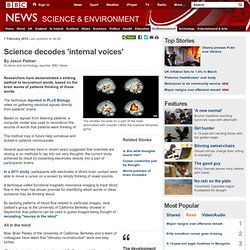
There was the predictable outrage at the manoeuvre though, as several commentators acknowledged, Elsevier is acting entirely legally. It is simply enforcing rights that were handed to it — for no compensation — by the authors who have now been affected by the takedown demands. The company is behaving rationally. The problem, and it is a fundamental one for legacy publishers as a whole, is that what seems reasonable in this market is changing. There is a sense that the company knows the ground is shifting beneath its feet. Science Museum, London. Science is Vital » Science Careers. Science decodes 'internal voices' 1 February 2012Last updated at 04:29 By Jason Palmer Science and technology reporter, BBC News The studies focused on a part of the brain associated with sounds called the superior temporal gyrus Researchers have demonstrated a striking method to reconstruct words, based on the brain waves of patients thinking of those words.

The technique reported in PLoS Biology relies on gathering electrical signals directly from patients' brains. Based on signals from listening patients, a computer model was used to reconstruct the sounds of words that patients were thinking of. The method may in future help comatose and locked-in patients communicate. Several approaches have in recent years suggested that scientists are closing in on methods to tap into our very thoughts; the current study achieved its result by implanting electrodes directly into a part of participants' brains. All in the mind Continue reading the main story “Start Quote End QuoteMindy McCumberFlorida Hospital. Colliding Particles - A series of films following research in particle physics at the LHC.

Animal Intelligence!

Brain. DNA-Gene-Omics-Netics. Other. Photobiology. Psychology. Seed-newScientific Thinking!@# Technology. Scale of Universe - Interactive Scale of the Universe Tool. Powers of Ten™ (1977) (65) Facebook. TO UNDERSTAND IS TO PERCEIVE PATTERNS. Universe Grows Like A Brain | Social Networks. The universe may grow like a giant brain, according to a new computer simulation. The results, published Nov.16 in the journal Nature's Scientific Reports, suggest that some undiscovered, fundamental laws may govern the growth of systems large and small, from the electrical firing between brain cells and growth of social networks to the expansion of galaxies.

"Natural growth dynamics are the same for different real networks, like the Internet or the brain or social networks," said study co-author Dmitri Krioukov, a physicist at the University of California San Diego. The new study suggests a single fundamental law of nature may govern these networks, said physicist Kevin Bassler of the University of Houston, who was not involved in the study. [What's That? Your Physics Questions Answered] "At first blush they seem to be quite different systems, the question is, is there some kind of controlling laws can describe them? " Similar Networks Brain cells and galaxies. VISTA gigapixel mosaic of the central parts of the Milky Way. Last Week At Science-Based Medicine. Here is a recap of the stories that appeared last week at Science-Based Medicine, a multi-author skeptical blog that separates the science from the woo in medicine. NIH funds training in behavioral intervention to slow progression of cancer by improving the immune system (James Coyne) The NIH is funding training in psychoneuroimmunological interventions for cancer, questionable treatments based on flawed studies.

This highlights the pseudoscience and heavy-handed politics in this field. There is no credible evidence that any psychosocial intervention reduces risk of cancer recurrence or improves survival. Andrew Weil/AAFP Article Rejected by Slate (Harriet Hall) Slate magazine asked Dr. CAM and Creationism: Separated at Birth? Trackback(0) A visual exploration on mapping complex networks.

Sam Harris: Science can answer moral questions. Critical Thinking mini-lessons. Topical index: critical thinking. From Abracadabra to Zombies | View All critical thinking The goal of critical thinking is to arrive at the most reasonable beliefs and take the most reasonable actions. We have evolved, however, not to seek the truth, but to survive and reproduce. Critical thinking is an unnatural act. By nature, we're driven to confirm and defend our current beliefs, even to the point of irrationality. The items below are listed in alphabetical order. 1) several essays I've written on the difficulty of changing minds: Belief Armor, Evaluating Personal Experience, Why Do People Believe in the Palpably Untrue? 2) the following entries: confirmation bias, cognitive dissonance, communal reinforcement, motivated reasoning, backfire effect, memory, and perception deception.

Resources. CSI collects resources of interest to skeptics from around the web. If you maintain a website or know of one we've missed, feel free to contact us! CSI Fellows Stephen Barrett M.D., psychiatrist, author, consumer advocate, Allentown, Pa. Andrew Fraknoi Astronomer, Foothill College, Los Altos Hills, Calif. Henri Broch Physicist, Univ. of Nice, France Paul Kurtz Chairman of CSI, Professor Emeritus of Philosophy, State University of New York at Buffalo. Elizabeth Loftus Professor of Psychology, Univ. of Washington. John Paulos Mathematician, author, Temple University. Massimo Polidoro Science writer, author, executive director CICAP, Italy. Richard Dawkins Ethologist and evolutionary biologist, Oxford University Robert Sheaffer Science writer.

Richard Wiseman Public Understanding of Psychology. Astrology and Astronomy Astrology & Science Articles covering scientific, historical and philosophical issues, and the results of scientific research. Bad Astronomy Corrects misinformation about astronomy. Creationism UFOs. The Skeptics Society & Skeptic magazine.