
Newzie, Your feature-rich news aggregator -2. IxodoiShop: ipad cases: Zazzle.com Store. Ordenar: ¡Gracias!

No vamos a mostrar este producto otra vez! Deshacer. IxodoiShop: iphone cases: Zazzle.com Store. eBooks. Grosses collections. All Things D Is Haunted by the Man Who Isn't Here. Steve Jobs in 2007//Photo Credit: Acaben/Flickr RANCHO PALOS VERDES, California — This year, as with the last 10, several hundred top digerati have flocked to Southern California for the All Things D tech conference.
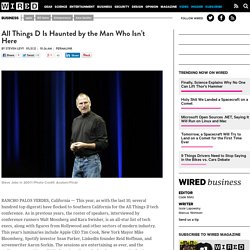
As in previous years, the roster of speakers, interviewed by conference runners Walt Mossberg and Kara Swisher, is an all-star list of tech execs, along with figures from Hollywood and other sectors of modern industry. This year’s luminaries include Apple CEO Tim Cook, New York Mayor Mike Bloomberg, Spotify investor Sean Parker, LinkedIn founder Reid Hoffman, and screenwriter Aaron Sorkin. The sessions are entertaining as ever, and the audience networking reliably ferocious. But a shadow hangs over the festive intentions of a well-deserved 10th anniversary celebration. It’s the first D Conference since Steve Jobs died last October.
Pearltrees videos. Magazines. EBOOKS FR. Steve Jobs dies; Apple's co-founder transformed computers and culture. Steven P.
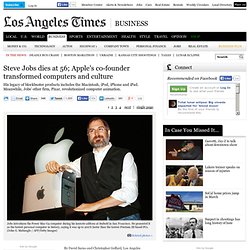
Jobs, the charismatic technology pioneer who co-founded and transformed one industry after another, from computers and smartphones to music and movies, has died. He was 56. Free Software. Free Software. Free Software. IxodoiShop: IPhone & IPod Accessories: Zazzle.com Store. Digital Flowers pattern iPhone 5 Cases. 美國是如何失去了製造iPhone的工作? D10 Video: Jobs Was an Awesome Flip-Flopper. All about Steve Jobs.com. Into The Wild: Lost Conversations From Steve Jobs' Best Years. All illustrations drawn on iPad by Jorge Colombo If Steve Jobs's life were staged as an opera, it would be a tragedy in three acts.
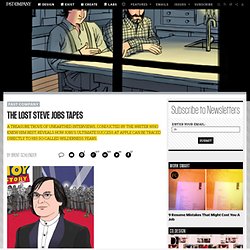
And the titles would go something like this: Act I--The Founding of Apple Computer and the Invention of the PC Industry; Act II--The Wilderness Years; and Act III--A Triumphant Return and Tragic Demise. The first act would be a piquant comedy about the brashness of genius and the audacity of youth, abruptly turning ominous when our young hero is cast out of his own kingdom. The closing act would plumb the profound irony of a balding and domesticated high-tech rock star coming back to transform Apple far beyond even his own lofty expectations, only to fall mortally ill and then slowly, excruciatingly wither away, even as his original creation miraculously bulks up into the biggest digital dynamo of them all. Both acts are picaresque tales that end with a surge of deep pathos worthy of Shakespeare.
Early videos of Steve Jobs. I’ve been tweeting instead of blogging for the past three months and it’s time for this to end.

Let me start with a number of videos you may or may not have seen featuring Steve Jobs. Macworld 1997 The first of these videos is the keynote of Macworld 1997. Now remember, Steve Jobs came back to Apple in December 1996 as an “informal advisor” to the then-CEO Gil Amelio. He only became CEO in July of that year, after the disappointing results of Q2’97 were revealed — a loss of over $50 million — and Amelio’s failure became evident. However, the rest of the show is very enlightening as a picture of how bad a state Apple was in back in 1997.
At the end of the keynote, Amelio tried to do a PR trick by having Steve Wozniak show up. Here is an embedded version of the video. Amazon: "Steve Jobs" may be company's top-selling book of 2011. By Jeremy C.

Owens jowens@mercurynews.com Posted: 10/24/2011 11:08:58 AM PDT# Comments|Updated: 3 years ago Amazon suspects that "Steve Jobs," the authorized biography of the late Apple (AAPL) co-founder written by Walter Isaacson, could be its top-selling book of the year, the online retailer said in a statement Monday. Isaacson's book officially hit bookshelves Monday, but pre-orders pushed it to No. 1 on Amazon's best-sellers list soon after Jobs' death on Oct. 5. "The way things are trending, it could very likely be our top-selling book of the year," Amazon spokeswoman Brittany Turner said in a statement, according to Reuters.The biography was the top-selling physical book and Kindle eBook on Amazon's site Monday. Steve Jobs bio debuts at No. 1 spot on bestseller lists. News October 24, 2011 01:54 PM ET Computerworld - The biography of Apple co-founder and former CEO Steve Jobs debuted today at the top of both Amazon's and Barnes & Nobles' bestseller lists.
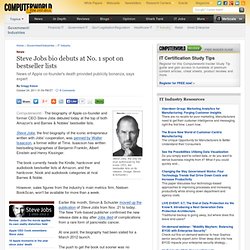
Steve Jobs, the first biography of the iconic entrepreneur written with Jobs' cooperation, was penned by Walter Isaacson, a former editor at Time. Review round-up: Is Steve Jobs' biography accurate? Designing the Jobs' Kitchen. Reader Bertrand Hayotte pointed out to me a story by kitchen designer Johnny Grey about how “Steve Jobs and his wife Laurene almost had one of [his] kitchens.”

The story gives an insight into the “private Steve Jobs” with details of his taste for a simple and authentic design for his kitchen. Grey only worked on the design part, going even as far as showing the drawing he made for the Jobses: It is not known whether his design was implemented, since Steve Jobs apparently “was a very private person and reluctant to have any building work done, powerfully disliking noise, mess and invasion of their home”. Although I did know that Steve worked very hard on his kitchen and on his garden design, it is the first time that such details come out. The story also reinforces the idea that he applied the same beliefs in all aspects of his life, from product design to kitchen decoration: Steve, Myself, And i-: The Big Story Of A Little Prefix. Hide caption.
Did Steve Jobs' flirtation with alternative medicine kill him? (update) A couple of weeks ago, in the immediate aftermath of Steve Jobs’ death, I took issue with the claims of a skeptic that “alternative medicine killed Steve Jobs.”
At the time, I pointed out that, although it was very clear that Steve Jobs did himself no favors by delaying his initial surgery for nine months after his initial diagnosis, we do not have sufficient information to know what his clinical situation was and therefore how much, if at all, he decreased his odds of survival by not undergoing surgery expeditiously. To recap: Did Steve Jobs harm himself by trying diet and alternative medicine first? Quite possibly. Did alternative medicine kill him? As I’ve argued before, that’s impossible to say, and any skeptic who dogmatically makes such an argument has taken what we known beyond what can be supported.
"Just one more thing" I’ve written quite a bit about Steve Jobs’ battle with pancreatic cancer over the years and, more recently, in the wake of his death nearly four weeks ago. The reason, of course, is that the course of his cancer was of intense interest after it became public knowledge that he had cancer. In particular, what I most considered to be worth discussing was whether the nine month delay between Jobs’ diagnosis and his undergoing surgery for his pancreatic insulinoma might have been what did him in.
Steve Jobs tribute: the history of the life of Steve Jobs. IGN Steve Jobs Tribute. Mai474big.jpg (JPEG Image, 1000x666 pixels) - Scaled (96%) What Steve Jobs taught us about failure. College dropout. Fired tech executive. Unsuccessful businessman. Steve Jobs will always be best known for his incredible success in guiding Apple Inc. and transforming the entire consumer computer and phone industry. But he’ll also be remembered fondly as the poster child for how making mistakes — and even failing — can sometimes end up being the best thing that ever happens to you. Jobs passed away Wednesday after suffering for years from health problems, likely stemming from a battle with cancer.
His death came after he was forced to step down from his position as chief executive of Apple because of the ongoing health problems. By the time he turned the reins of the company over to his second in command, Tim Cook, Jobs had become one of the business world’s greatest comeback kids. The company he founded, was fired from, and then returned to has gone from also-ran to technology industry leader. Apple also is now one of the most valuable companies in America by market capitalization. Text of Steve Jobs' Commencement address (2005) Stanford Report, June 14, 2005 This is a prepared text of the Commencement address delivered by Steve Jobs, CEO of Apple Computer and of Pixar Animation Studios, on June 12, 2005.
Video of the Commencement address. I am honored to be with you today at your commencement from one of the finest universities in the world. I never graduated from college. Steve Jobs' 2005 Stanford Commencement Address. The Soul of Apple by Kevin Kelly. This week something unusual happened. At the very same time that tens of thousands of ordinary citizens were camping out in New York, Washington, and Seattle to protest corporate greed, and the capitalistic wealth of the very rich, a similar number of ordinary citizens were depositing flowers and spiritual offerings at the corporate stores of the wealthiest company in the world (with earnings larger than most countries), in memory of one of the richest people in the world, the late Steve Jobs. Why would a billionaire elicit such affection and love during this moment of fierce dissatisfaction with global capitalism?
Because Steve Jobs was a CEO of beauty. In his interviews and especially in private, Jobs often spoke about Art. Taste. Walter Isaacson's 'Steve Jobs' Tuesday, 14 February 2012 What is Apple at heart: a software company, or a hardware company? This is a perennial question. Celebrities, CEOs & a former president attended Steve Jobs memorial. By Sam Oliver A private memorial for Steve Jobs, held Sunday at Stanford Memorial Church, was attended by a long list of notable people, including politicians, actors, musicians and peers of the late Apple co-founder. Though Apple was "tight-lipped" about the hundreds of people who attended the event, Apple 2.0 obtained some of the names of those who attended. They include former U.S. President Bill Clinton, Google CEO Larry Page, and Adobe co-founders John Warnock and Chuck Geschke.
Also in attendance was former U.S. Bono, lead singer of the band U2, was there as well. Others present included actor Stephen Fry, Chicago Mayor Rahm Emmanuel, Oracle CEO Larry Ellison, former California first lady Maria Shriver, Microsoft Chairman Bill Gates, and singer Joan Baez. News of the memorial for Jobs was first revealed last week. Bill Gates among mourners at Steve Jobs memorial. Apple to Hold Memorial Service for Steve Jobs. Apple will hold a memorial service for Steve Jobs on Oct. 19 in an amphitheater at the company’s corporate headquarters, CEO Tim Cook told employees in a company-wide e-mail.
"Although many of our hearts are still heavy, we are planning a celebration of his life for Apple employees to take time to remember the incredible things Steve achieved in his life and the many ways he made our world a better place," Cook told employees in the e-mail, which was obtained by various news organizations. California, tech, TV pay tribute to Steve Jobs. Bill Gates on Steve Jobs, Who Died Wednesday. Disney's Iger pays tribute to Apple's Steve Jobs. Disney President Bob Iger, perhaps the closest entertainment executive to Steve Jobs, said the Apple co-creator leaves a legacy that will "extend far beyond the products he created or the businesses he built. " Jobs, who died Wednesday at age 56 after a battle with pancreatic cancer, was on Disney's board of directors and was seen as a key advisor to the company on digital strategies.
Eternal Flame. The Tech World Reacts to Jobs Death. What Bill Gates Has Said About Steve Jobs Through the Decades. Bill Gates and Steve Jobs have been competitors and friends for decades. Eric Schmidt on Steve Jobs. Everyone knows the transaction where the board sided with John Sculley and Steve left Apple (AAPL). Discovery orders Steve Jobs documentary with 'Mythbusters' hosts. XKCD's Perfect Steve Jobs Tribute. What we really owe to Steve Jobs. Steve Jobs Talk 1983 - Center for Design Innovation by TNW. The Real Leadership Lessons of Steve Jobs. D10 Video: Steve Jobs's Career Lessons. How Steve Jobs transformed the tech industry. Timeline: Steve Jobs' career.
Steve Jobs: His Legacy of Deals.