
Calculators, Lessons, and Worksheets - StumbleUpon. Math for Artists: Exponents and Radicals. How do you assess a 14-year-old maths genius? Blog : Test Your “Subitizing” Ability. Recently I found myself reading about “subitizing”, which is the process of instinctively counting small sets of items in a fraction of second.
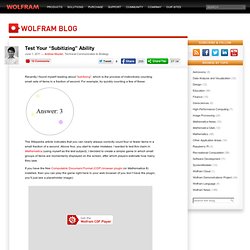
For example, try quickly counting a few of these: The Wikipedia article indicates that you can nearly always correctly count four or fewer items in a small fraction of a second. Above four, you start to make mistakes. I wanted to test this claim in Mathematica (using myself as the test subject). I decided to create a simple game in which small groups of items are momentarily displayed on the screen, after which players estimate how many they saw. If you have the free Computable Document Format (CDF) browser plugin (or Mathematica 8) installed, then you can play the game right here in your web browser (if you don’t have the plugin, you’ll just see a placeholder image): The game keeps track of your successes and failures and plots them as a function of how many items were present and the time you were given to count them.
Results. Math Playground - Online Math Games that Give Your Brain a Workout. National STEM Centre - Browse Collection. Nerd Paradise : Divisibility Rules for Arbitrary Divisors. Calculus Video Tutorials. Nature by numbers. The theory behind this movie. We can find interactive sites on the internet (like this) to draw points, move them, and check how the structure becomes updated in real time.
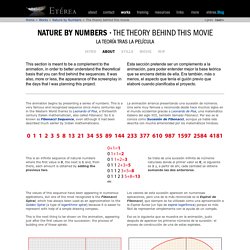
In fact, if we have a series of random dots scattered in the plane, the best way of finding the correct Voronoi Telesación for this set is using the Delaunay triangulation. And in fact, this is precisely the idea shown on the animation: first the Delaunay Triangulation and then, subsequently, the Voronoi Tessellation. But to draw a correct Delaunay Triangulation is necessary to meet the so-called “Delaunay Condition”.
Touch Trigonometry. Math is not linear by Alison Blank on Prezi. Playing to Learn Math? by Maria Andersen on Prezi. Khan Academy. Free Mathematics Books. Rader's NUMBERNUT.COM. Conrad Wolfram: Teaching kids real math with computers. PatrickJMT. Alpha—Computational Knowledge Engine.
Wolfram Demonstrations Project. Decimal Division. The Dot and the Line : A Romance in Lower Mathematics - une vidéo Cinéma. Golden Ratio. Nature by Numbers. The Fibonacci Numbers and Golden section in Nature - 1. This page has been split into TWO PARTS.
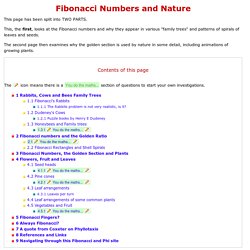
This, the first, looks at the Fibonacci numbers and why they appear in various "family trees" and patterns of spirals of leaves and seeds. The second page then examines why the golden section is used by nature in some detail, including animations of growing plants. 0, 1, 1, 2, 3, 5, 8, 13, 21, 34, 55, 89, 144, 233, 377, 610, 987 ..More.. 1 Rabbits, Cows and Bees Family Trees Let's look first at the Rabbit Puzzle that Fibonacci wrote about and then at two adaptations of it to make it more realistic.
StumbleVideo - A Night Of Numbers - Go Forth And Multiply. StumbleVideo - A Magic Number - Sixty Symbols. Fractice Mandelbrot deep zoom to 2^316 (bigger than the universe!) Fractal Mandelbrot 2^316. Triangle Dissection Paradox. The Tesseract. Buddhabrot (LlopSite) NumberSpiral.com - Home. Making Math Fun Download Page. Math Gems. Math That Makes You Go Wow. Blog : The Incredible Convenience of Mathematica Image Processing. It’s been possible since Version 6 of Mathematica to embed images directly into lines of code, allowing such stupid code tricks as expanding a polynomial of plots.
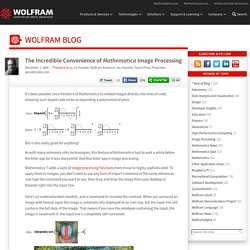
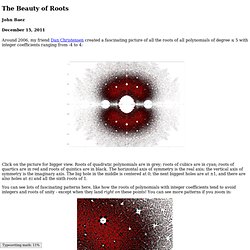
But is this really good for anything? As with many extremely nifty technologies, this feature of Mathematica had to wait a while before the killer app for it was discovered. And that killer app is image processing. Mathematica 7 adds a suite of image processing functions from trivial to highly sophisticated. To apply them to images, you don’t need to use any form of import command or file name references. Is that too much contrast? OK, but you could just do that in Photoshop, right? Here’s a clown fish, and a command that breaks it into 40-pixel squares. By the way, we’re seeing another neat thing about the integration of images with Mathematica‘s typeset input/output system. And here they are sorted by average pixel value (roughly by brightness): Remember how we made a Manipulate to play with the contrast of an image? Roots. Typesetting math: 8% John Baez December 15, 2011.
PencilWise. PENCILWISE - Equation Analysis Test Take this "test" as your personal challenge.
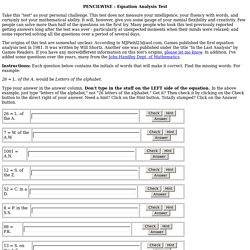
This test does not measure your intelligence, your fluency with words, and certainly not your mathematical ability. It will, however, give you some gauge of your mental flexibility and creativity. Spell and Summon. This card curiosity is attributed to Lewis Carroll.
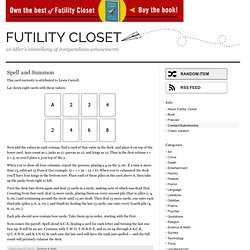
Lay down eight cards with these values: Now add the values in each column, find a card of that value in the deck, and place it on top of the lower card. Aces count as 1, jacks as 11, queens as 12, and kings as 13. ALL. I'm afraid we need to use...MATH. Wonders of Math - The Game of Life. What is the Game of Life?
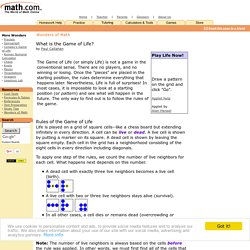
By Paul Callahan Rules of the Game of Life Life is played on a grid of square cells--like a chess board but extending infinitely in every direction. A cell can be live or dead. A live cell is shown by putting a marker on its square. A dead cell is shown by leaving the square empty. The Socratic Method. The Socratic Method:Teaching by Asking Instead of by Tellingby Rick Garlikov The following is a transcript of a teaching experiment, using the Socratic method, with a regular third grade class in a suburban elementary school.

I present my perspective and views on the session, and on the Socratic method as a teaching tool, following the transcript. The class was conducted on a Friday afternoon beginning at 1:30, late in May, with about two weeks left in the school year. This time was purposely chosen as one of the most difficult times to entice and hold these children's concentration about a somewhat complex intellectual matter. The point was to demonstrate the power of the Socratic method for both teaching and also for getting students involved and excited about the material being taught. The experiment was to see whether I could teach these students binary arithmetic (arithmetic using only two numbers, 0 and 1) only by asking them questions. A Visual Tutorial in Formal Logic - The 16 Combinations of Meaning. Einstein for Everyone.
Einstein for Everyone Nullarbor Press 2007revisions 2008, 2010, 2011, 2012, 2013 Copyright 2007, 2008, 2010, 2011, 2012, 2013 John D.
The Thirty Greatest Mathematicians. Click for a discussion of certain omissions. Please send me e-mail if you believe there's a major flaw in my rankings (or an error in any of the biographies). Obviously the relative ranks of, say Fibonacci and Ramanujan, will never satisfy everyone since the reasons for their "greatness" are different.
I'm sure I've overlooked great mathematicians who obviously belong on this list. Please e-mail and tell me! Physics Flash Animations. We have been increasingly using Flash animations for illustrating Physics content. This page provides access to those animations which may be of general interest. The animations will appear in a separate window.