
Person-to-person lending. Peer-to-peer lending (also known as person-to-person lending, peer-to-peer investing, and social lending; abbreviated frequently as P2P lending) is the practice of lending money to unrelated individuals, or "peers", without going through a traditional financial intermediary such as a bank or other traditional financial institution.
This lending takes place online on peer-to-peer lending companies' websites using various different lending platforms and credit checking tools. Overview[edit] The interest rates are set by lenders who compete for the lowest rate on the reverse auction model, or are fixed by the intermediary company on the basis of an analysis of the borrower's credit.[1] Borrowers assessed as having a higher risk of default are assigned higher rates. Lenders mitigate the individual risk that borrowers will not pay back the money they received by choosing which borrowers to lend to, and mitigate total risk by diversifying their investments among different borrowers. Intention economy. The intention economy is an approach to viewing markets and economies focusing on buyers as a scarce commodity.

The consumers' intent to buy drives the production of goods to meet their specific needs. It is also the title of Doc Searls book: The Intention Economy: When Customers Take Charge published in May, 2012. Concept[edit] Doc Searls coined the term in an article for Linux Journal. He wrote: "The Intention Economy grows around buyers, not sellers. Despite the advancement internet businesses are still seller oriented. Some sites have similar characteristics of an intention economy. Companies need to be able to respond to a customers precise needs. Pull Economies. This is a widely discussed meme, referring to the contrast between the old industrial model of push economies, vs. the new pull economies.

"Pull approaches differ significantly from push approaches in terms of how they organize and manage resources. Social entrepreneurship. Social entrepreneurship is the process of pursuing innovative solutions to social problems.
Co-operative economics. Monetary reform. Monetary reform describes any movement or theory that proposes a different system of supplying money and financing the economy from the current system.[1] Monetary reformers may advocate any of the following, among other proposals: Common targets for reform[edit] Of all the aspects of monetary policy, certain topics reoccur as targets for reform: Reserve Requirements[edit] Banks typically make loans to customers by crediting new demand deposits to the account of the customer.

Fair trade. Fair trade is an organized social movement whose stated goal is to help producers in developing countries achieve better trading conditions and to promote sustainability.
Members of the movement advocate the payment of higher prices to exporters, as well as higher social and environmental standards. The movement focuses in particular on commodities, or products which are typically exported from developing countries to developed countries, but also consumed in domestic markets (e.g. Brazil and India) most notably handicrafts, coffee, cocoa, sugar, tea, bananas, honey, cotton, wine,[1] fresh fruit, chocolate, flowers, gold[2] and 3D printer filament.[3] The movement seeks to promote greater equity in international trading partnerships through dialogue, transparency, and respect. It promotes sustainable development by offering better trading conditions to, and securing the rights of, marginalized producers and workers in developing countries.[4] The fair trade system[edit] Mutual credit. Mutual credit is a type of alternative currency in which the currency used in a transaction can be created at the time of the transaction.
LETS are mutual credit systems. Typically this involves keeping track of each individual's credit or debit balance. Although the effect is like a loan, no interest is charged, and since mutual credit allows for trading and cancelling balances with others, debts can be paid off indirectly. The "IOU" is a common example of this. Credit union. Worldwide, credit union systems vary significantly in terms of total system assets and average institution asset size,[6] ranging from volunteer operations with a handful of members to institutions with assets worth several billion US dollars and hundreds of thousands of members.[7] Credit unions operate alongside other mutual and/or co-operative organisations engaging in cooperative banking, such as building societies.
Differences from other financial institutions[edit] Local exchange trading system. A local exchange trading system (also local employment and trading system or local energy transfer system; abbreviated to LETS or LETSystem) is a locally initiated, democratically organised, not-for-profit community enterprise that provides a community information service and record transactions of members exchanging goods and services by using the currency of locally created LETS Credits.[1] History[edit] Michael Linton originated the term "local exchange trading system" in 1983 and for a time ran the Comox Valley LETSystems in Courtenay, British Columbia.[2] The system he designed was intended as an adjunct to the national currency, rather than a replacement for it,[3] although there are examples of individuals who have managed to replace their use of national currency through inventive usage of LETS.
Time-based currency. In economics, a time-based currency is an alternative currency where the unit of exchange is the person-hour. Some time-based currencies value everyone’s contributions equally: one hour equals one service credit. In these systems, one person volunteers to work for an hour for another person; thus, they are credited with one hour, which they can redeem for an hour of service from another volunteer. Critics charge that this would lead to fewer doctors or dentists. Metacurrency Project. = The meta-currency project is about defining an approach to creating a currency network: MetaCurrency is the name for the infrastructure and protocols necessary for an open source economy, and Free Currencies to flow in an interoperable and standardized way. This requires new technological capacities which need to function in a non-monopolizable manner. Alternative currency. An alternative currency (or private currency) is any currency used as an alternative to the dominant national or multinational currency systems (usually referred to as national or fiat money).
They are created by an individual, corporation, or organization, they can be created by national, state, or local governments, or they can arise naturally as people begin to use a certain commodity as a currency. Community currency. A Community Currency is often used as synonym for complementary currency, local currency, regional currency, alternative currency, auxiliary currencies, and private currencies. The debate is not easy to solve at the moment, since the words have different meanings to different people. All are currencies that have different designs and serve different purposes than our conventional money. They depart from the notion that money is essentially a human invention and instrument to influence the relations between citizens and organizations. A solid theoretical framework legitimizes this idea and in the past hundred years a lot of experimentation and experience was picked up with realizing social goals by the implementation of community currencies.
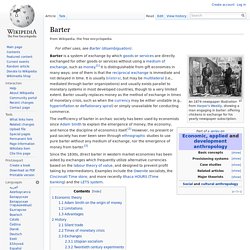
Barter. An 1874 newspaper illustration from Harper's Weekly, showing a man engaging in barter: offering chickens in exchange for his yearly newspaper subscription.
The inefficiency of barter in archaic society has been used by economists since Adam Smith to explain the emergence of money, the economy, and hence the discipline of economics itself.[2] However, no present or past society has ever been seen through ethnographic studies to use pure barter without any medium of exchange, nor the emergence of money from barter.[3] Since the 1830s, direct barter in western market economies has been aided by exchanges which frequently utilize alternative currencies based on the labour theory of value, and designed to prevent profit taking by intermediators.
Examples include the Owenite socialists, the Cincinnati Time store, and more recently Ithaca HOURS (Time banking) and the LETS system. Sharing. Sharing food Sharing is the joint use of a resource or space.
Gift economy. Collaborative consumption. Microfinance. Community-based savings bank in Cambodia. There are a rich variety of financial institutions which serve micro-entrepreneurs and small businesses. Crowd funding.