
Denotation (semiotics) Modality (semiotics) Text is a medium for presenting the modality of natural language;image is both a medium and a modality;music is a modality for the auditory media.
Barthes, Roland. Elements of Semiology. (Translated by Annette Lavers & Colin Smith). London: Jonathan Cape. ([1964] 1967)Barthes, Roland. Semiotics. Semiotics frequently is seen as having important anthropological dimensions; for example, Umberto Eco proposes that every cultural phenomenon may be studied as communication.[2] Some semioticians focus on the logical dimensions of the science, however.
They examine areas belonging also to the life sciences – such as how organisms make predictions about, and adapt to, their semiotic niche in the world (see semiosis). Hyperreality. In semiotics and postmodernism, hyperreality is an inability of consciousness to distinguish reality from a simulation of reality, especially in technologically advanced postmodern societies.
Hyperreality is seen as a condition in which what is real and what is fiction are seamlessly blended together so that there is no clear distinction between where one ends and the other begins.[1] It allows the co-mingling of physical reality with virtual reality (VR) and human intelligence with artificial intelligence (AI).[2] Individuals may find themselves for different reasons, more in tune or involved with the hyperreal world and less with the physical real world. Some famous theorists of hyperreality/hyperrealism include Jean Baudrillard, Albert Borgmann, Daniel J. Boorstin, Neil Postman and Umberto Eco. Photorealism. John's Diner with John's Chevelle, 2007John Baeder, oil on canvas, 30×48 inches.
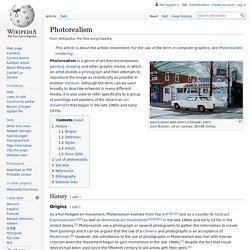
History[edit] Origins[edit] As a full-fledged art movement, Photorealism evolved from Pop Art[1][2][3] and as a counter to Abstract Expressionism[2][3] as well as Minimalist art movements[2][3][4][5] in the late 1960s and early 1970s in the United States.[5] Photorealists use a photograph or several photographs to gather the information to create their paintings and it can be argued that the use of a camera and photographs is an acceptance of Modernism.[6] However, the admittance to the use of photographs in Photorealism was met with intense criticism when the movement began to gain momentum in the late 1960s,[7] despite the fact that visual devices had been used since the fifteenth century to aid artists with their work.[8] Ralph's Diner (1981–1982), oil on canvas. Simulacrum. World view. Origins[edit] Linguistics[edit] The founder of the idea that language and worldview are inextricable is the Prussian philologist, Wilhelm von Humboldt (1767–1835).
Humboldt argued that language was part of the creative adventure of mankind[vague]. Culture, language and linguistic communities developed simultaneously, he argued, and could not do so without one another. In stark contrast to linguistic determinism, which invites us to consider language as a constraint, a framework or a prison house, Humboldt maintained that speech is inherently and implicitly creative. Edward Sapir also gives an account of the relationship between thinking and speaking in English. The linguistic relativity hypothesis of Benjamin Lee Whorf describes how the syntactic-semantic structure of a language becomes an underlying structure for the world view or Weltanschauung of a people through the organization of the causal perception of the world and the linguistic categorization of entities.
Friedrich Nietzsche. Friedrich Wilhelm Nietzsche (/ˈniːtʃə/[1] or /ˈniːtʃi/;[2] German: [ˈfʁiːdʁɪç ˈvɪlhɛlm ˈniːt͡sʃə]; 15 October 1844 – 25 August 1900) was a German philosopher, cultural critic, poet, composer and Latin and Greek scholar.
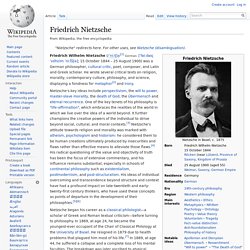
He wrote several critical texts on religion, morality, contemporary culture, philosophy and science, displaying a fondness for metaphor[3] and irony. Nietzsche's key ideas include perspectivism, the will to power, the death of God, the Übermensch and eternal recurrence. One of the key tenets of his philosophy is "life-affirmation", which embraces the realities of the world in which we live over the idea of a world beyond. Nietzsche began his career as a classical philologist—a scholar of Greek and Roman textual criticism—before turning to philosophy. In 1869, at age 24, he became the youngest-ever occupant of the Chair of Classical Philology at the University of Basel. Immanuel Kant. Immanuel Kant (/kænt/;[1] German: [ɪˈmaːnu̯eːl kant]; 22 April 1724 – 12 February 1804) was a German philosopher who is widely considered to be a central figure of modern philosophy.
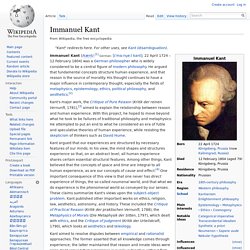
He argued that fundamental concepts structure human experience, and that reason is the source of morality. His thought continues to have a major influence in contemporary thought, especially the fields of metaphysics, epistemology, ethics, political philosophy, and aesthetics.[2] Kant's major work, the Critique of Pure Reason (Kritik der reinen Vernunft, 1781),[3] aimed to explain the relationship between reason and human experience. With this project, he hoped to move beyond what he took to be failures of traditional philosophy and metaphysics.
He attempted to put an end to what he considered an era of futile and speculative theories of human experience, while resisting the skepticism of thinkers such as David Hume. Kant argued that our experiences are structured by necessary features of our minds. Sense. Five senses and the respective sensory organs An allegory of five senses.
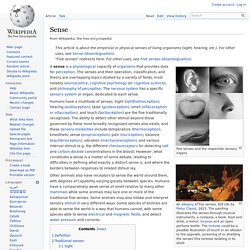
Still Life by Pieter Claesz, 1623. The painting illustrates the senses through musical instruments, a compass, a book, food and drink, a mirror, incense and an open perfume bottle. The tortoise could be a possible illustration of touch or an allusion to the opposite, screening of or shielding the senses (the tortoise isolating in its shell) Truth. Truth is most often used to mean being in accord with fact or reality,[1] or fidelity to an original or to a standard or ideal.[1]
Conditional Statements. Truth and validity. Validity. Validity of arguments[edit] An argument that is not valid is said to be "invalid".
An example of a valid argument is given by the following well-known syllogism: All men are mortal. List of memory biases. In psychology and cognitive science, a memory bias is a cognitive bias that either enhances or impairs the recall of a memory (either the chances that the memory will be recalled at all, or the amount of time it takes for it to be recalled, or both), or that alters the content of a reported memory. There are many different types of memory biases, including: See also[edit] [edit] ^ Jump up to: a b c d e Schacter, Daniel L. (1999). "The Seven Sins of Memory: Insights From Psychology and Cognitive Neuroscience". List of cognitive biases. Systematic patterns of deviation from norm or rationality in judgment The loss aversion cognitive bias has been shown in monkeys Cognitive biases are systematic patterns of deviation from norm and/or rationality in judgment.
They are often studied in psychology and behavioral economics.[1] Although the reality of most of these biases is confirmed by reproducible research,[2][3] there are often controversies about how to classify these biases or how to explain them.[4] Gerd Gigerenzer has criticized the framing of cognitive biases as errors in judgment, and favors interpreting them as arising from rational deviations from logical thought.[5] Explanations include information-processing rules (i.e., mental shortcuts), called heuristics, that the brain uses to produce decisions or judgments. Outline of thought. Nature of thought[edit] Thought (or thinking) can be described as all of the following: An activity taking place in a: brain – organ that serves as the center of the nervous system in all vertebrate and most invertebrate animals (only a few invertebrates such as sponges, jellyfish, adult sea squirts and starfish do not have a brain).
It is the physical structure associated with the mind. mind – abstract entity with the cognitive faculties of consciousness, perception, thinking, judgement, and memory. Having a mind is a characteristic of humans, but which also may apply to other life forms.[1][2] Activities taking place in a mind are called mental processes or cognitive functions.computer (see automated reasoning, below) – general purpose device that can be programmed to carry out a set of arithmetic or logical operations automatically.