
Bloom's Digital Taxonomy. Born to Learn. Bloom's Taxonomy of Learning Domains. Bloom's Taxonomy was created in 1956 under the leadership of educational psychologist Dr Benjamin Bloom in order to promote higher forms of thinking in education, such as analyzing and evaluating, rather than just remembering facts (rote learning).
The Three Types of Learning The committee identified three domains of educational activities or learning (Bloom, 1956): Cognitive: mental skills (Knowledge) Affective: growth in feelings or emotional areas (Attitude or self) Psychomotor: manual or physical skills (Skills) Since the work was produced by higher education, the words tend to be a little bigger than we normally use. Domains can be thought of as categories. While the committee produced an elaborate compilation for the cognitive and affective domains, they omitted the psychomotor domain.
This compilation divides the three domains into subdivisions, starting from the simplest behavior to the most complex. Cognitive Domain Table of The Cognitive Domain. Bringing Gamification to the Classroom. On April 7, 2014, a vulnerability with the OpenSSL library, a data encryption protocol used by many web servers across the internet, was discovered and published.

This vulnerability, known as Heartbleed Bug (CVE-2014-0160), could be used to remotely obtain and exploit sensitive information. After a thorough audit of our system, we have determined that none of the schoology.com sites (including white-labeled domains that point to Schoology) have been affected by this vulnerability. All of ... Schoology NEXT 2014 is getting closer, and it’s already shaping up to be an incredible event. We have keynotes by Alan November and our CEO Jeremy Friedman, numerous presentations by passionate Schoology users, collaborative workshops, and much more. Mobile technologies have condensed our whole digital world into a pocket-sized gadget that was science fiction a few decades ago. Some people love jigsaw puzzles. We joined Dr. Four Phases of Learning. Make Assessments Meaningful? I think meaningful assessments can come in many shapes and sizes.
In fact, to be thoroughly engaging and to draw the best work out of the students, assessments should come in different formats. Thankfully, with the Common Core standards exemplifying the 4Cs -- Creativity and Critical Thinking (through performance-based assessments), Collaboration, and Communication (through the use of interdisciplinary writing) -- we are looking at a more fluid future in testing formats. As long as the format itself is aligned with real-world skills, a meaningful assessment does not need to be lockstep with a particular structure any more. When I think about my own definition of a "meaningful assessment," I think the test must meet certain requirements. The assessment must have value other than "because it's on the test. " Assessment rubrics. Rubrics for Assessment. Learn more about our Online Courses, Online Certificate Programs, and Graduate Degree A collection of rubrics for assessing portfolios, group work/cooperative learning, concept map, research process/ report, PowerPoint, oral presentation, web page, blog, wiki, and other social media projects.
Quick Links to Rubrics Social Media Project Rubrics Wiki RubricCriteria for assessing individual and group Wiki contributions. Blog RubricAssess individual blog entries, including comments on peers' blogs. Twitter RubricAssess learning during social networking instructional assignments. Discussion, Teamwork, and Group Work Rubrics Online Discussion Board RubricAssessing ability to share perspectives, refine thoughts through the writing process, and participate in meaningful discussionPrimary Grade Self-Evaluation Teamwork Rubric (PDF)Features of a sandwich to graphically show the criteria PowerPoint and Podcast Rubrics A+ PowerPoint Rubric Joan Vandervelde's rubric provides 10 performance categories. The 4Cs. 30 COMPETENCES. Jean-Pierre Astolfi s’inscrit dans le courant de la professionnalisation du métier d’enseignant.
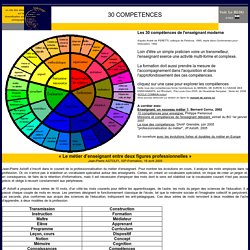
Pour montrer les évolutions en cours, il analyse les mots employés dans la profession. Or, on n’arrive pas à stabiliser un vocabulaire spécialisé autour des enseignants. Certes, en créant un vocabulaire spécialisé, on risque de créer un jargon et, en conséquence, de faire de la rétention d'informations, mais il est nécessaire d'employer des mots dont le sens est stabilisé car le vocabulaire courant n'est pas assez précis et oblige à recourir constamment aux périphrases. JP Astolfi a proposé deux séries de 10 mots, d’un côté les mots courants pour définir les apprentissages, de l’autre, les mots du jargon des sciences de l'éducation.
Il a passé chaque couple de mots en revue. 1- Transmission/Construction La transmission. 9 compétences essentielles. How Learners Are Like Cats. Learners are like cats.

This occurred to me recently when teaching a group of 8th graders about the wonders of the preposition. Cats are curious, aloof little prima donnas capable of great feats of athleticism and laziness. They have their own internal clocks, their own schedules, and their own reasons for breathing. They are only selectively aware of anything–can sprint at barely discernible stimuli, or nap right through a thermonuclear explosion.
Truth be told, I’m not a cat person. How’s that for gratitude? But cats are cool because they have this odd way of keeping you close without ever admitting they need you for anything. Engage or entertain? Accelerated Learning. Center for Accelerated Learning. Helping organizations speed and enhance learning What Is Accelerated Learning?
Workshop Products A.L. Europe Tips Resources Links About Us Contact Us Clients Testimonials Success Stories.