
Themes & Things To Keep In Mind When Writing Fantasy Stories and... This list is far from complete.
It’s not even trying to be complete. It knows better than that. It just wants to be helpful and provide some inspiration here and there; you know, offer little suggestions that might lead to bigger ideas. (Especially by using the words offered as Wikipedia searches!) Feel free to make suggestions in the comments! Victorian & Steampunk Name Generator. How to Undress a Victorian Lady in Your Next Historical Romance. How to Plot and Write a Novel: Plan Your Novel Writing with the Snowflake Method.
Many novelists mull over story ideas, letting them ripen and develop over time.
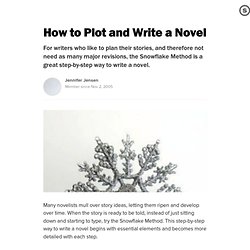
When the story is ready to be told, instead of just sitting down and starting to type, try the Snowflake Method. This step-by-step way to write a novel begins with essential elements and becomes more detailed with each step. Essential Elements for Novel Structure Snowflakes have a structure which begins with a simple form and adds more elements to create complex patterns. Novelist and physicist Randy Ingermanson created the Snowflake Method to break novel-writing into steps that build on each other in the same way. 1. 2. 3.
The time-saving factor for novelists here is that at this point, a writer knows whether or not the story has problems. How to Write a Novel Using the Snowflake Method. A Simple Novel Outline - 9 questions for 25 chapters & H.E. Roulo. Just as every tree is different but still recognizably a tree, every story is different but contains elements that make it a story.
By defining those before you begin you clarify the scope of your work, identify your themes, and create the story you meant to write. At Norwescon 2011 I sat in on a session called Outline Your Novel in 90-minutes led by Mark Teppo. I’ll give you the brief, readable, synthesized version. Answer 9 questions and create 25 chapter titles and you’re there. Character Chart for Fiction Writers - EpiGuide.com.
If you're a fiction writer -- whether you're working on a novel, short story, screenplay, television series, play, web series, webserial, or blog-based fiction -- your characters should come alive for your reader or audience. The highly detailed chart below will help writers develop fictional characters who are believable, captivating, and unique. Print this page to complete the form for each main character you create. IMPORTANT: Note that all fields are optional and should be used simply as a guide; character charts should inspire you to think about your character in new ways, rather than constrain your writing. Fill in only as much info as you choose. Have fun getting to know your character! If this character chart is helpful, please let us know! Eight Secrets Which Writers Won't Tell You. Image from Flickr by Lazurite This is not particularly relevant to the post, but I’m getting an awful lot of comments telling me, often a little snarkily, “it’s ‘THAT’ not ‘WHICH’”.
The “don’t use which for restrictive clauses” rule comes (as far as I can tell) from Strunk and White. Cure writers block with writing prompts - writing tips character name generator. 10 Commandments for a Happy Writer by Nathan Bransford. Writers aren't generally known as the happiest lot.
As a recent Guardian survey of some top writers shows, even the best ones don't particularly enjoy it all that much. And in case you think this is a new development, an 1842 letter from Edgar Allen Poe to his publisher recently surfaced in which he was found apologizing for drinking so much and begging for money. But believe it or not, writing and happiness can, in fact, go together. For our Thursday entry in Positivity Week, here are ten ways for a writer to stay positive: How To Steal Like An Artist (And 9 Other Things Nobody Told Me) - Austin Kleon. Wednesday, March 30th, 2011 Buy the book: Amazon | B&N | More… Here’s what a few folks have said about it:

Pixar’s 22 Rules of Storytelling « Aerogramme Writers' Studio. These rules were originally tweeted by Emma Coats, Pixar’s Story Artist.
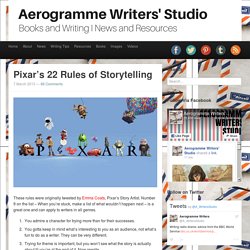
Number 9 on the list – When you’re stuck, make a list of what wouldn’t happen next – is a great one and can apply to writers in all genres. You admire a character for trying more than for their successes.You gotta keep in mind what’s interesting to you as an audience, not what’s fun to do as a writer. They can be very different.Trying for theme is important, but you won’t see what the story is actually about til you’re at the end of it. Now rewrite.Once upon a time there was ___. 73 Ways to Become a Better Writer. 25 Things You Should Know About Character. Previous iterations of the “25 Things” series: 25 Things Every Writer Should Know 25 Things You Should Know About Storytelling And now… Here you’ll find the many things I believe — at this moment!

— about characters: 1. Without character, you have nothing. 2. A great character can be the line between narrative life and story death. 3. Don’t believe that all those other aspects are separate from the character. 4. The audience will do anything to spend time with a great character. 5. It is critical to know what a character wants from the start. 6. It doesn’t matter if we “like” your character, or in the parlance of junior high whether we even “like-like” your character. 7. It is critical to smack the audience in the crotchal region with an undeniable reason to give a fuck. 8. 33_ways_to_stay_creative-500x646.jpg (500×646) 12, William Faulkner. William Faulkner, ca. 1954.
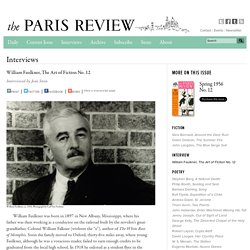
Photograph by Carl Van Vechten William Faulkner was born in 1897 in New Albany, Mississippi, where his father was then working as a conductor on the railroad built by the novelist’s great-grandfather, Colonel William Falkner (without the “u”), author of The White Rose of Memphis. Soon the family moved to Oxford, thirty-five miles away, where young Faulkner, although he was a voracious reader, failed to earn enough credits to be graduated from the local high school. In 1918 he enlisted as a student flyer in the Royal Canadian Air Force. He spent a little more than a year as a special student at the state university, Ole Miss, and later worked as postmaster at the university station until he was fired for reading on the job. Encouraged by Sherwood Anderson, he wrote Soldier’s Pay (1926). A steady succession of novels followed, most of them related to what has come to be called the Yoknapatawpha saga: Light in August (1932), Pylon (1935), Absalom, Absalom!
Mr. Guest Post: How I Went From Writing 2,000 Words a Day to 10,000 Words a Day. By Rachel Aaron When I started writing The Spirit War (Eli novel #4), I had a bit of a problem. I had a brand new baby and my life (like every new mother’s life) was constantly on the verge of shambles. I paid for a sitter four times a week so I could get some writing time, and I guarded these hours like a mama bear guards her cubs – with ferocity and hiker-mauling violence. To keep my schedule and make my deadlines, I needed to write 4000 words during each of these carefully arranged sessions. 25 Things You Should Know About Word Choice - StumbleUpon.
1.
A Series Of Word Choices Here’s why this matters: because both writing and storytelling comprise, at the most basic level, a series of word choices. Words are the building blocks of what we do. They are the atoms of our elements. They are the eggs in our omelets. 11 Goal Hacks: How to Achieve Anything. Goal-setting research on fantasising, visualisation, goal commitment, procrastination, the dark side of goal-setting and more… We’re all familiar with the nuts and bolts of goal-setting.
We should set specific, challenging goals, use rewards, record progress and make public commitments (if you’re not familiar with these then check out this article on how to reach life goals). William Shunn : Manuscript Format : Short Story. Synonym Finder & Find synonyms, antonyms & definition for (almost)... 20 Common Grammar Mistakes That (Almost) Everyone Gets Wrong. I’ve edited a monthly magazine for more than six years, and it’s a job that’s come with more frustration than reward. If there’s one thing I am grateful for — and it sure isn’t the pay — it’s that my work has allowed endless time to hone my craft to Louis Skolnick levels of grammar geekery. As someone who slings red ink for a living, let me tell you: grammar is an ultra-micro component in the larger picture; it lies somewhere in the final steps of the editing trail; and as such it’s an overrated quasi-irrelevancy in the creative process, perpetuated into importance primarily by bitter nerds who accumulate tweed jackets and crippling inferiority complexes.
Find Writing Contests, Poetry Contests & Grants. The Creative Writing MFA Blog. The Simple, Ridiculously Useful Guide to Earning a Living from Your Passion... Post written by Leo Babauta. National Novel Writing Month. 23 (More) Websites that Make Your Writing Stronger. 23 Websites that Make Your Writing Stronger. Save The Words.