
Support for Windows XP technical problems and troubleshooting. Apache 403 Forbidden Error and Solution. I have successfully configured Apache web server for my client.

But why does my clients website just say "Error 403 Forbidden"? For example when client send request Apache generate a 403 error. How do I troubleshoot this problem? Error code that start with 4xx is generated because of client browser request. A 403 error code means client browser (or person who is trying to access your site) cannot access the requested URL. A) A 403 status code indicates that the client cannot access the requested resource. B) No default directory index page is present. C) Make sure the CGI script requested have executable permissions set on files. D) Make sure you have permission to use .htaccess file for Apache web server.
E) Make sure correct directory permissions are set on directory: <Directory "/home/domain/www"> Options +Indexes FollowSymLinks +ExecCGI AllowOverride AuthConfig FileInfo Order allow,deny Allow from all </Directory> Speedtest.net - The Global Broadband Speed Test. Role Playing - Communication Skills Training from MindTools. Preparing for Difficult Conversations and Situations © iStockphotozoranm Act out possible scenarios.

Think back to the last time you prepared for an important meeting. Perhaps you needed to convince a prospective client to do business with your organization. Or maybe you had to present to executive board members, and you knew that they would be peppering you with questions about your proposal. Whatever the situation, chances are that you were nervous about the meeting; and practicing in front of a mirror may not have helped you overcome your anxiety, especially with respect to answering difficult questions. This is where role-playing can be useful. Uses and Benefits Role-playing takes place between two or more people, who act out roles to explore a particular scenario. How To Properly Handle An Irate Customer. Pacifying irate customers is one of the several challenging aspects of customer service.

If you are working in a call center facility, you know what and how irate customers are. Whether you are in the customer service department, sales, or technical support department of the call center company, you surely know how and what irate customers are like. Consider it as an accomplishment if you effortlessly pacify an angry and dissatisfied customer. Talking to an emotionally-charged customer could sometimes feel like defusing an explosive bomb. A customer service representative should be attentive to every detail involved in the situation.
Seven steps to remarkable customer service. Seven steps to remarkable customer service by Joel Spolsky Monday, February 19, 2007 As a bootstrapped software company, Fog Creek couldn’t afford to hire customer service people for the first couple of years, so Michael and I did it ourselves.

The time we spent helping customers took away from improving our software, but we learned a lot and now we have a much better customer service operation. Here are seven things we learned about providing remarkable customer service. 1. Almost every tech support problem has two solutions. Sometimes that means adding more intelligence to the software or the SETUP program; by now, our SETUP program is loaded with special case checks.
We treat each tech support call like the NTSB treats airliner crashes. This has two implications. One: it’s crucial that tech support have access to the development team. Computer keyboard help and support. Www.mrbios.com. Welcome to The PC Guide! Linksys® by Cisco » Home. PracticallyNetworked.com. Local Area Network Troubleshooting - LAN with Cat 5 Network Cards and Hubs Diagnostic Flowchart. PC Sound Card Troubleshooting - Computer Sound Diagnostic Flowchart. Hard Drive Troubleshooting - SATA Drive and ATA CD, DVD Diagnostic Flowchart. Ths ATA drive troubleshooting chapter for hard drives is from my book, "Computer Repair with Diagnostic Flowcharts, Third Edition.

" The main update to the hard drive failure flowchart in the Third Edition is the addition of SSD and SATA 3, with similar updates to the hard drive performance chapter. CPU, RAM and Motherboard Troubleshooting - PC Memory, Processor and Motherboard Diagnostic Flowchart. The troubleshooting flowchart for motherboard, CPU and ram problems along with the explanations below are from my book, "Computer Repair with Diagnostic Flowcharts, Third Edition.
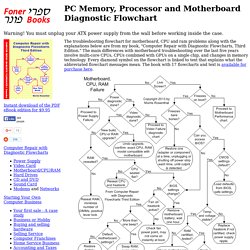
" The main differences with motherboard troubleshooting over the last five years involve multi-core CPUs, CPUs combined with GPUs on a single chip, and changes in memory technology. Every diamond symbol on the flowchart is linked to text that explains what the abbreviated flowchart messages mean. The book with 17 flowcharts and text is available for purchase here. Note that these steps correspond with decision points on the flowchart and are reached directly by clicking on the diamond symbols. The text below cannot be read sequentially. Does the PC start the boot process and get at least as far as displaying a message from the BIOS or any signs of life from Windows? Video Card Troubleshooting - Video Adapter and PC Display Diagnostic Flowchart. Instant download of the PDF eBook edition for $9.95 Computer Repair with Diagnostic Flowcharts Starting Your Own Computer Business Laptop Repairs Replacing a Video Adapter Copyright 2013 by Morris Rosenthal Contact info All Rights Reserved.

Computer Power Supply Troubleshooting - ATX PC Power Supply Diagnostic Flowchart. The power supply troubleshooting chapter below is from my book, "Computer Repair with Diagnostic Flowcharts, Third Edition.
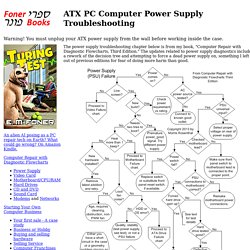
" The updates related to power supply diagnostics include a rework of the decision tree and attempting to force a dead power supply on, something I left out of previous editions for fear of doing more harm than good. Note that these steps correspond with decision points on the flowchart and are reached directly by clicking on the diamond symbols. The text below cannot be read sequentially. The first step in the troubleshooting process is simply determining if the power supply is coming on. You can usually hear the mechanical components in PCs that make rotational noise when they are powered up. Return to Diagnostic Chart If your computer has a display connected, can you get a live screen, whether it's a simple text message or a colorful splash screen?
If the power comes on but the screen never goes live, try switching back off again and retrying.