
Esoteric Archives. Magick of Alexandria - Home. Pagan Influence on Religion. {*style:<b>Clicking on any one of the thumbnails below will provide you with larger photos, related photos, and historic information concerning each photo. </b>*} {*style:<b>Do NOT assume that Roman Rule ended with the death of The Roman Government. Roman Rule is alive and in power today under a New Guise, which is currently in the process of becoming a universal "New World Order. " </b>*} {*style:<b> </b>*} Constantine And The Cross 1963. The Dark History of The Vatican - La Oscura Historia del Vaticano.
Edu : Occult. Pagan origins of Christianity? This paper is a response to a post by a Muslim named Dhia concerning the influences of Paganism on Christianity.

I have slightly edited some of the posts to eliminate redundancy. Dhia's series of posts starts first. Dhia based his comments mainly on F. Artz's book, "The Mind of the Middle Ages". Modern scholarship is not in agreement on the subject of how much Christianity drew from the mystery religion. Read "The Mind of the Middle Ages" By Frederick B. Mithraism comes from Persia. Osiris another pagan god. You guys from the minute you're entering the church to the minute you leave church, you are practicing nothing but paganism. From a book called "Jesus' Tomb In India" Debate on his death and resurrection, by Paul C. On page 13, ...........cult of Mithra from Persia were sun cults that had become popular among the Roman soldiers, and their beliefs and rituals were borrowed to some degree by Christianity.
From a book called Pagan Christs, by J.M. Paul C. PAGANISM The Mother of All Religions - Paganism in Africa. Keep in mind that all the African symbols and rituals (of its Mystery System) described in the following paragraphs preceded Ethiopian/Chaldean/Babylonian Albigensianism by over 100 years, Hinduism by over 1000 years, Judaism by over 3,000 years, Zoroastrianism and Buddhism by over 3,500 years, Christianity by over 4425 years and Islam by nearly 5000 years.
Africans invented religion from which all the religions of the world took their bearing, ideas, dogma, structure, symbols, architecture, rituals and traditions. African Osirianism was founded by many, consolidated by Ausar in 4100 BCE. Africans created several Gods and do not worship the 'One Source,' which they revere and which in modern time, we call Tu-SoS. No religion or spiritual movement worships the 'One Source.' The Jews do not worship Tu-SoS which they call En-Sof, instead, they worship the ten Gods they created and called Attributes of the One Source. Osirianism's Holy day is Sunday. Sikhism. Egyptians' Lucky Girdle. Mithraic Mysteries. Double-faced Mithraic relief.
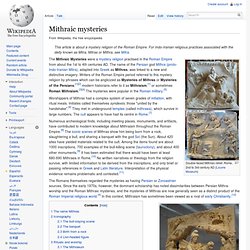
Rome, 2nd to 3rd century AD (Louvre Museum) The Mithraic Mysteries were a mystery religion practised in the Roman Empire from about the 1st to 4th centuries AD. The name of the Persian god Mithra (proto-Indo-Iranian Mitra), adapted into Greek as Mithras, was linked to a new and distinctive imagery. Writers of the Roman Empire period referred to this mystery religion by phrases which can be anglicized as Mysteries of Mithras or Mysteries of the Persians;[1][2] modern historians refer to it as Mithraism,[1] or sometimes Roman Mithraism.[3][4] The mysteries were popular in the Roman military.[5] Julian Calendar History. Edu : Occult. Semiramis. Semiramis depicted as an armed Amazon in this eighteenth-century Italian illustration.

EASTER AND CHRISTMAS PAGANISM. "Learn not the way of the heathen.

" Jer. 10:2 "Prove all things" I Thes. 5:21 Is the name "Easter" of divine origin simply because it is found in our Bibles, in the King James translation of Acts 12:4 - "... intending after Easter to bring him forth"? Buon Natale! Christmas in Italy - Origins in Pagan Celebrations. Part 1: Origins in Pagan Celebrations Green, white, and red—the colors of Italy's national flag, and the traditional Christmas colors as well.

It may not be a surprise, then, that Christmas probably originated in Italy. One widely held theory is that the holiday was an intentional christianization of Saturnalia and other pagan festivals. In the third and fourth centuries, the church in Rome found itself in fierce competition with popular pagan religions and mystery cults, most of them involving sun worship. From the middle of December through the first of January, Romans would engage in feasts and drunken revelry, paying homage to their gods and marking the winter solstice, when days began to lengthen. In A.D. 274, Emperor Aurelian decreed December 25—the solstice on the Julian calendar—as natalis solis invicti ("birth of the invincible sun"), a festival honoring the sun god Mithras.
Primary Literary Sources. The Cross, The Whole Truth. Greek Winter Solstice Celebration in Honor of Poseidon. Solstice (from the Latin sol 'sun') celebrations honor the sun.
At the summer solstice in late June, there is no dearth of sun, so celebrants just enjoy the extra hours of daylight, but by the winter solstice in late December, the sun is getting weaker and weaker every day. Although it doesn't take long to realize the sun will return to its former glory all on its own, so there's really no need to worry, it takes the edge off the cold and dark to help the sun along with a bit of sympathetic magic and a few rituals. Winter solstice celebrations often include two activities related to the failing sun: producing light and enjoying the cover the darkness provides....Thus, it is common for winter solstice celebrations to include candle lighting, bonfire creation, and drunken debauchery. Saturnalia.Part I. Saturnalia - Celebrate the Saturnalia. "For how many years shall this festival abide!
Never shall age destroy so holy a day!