
The Corrupt Corporate Incarceration Complex. Seventeen-year-old Hillary Transue did what lots of 17-year-olds do: Got into mischief.
Hillary's mischief was composing a MySpace page poking fun at the assistant principal of the high school she attended in Wilkes-Barre, Pennsylvania. Hillary was an honor student who'd never had any trouble with the law before. And her MySpace page stated clearly that the page was a joke. But despite all that, Hilary found herself charged with harassment.
She stood before a judge and heard him sentence her to three months in a juvenile detention facility. What she expected was perhaps a stern lecture. It wasn't until two years later that she found out why. PA Child Care is a juvenile detention center in Pittston Township, Pennsylvania. In July 2009, Powell pled guilty to failing to report a felony and being an accessory to tax evasion conspiracy in connection with $770,000 in kickbacks he paid to Ciavarella and Conahan in exchange for facilitating the development of his facilities. For example: Public Safety Shouldn't Be Privatized, Fasano Says - Video. The Private Prison Business. The Influence of the Private Prison Industry in Immigration Detention. Introduction Since the late 1990’s, the number of people held in immigration detention has exploded.
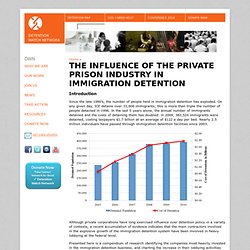
On any given day, ICE detains over 33,000 immigrants; this is more than triple the number of people detained in 1996. In the last 5 years alone, the annual number of immigrants detained and the costs of detaining them has doubled: in 2009, 383,524 immigrants were detained, costing taxpayers $1.7 billion at an average of $122 a day per bed. Nearly 2.5 million individuals have passed through immigration detention facilities since 2003. U.S. Private Prison Population Grew 37 Percent Between 2002-2009 As Industry Lobbying Dollars Grew 165 Percent. By Zaid Jilani on September 26, 2011 at 1:40 pm "U.S.

Private Prison Population Grew 37 Percent Between 2002-2009 As Industry Lobbying Dollars Grew 165 Percent" Today, the Michigan Messenger reports about how the private prisons behemoth Corrections Corporations of America grew over the last decade, expanding both its prisoner population and its political clout. The Messenger cites data from the U.S. Department of Justice showing that the private prison population grew from 87,369 to 129,336 from 2000 to 2009: Then, citing figures from the Justice Policy Institute, the Messenger notes that lobbying dollars from the major private prison operators grew from $840,885 to $1,391,056 from 2002 to 2009: This means that as industry lobbying dollars increased 165 percent between 2002 and 2009, the U.S. private prison population grew 37 percent. Unholy Alliance. How the private prison industry is corrupting our democracy and promoting mass incarceration New report from: November 15, 2011 Introduction Many Americans were shocked to learn that two Pennsylvania judges accepted “cash-for-kids,” kickbacks from for-profit juvenile detention companies in exchange for locking up young people for very minor offenses.
Yet the reality is that private prison lobbyists regularly buy influence with state and federal officials, not only to win lucrative contracts, but also to change or preserve policies that increase the number of people behind bars. A Brief History of Private Prisons in Immigration Detention. Although the number of privately managed immigration detention beds has grown drastically since 1996, corporations have actually dominated the field for more than two decades.
In fact a contract between the INS and the newly formed Corrections Corporation of America (CCA) gave birth to the private prison industry itself in 1983. Since then, dozens of other companies have emerged to compete for government contracts not only in detention operations, but in peripheral industries such as prison construction and correctional officer services. Companies that run private prisons are responsible to their shareholders, not to the public. The incentive to maximize profit leads private corrections groups to cut expenses by, among other things, keeping facilities chronically understaffed, leading to higher rates of human rights violations and violence (1), and paying significantly less than their public counterparts. In 2010, a CCA supervisor at the company’s T. David Donnelly: Private Prisons Industry: Increasing Incarcerations, Maximizing Profits and Corrupting Our Democracy. Earlier this year in Louisiana, a plan by Gov.

Bobby Jindal (R-LA) to privatize prisons narrowly failed in a legislative committee by a vote of 13 to 12. The 12 members of the House Appropriations Committee who voted to approve the prison privatization plan have received more than three times more money from private prison donors than the 13 members who voted against the plan, according to an analysis of data from the Louisiana Ethics Administration and the National Institute on Money in State Politics. Gov. Jindal himself has taken nearly $30,000 from the private prison industry. This is but one example of many in a new report from Public Campaign and PICO National Network, Unholy Alliance: How the Private Prison Industry is Corrupting Our Democracy and Promoting Mass Incarceration, highlighting the increasingly powerful and influential private prison industry.
This isn’t an accident.