
Fig and Plum. Crazy Aunt Purl. …and does other crafty things too.
Sock prØn. Yarns of the heart. Urban Yarns Vancouver - Buy Premium Yarn Online. We Do Not Have A Knitting Problem. Knitting has an image problem.
Some might say, right? I know before blogging and being active in my local stitch n bitch, I certainly had my stereotypes about knitting and knitters. I remember it was my sister who told my boyfriend that I knit. I had left that out for a good month or so. I didn't know what he would think. Back to that image problem. In the Loop: Knitting Now explores the progression of knitting, a craft which has come a long way from its fuzzy image of thick socks, long shawls and embarrassing motifs on Christmas jumpers. Knitting Blog Chic Knits. Knitting Blog: Bonne Marie Burns Rambles on... Amazed knitter's patterns. Knitting a carpet. It's fairly easy.
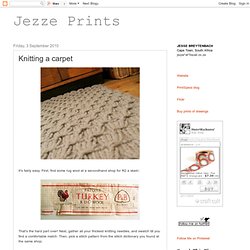
First, find some rug wool at a secondhand shop for R2 a skein: That's the hard part over! Next, gather all your thickest knitting needles, and swatch till you find a comfortable match. Then, pick a stitch pattern from the stitch dictionary you found at the same shop: Tassel stitch, apparently. I couldn't find it online to link to, so here goes: Irisheyes knitting blog. Peruvian Knitting Sample 1. Knitting before Newton. Lack of evidence for existence may or MAY NOT be evidence of non-existence.
Lack of evidence may simply be good evidence for moths, mold, damp, hearths without chimneys, and frogging for reuse. Lack of evidence may be a problem with experimental design or the mechanics of the sampling methodology. Knitting Elegance KAL. A to Z: P is for Peru. Peru is a land of two cultures, where colonial heritage and creole culture thrive by the sea, and where earflaps (as imitated at left), Quechua, camelids, Incan ruins, and textiles thrive in the highlands & mountains.
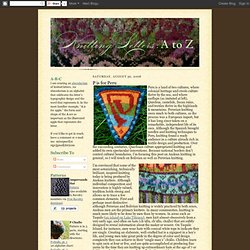
Peruvian knitting owes much to both cultures, as the process was a European import, but it has long since taken on a remarkable, independent life of its own. D a n c e s W i t h W o o l. Yarns of the heart. Irish Tradition and Swedish Couture. The thermometer read 14 below last night.
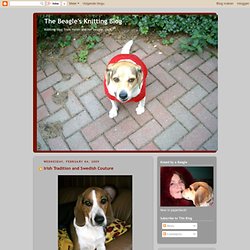
That's when you throw another log on the fire, snuggle up with your beagle, and take up the knitting needles. An entire evening of knitting and the cabled baby cardi Trellis came off the needles and got itself some seams and buttons. And not one minute too soon, either. It's for my grandnephew Will's first birthday in North Carolina this Saturday.
The yarn is Rowan's All-Season Cotton (which is actually 40% poly, making the sweater much lighter than an actual 100% cotton garment). To say that I love the way this sweater turned out is an understatement. Love2knit Bilingual Knitting Blog (English/Spanish) Rndnrnd we knit. Sue Knits. Latvian & Andean knitting. I’m relying on Upitis and Gravelle Lecount (full reference in Knitting Books list) for this short section that focuses on color and design in Latvia and the Andes.
As we saw with knitting from Fair Isle, the Faroe Islands, Norway, Sanquhar, and Bohus, color and design were traditionally associated with a particular place. Some designs and color combinations might start in a single place, like the mittens of Selbu, and then come to represent the entire country. Coventry Knit-Wits. Knit Witch Blog. Icelandic Knitting Fever and progress on 1 Sock Blanket. During our trip around Iceland I was amazed at how many shops stocked knitting wool. I couldn't resist buying enough wool for a cardigan, and a great pattern. I will just have to learn a bit of Icelandic to read the pattern.... KnitPick needles are the chosen weapon of Icelandic, and you can buy then where ever you buy wool. Remarkably, they were a reasonable price in Iceland, cheaper than I can get in Germany, and I got a tax refund at the airport on the way out. While I was in the shop choosing a pattern Cameron had the camera.
Me, looking through patterns books to find just the right souvenir. We found this pattern for a horse jumper. I also bought wool for mittens as well, the patterns we saw in the stores were fantastic. I see on the website, the pattern book I bought comes in English....but where is the fun in that??? Meanwhile, I have been using up left over sock wool to increase the size of this sock wool blanket. Celtic Memory Yarns. Yellow Ribbon Baby Hat/Bonnet. Lacefreak. Search results for Herbert Niebling. Been gone so long that I have a backlog of things I have been working on.
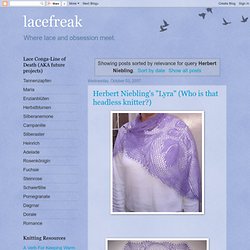
Last year I had things to deal with that ate up all my time and attention. I managed to sort of keep up with Ravelry but little else. Since my life has now calmed down to the point where I can see my way to posting on the blog again, these are catch-up pictures of some of the things I got done. Sewing down a picot edge. This is how I finished off the picot edge on the toe up socks in the previous entry.
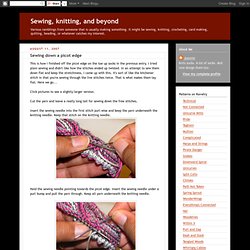
I tried plain sewing and didn't like how the stitches ended up twisted. In an attempt to sew them down flat and keep the stretchiness, I came up with this. It's sort of like the kitchener stitch in that you're sewing through the live stitches twice. That is what makes them lay flat. Here we go... Click pictures to see a slightly larger version. Cut the yarn and leave a really long tail for sewing down the free stitches.