
A manifesto – Apps for Smart cities. Apps for Smart cities is a unique event at the intersection of technology and society.
Putting people and ‘grassroots/ Long Tail’ innovation at the heart of Smart cities, speakers at the Apps for Smart Cities event will share real life experiences from their work including demos and videos. The discussion will cover a range of topics including Air pollution monitoring, helping people with disabilities, Urban farming, Next generation art, Parking vehicles, The Web, Real time news and updates from sensors, Citizens participation, Quantified self(healthcare), citizens involvement etc. The event brings together international perspectives with speakers from USA, UK, China, Ireland, Germany and others to Amsterdam. Apps for Smart cities lays the foundation of a new cross-functional community. Date : March 29 at the RAI (one of Amsterdam’s largest venues). Pricing is free for developers: for other tickets please contact me at the email address below.
. - Sensible – sensors sensing the environment. Willkommen : Audi Urban Future Initiative. The City of the Future. The City Is A Battlesuit For Surviving The Future. Cities always provided a protective function, and it's one of the tragedies of our time that, e.g. in the case of new orleans, they are not capable of providing that function (due to various reasons)...some quotes and some remarks on the great article: "...the way the street feels may soon be defined by what cannot be seen by the naked eye.
" a rather mcluhanesque euphoria washes over me right now and is gone rather quickly. i would wonder how differential perceptibility generated by some kind of digital gadget (which the quote implies, i guess?) Influences the egalitarian character of society... Smart urban stage. Urban Age. Data Deluge Makes Smart Cities Smarter. Exosquelette : la révolution piétonne en marche. Avec la fin de la voiture d'une tonne au sein des villes, les petits véhicules seront roi et surtout, surtout, le piéton va reprendre sa suprématie.
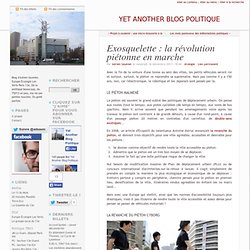
Mais pas comme il y a 150 ans, non, car l'électronique, la robotique et les Japonais sont passés par là. Le piéton malmené Le piéton est souvent le grand oublié des politiques de déplacement urbain. ESTUARY OF THE THAMES, A NEXT EUROPEAN HUB ? L'estuaire de la Tamise peut-il devenir d'ici une vingtaine d'années le grand hub multimodal de l'Europe ?
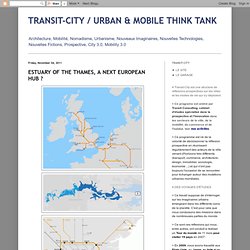
C'est en tout cas l'ambition du projet présenté par les cabinets Halcrow et Foster + Partners avec leur très stimulant "Thames Hub - An integrated vision for Britain ". L'ambition, la voilà : "Britain can no longer trade on an inadequate and aged infrastructure. A fast-growing population and an evolving global economy demand that the quality of the UK’s infrastructure be improved and its capacity increased dramatically.
The study describes proposals for a Spine which combines rail, energy, communications and data running the length of the UK. L’écologie graphique de la ville et sa disparition. Publicité, graffiti, signalisation, affiches politiques...
Les signes, souvent éphémères, recouvrent nos villes. [pop-up] urbain - [pop]servatoire d'urbanités. Global cities of the future: An interactive map - McKinsey Quarterly - Economic Studies - Productivity & Performance. Over the next 13 years, 600 cities will account for nearly 65 percent of global GDP growth.
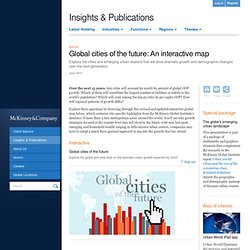
Which of them will contribute the largest number of children or elderly to the world’s population? Which will rank among the top 25 cities by per capita GDP? Self–Repairing Architecture. All buildings today have something in common: They are made using Victorian technologies.
This involves blueprints, industrial manufacturing and construction using teams of workers. All this effort results in an inert object, which means there is a one–way transfer of energy from our environment into our homes and cities. This is not sustainable. I believe that the only possible way for us to construct genuinely sustainable homes and cities is by placing them in a constant conversation with their surroundings. In order to do this, we need to find the right language. By Rachel Armstrong Metabolic materials are a technology that acts as a chemical interface or language through which artificial structures such as, architecture, can connect with natural systems.
Blog for street art and urban culture.
The Pop-Up City. City Crawlers Berlin. The Information Architecture of Cities Cities can be viewed as information architecture systems. The term makes sense not in reference to the the design of buildings, but rather to the components of a complex system that interact with each other.
An urban sustainability, green building, and alternative transportation community. TOURS ABANDONED AS VERTICAL SLUMS OF THE FUTURE ? Pour prolonger mes récentes réflexions sur la forme des bidonvilles dans les années à venir (voir là), je voulais vous proposer ces quelques images tirées de l'exceptionnel et passionnant travail conduit par Mikhael Subotzky et Patrick Waterhouse sur la tour Ponte City située au coeur de Johannesburg (Plus de photos, là.)
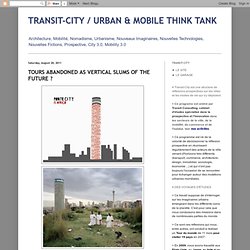
Construite en 1976, année des premiers soulèvements de Soweto, elle fut désertée peu à peu après la fin de l'apartheid en 1994, par la bourgeoisie blanche qui l'occupait jusque là et qui fuyait l'insécurité du centre ville pour rejoindre les gated communities des banlieues riches du nord. La tour est ainsi devenue sur ses 54 étages un improbable lieu d'abandon, de prostitution, de squats en tous genres, de violence. Cities in Fact and Fiction: An Interview with William Gibson. The city looms large in the fiction of author William Gibson.
In the September issue of Scientific American, Gibson's essay, "Life in the Meta-City," details how cities increase "the number and randomization of potential human and cultural contacts" and how they serve as "vast, multilayered engines of choice. " Cities that cease to provide choice—or which try to overcontrol their denizens—lose their spark and sometimes perish.
In the interview that follows, Gibson shares his perceptions about existing cities and their links to his fiction. Street Markets and Shantytowns Forge the World's Urban Future. The Windowfarms Project. The World Park—an event in Central Park Arbor Day Weekend 2010. Event Information *Our first event has passed.

Play The World Park An Arbor Day Weekend Event in New York's Central Park. Dates: Friday, April 30th / Saturday May 1st, 2010 Location: Southeastern corner park entrance on 59th Street and Grand Army Plaza. Time: 10am-6pm. Join The World Park attendees on Facebook and mingle with the Central Park animals. Back to Menu The Experience—What is 'The World Park'? The World Park is a mobile interactive experience that raises awareness and engagement for our city parks. How to get started: All you need is a web-enabled smartphone and a Parkode™ or Qr-Code reader (Headphones are also recommended). ITO World. WorkSnug.