
Can Open Government Be Gamed? If information is power, the first step to gaining power is to get the right data.
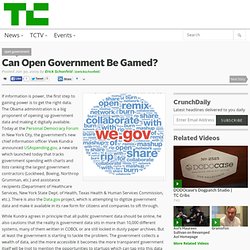
The Obama administration is a big proponent of opening up government data and making it digitally available. Today at the Personal Democracy Forum in New York City, the government’s new chief information officer Vivek Kundra announced USAspending.gov, a new site which launched today that tracks government spending with charts and lists ranking the largest government contractors (Lockheed, Boeing, Northrop Grumman, etc.) and assistance recipients (Department of Healthcare Services, New York State Dept. of Health, Texas Health & Human Services Commission, etc.).
There is also the Data.gov project, which is attempting to digitize government data and make it available in its raw form for citizens and companies to sift through. Digital tools are bringing participation back to democracy, or at least that is the idea. Except there is one big problem: indifference. John Hunter: Teaching with the World Peace Game. Reality Drop: Spread Science about Climate Change, Global Warming. World Peace Game Foundation. Harnessing Collective Intelligence with Games 2012. Jane McGonigal: The game that can give you 10 extra years of life. SuperBetter. How games can organize millions of people to accomplish great things (book excerpt) By Adam L.
Penenberg On October 4, 2013. Synthesis: How Games Could Save the World. Reality Is Broken: Why Games Make Us Better and How They Can Change the World, Jane McGonigal, Penguin Press, 2011 Game Developers Conference,www.gdconf.com Abdul Latif Jameel Poverty Action Lab,www.povertyactionlab.org.
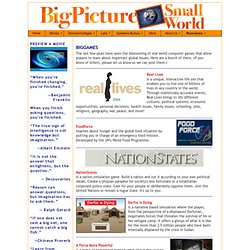
Top 10 Social Gamification Examples and Cases that Save the World. Ingress. BigGames. The last few years have seen the blossoming of real world computer games that allow players to learn about important global issues.
C.F.O.I.R. Earth OS. Project 10X: A Game-Changing Approach to Growing 21st Century 'Leadership Everywhere' Jane McGonigal: Gaming can make a better world. EarthGame—Welcome. EarthGame™ is a massively multiplayer online strategic design and planning real-world "game.
" It is also a set of tools for recognizing, defining and solving global and local problems onboard Spaceship Earth. It combines the vast and growing wealth of global data available on the web with sophisticate data visualization techniques, embeds these within a powerful strategic planning and design methodology, and places all this into a gaming context. The EarthGame is being developed by EarthGame Inc. a non-profit research and education organization. For more information and to learn how you can get involved, contact us here. EarthGame Tools The dashboard of a vehicle describes the present state of the condition of the vehicle— it’s speed, remaining fuel, engine temperature, etc. Creating the EarthGame. Proposal for a World Brain Institute and Development of a Global Game. Robert David Steele Vivas December 26, 2012.
Story-Based Games as Transformational Media. Story-Based Games as Transformational Media In John Stewart’s posting, “Flow Engineering using computer games,” he begins to “sketch some ways in which computer game frameworks can be used to promote the positive development of humanity, both as individuals and collectively.”
The general subject of transformative media is directly relevant to another conference venue, Social Approaches to Consciousness, and together they become a mandate for meaningful media. The term media covers a lot of ground, and it is by virtue of an infinite array of mediation that humans learn about their environment, themselves, their cultural values, and the meaning underlying the patterns of their lives. I think that the discovery of relative meaning (personal or collective) is the essence of the “Flow” experience in its many forms. Games and the Common Core: Two Movements That Need Each Other. Recently I witnessed two expert panels discussing critical issues for our educational system -- on the same day.
The first one was on implementing the Common Core for English-language learners; the second was on how games offer an exciting new frontier for student learning and engagement. In the morning, I listened in to an Alliance for Excellent Education panel including Stanford professor Kenji Hakuta and Carrie Heath Phillips, director of Common Core implementation at the Council of Chief State School Officers. That evening, I went to Stanford to hear a panel on Education’s Digital Future that included professors James Paul Gee of Arizona State and Constance Steinkuehler of the University of Wisconsin - Madison.
I was struck by two things: 1) How neither community of experts mentioned the other, and 2) how these two "movements" urgently need to work together. They need each other. Student Choice Dr. Hive-mind solves tasks using Google Glass ant game - tech - 05 August 2013. GOOGLE Glass could soon be used for more than just snapping pics of your lunchtime sandwich.
A new game will connect Glass wearers to a virtual ant colony vying for prizes by solving real-world problems that vex traditional crowdsourcing efforts. Crowdsourcing is most famous for collaborative projects like Wikipedia and "games with a purpose" like FoldIt, which turns the calculations involved in protein folding into an online game.
All require users to log in to a specific website on their PC. Now Daniel Estrada of the University of Illinois in Urbana-Champaign and Jonathan Lawhead of Columbia University in New York are seeking to bring crowdsourcing to Google's wearable computer, Glass. The pair have designed a game called Swarm! Game mechanics for causes – Catalysts for Change – Evolution of Philanthropy. Nothing is more captivating than a well-thought out game.
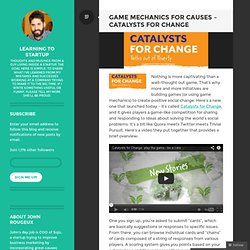
That’s why more and more initiatives are building games (or using game mechanics) to create positive social change. Wisdom, Games, and Mindfulness. Gamification to improve our world: Yu-kai Chou at TEDxLausanne. Catalysts for Change: Paths out of Poverty. Game for Change: Fate of the World. New Computer Game Simulates Challenges of Global Warming A British company has developed a new computer game that allows players to save the planet from the effects of global warming — at least in a simulated setting. “Fate of the World,” produced by the gaming company Red Redemption, places players at the head of a global environmental organization — a “UN with teeth” — charged with saving the world over the next 200 years in the face of rising temperatures, diminishing resources, disappearing ecosystems, and growing population. Using actual climate models and data from scientists at the University of Oxford, players can confront these challenges globally through a variety of policies — including cap-and-trade, promotion of renewable energy, and geoengineering schemes.
“In many ways, it’s just a very complex puzzle,” Matt Giles Griffiths, one of the designers, told the New York Times. Welcome to the Superstruct Game Archive. Manifesto: The 21st Century Will Be Defined By Games. Previous centuries have been defined by novels and cinema. In a bold manifesto we’re proud to debut here on Kotaku, game designer Eric Zimmerman states that this century will be defined by games.ore Below is Zimmerman’s manifesto, which will also appear in the upcoming book The Gameful World from MIT press. We invite you to read it, to think about it and even to annotate it. Zimmerman’s manifesto is followed by an exploration of the ideas behind it, in an essay by author and professor Heather Chaplin. In the days to come, we’ll be expanding the discussion even further with perspectives from other gamers and game-thinkers.
Win the Planet – games that change the world! Top 10 Social Gamification Examples and Cases that Save the World. Urgent Evoke - A crash course in changing the world. The Playpump: How a Simple Gamification Concept can Save the (third) World. New to Gamification? Check out my post What is Gamification & my Gamification Framework: Octalysis Gamification visits the Third World Most of the time, we think of Gamification as a technique to get consumers to like our products more, to be more productive in life, and improve our workplace, but Gamification can sometimes be used to save an entire nation. While we enjoy our Twitter, iPhones, Starbucks, and Reality Shows, many third world country nations are literally thirsty for clean water. By Rajat Paharia, Founder of Bunchball & Father of Gamification.
iGAM4ER. The Game of Collaboration. HipBone Games Welcome. It's been a while: click on the update button for details. Welcome to HipBone's site. The HipBone Games are so simple a child can play them: if you've ever thought, "and that reminds me", or "isn't that like such and such", you've already got the basic idea. We call them "HipBone Games" because of the old song, "the hip-bone connected to the thigh-bone", and because they are games of connection, of the links between ideas. PSFK Gaming For Good Report. Games for Change is the leading global advocate for supporting and making games for social impact.
Games for Change. Introducing a Game-Based Curriculum in Higher Ed. Educating Players: Are Games the Future of Education? CAMBRIDGE, Mass. —Smart phones, tablets and video game systems are often seen as distractions to school children in developed countries, which tend to adhere to a strict teacher-student educational model. The Gamification of Education and Cognitive, Social, and Emotional Learning Benefits. Guest post by Jane Wolff. The current trend towards the increased use of games and game mechanics in instructional situations could probably have been foreseen quite some time ago. Games for Impact - by IdeaScale. Can a mobile game help find the cure for cancer? Amazon, Google and Facebook hope so. Games that Can Change the World. Posted by Mark DeLoura on December 13, 2013 at 03:44 PM EDT.
Logiciel de gestion de comportement - ClassDojo. Ludicité - Gamification et jeux dans l'espace public. Socialgames4good-big_0.png (Image PNG, 4019x2541 pixels) - Redimensionnée (31%) GTI-Perspectives-Game_On.pdf. Social Gaming for Social Change: Introduction and Opportunities. These kickass games let you do real-life science.