
Imagining the Tenth Dimension. Chaos theory. A double rod pendulum animation showing chaotic behavior.
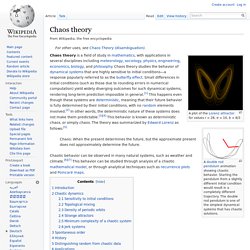
Starting the pendulum from a slightly different initial condition would result in a completely different trajectory. The double rod pendulum is one of the simplest dynamical systems that has chaotic solutions. Chaos: When the present determines the future, but the approximate present does not approximately determine the future. Chaotic behavior can be observed in many natural systems, such as weather and climate.[6][7] This behavior can be studied through analysis of a chaotic mathematical model, or through analytical techniques such as recurrence plots and Poincaré maps. Introduction[edit] Chaos theory concerns deterministic systems whose behavior can in principle be predicted. Chaotic dynamics[edit] The map defined by x → 4 x (1 – x) and y → x + y mod 1 displays sensitivity to initial conditions. In common usage, "chaos" means "a state of disorder".[9] However, in chaos theory, the term is defined more precisely.
21. Chaos and Reductionism. The Alignment System - Chaotic Good. A chaotic good character acts as his conscience directs him with little regard for what others expect of him.

He makes his own way, but he's kind and benevolent. He believes in goodness and right but has little use for laws and regulations. He hates it when people try to intimidate others and tell them what to do. He follows his own moral compass, which, although good, may not agree with that of society. Building the Brain: From Simplicity to Complexity. A Magic Number - Sixty Symbols. Supersymmetry Fails Test, Forcing Physics to Seek New Ideas. From Simons Science News As a young theorist in Moscow in 1982, Mikhail Shifman became enthralled with an elegant new theory called supersymmetry that attempted to incorporate the known elementary particles into a more complete inventory of the universe.

“My papers from that time really radiate enthusiasm,” said Shifman, now a 63-year-old professor at the University of Minnesota. Over the decades, he and thousands of other physicists developed the supersymmetry hypothesis, confident that experiments would confirm it. “But nature apparently doesn’t want it,” he said. “At least not in its original simple form.” What is Chaos? An Interactive Online Course for Everyone.
Lateral thinking. Lateral thinking is solving problems through an indirect and creative approach, using reasoning that is not immediately obvious and involving ideas that may not be obtainable by using only traditional step-by-step logic.

Maze Design. We've been working on producing mazes by computer, with input from a human designer.
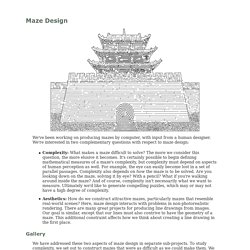
We're interested in two complementary questions with respect to maze design: Complexity: What makes a maze difficult to solve? The more we consider this question, the more elusive it becomes. Solving the Complexity of Communicating. Masterbreak.jpg (1200×785) Part 1 - T. A. Z.: The Temporary Autonomous Zone, Ontological Anarchy, Poetic Terrorism. CHAOS: THE BROADSHEETS OF ONTOLOGICAL ANARCHISM was first published in 1985 by Grim Reaper Press of Weehawken, New Jersey; a later re-issue was published in Providence, Rhode Island, and this edition was pirated in Boulder, Colorado.
Another edition was released by Verlag Golem of Providence in 1990, and pirated in Santa Cruz, California, by We Press. "The Temporary Autonomous Zone" was performed at the Jack Kerouac School of Disembodied Poetics in Boulder, and on WBAI-FM in New York City, in 1990. Thanx to the following publications, current and defunct, in which some of these pieces appeared (no doubt I've lost or forgotten many--sorry!)
: KAOS (London); Ganymede (London); Pan (Amsterdam); Popular Reality; Exquisite Corpse (also Stiffest of the Corpse, City Lights); Anarchy (Columbia, MO); Factsheet Five; Dharma Combat; OVO; City Lights Review; Rants and Incendiary Tracts (Amok); Apocalypse Culture (Amok); Mondo 2000; The Sporadical; Black Eye; Moorish Science Monitor; FEH! BBC Documentary - Stupidity "Full Movie" Web. 15 Styles of Distorted Thinking. List of cognitive biases. Systematic patterns of deviation from norm or rationality in judgment Cognitive biases are systematic patterns of deviation from norm and/or rationality in judgment.
They are often studied in psychology, sociology and behavioral economics.[1] Although the reality of most of these biases is confirmed by reproducible research,[2][3] there are often controversies about how to classify these biases or how to explain them.[4] Several theoretical causes are known for some cognitive biases, which provides a classification of biases by their common generative mechanism (such as noisy information-processing[5]). Gerd Gigerenzer has criticized the framing of cognitive biases as errors in judgment, and favors interpreting them as arising from rational deviations from logical thought.[6] Explanations include information-processing rules (i.e., mental shortcuts), called heuristics, that the brain uses to produce decisions or judgments. Belief, decision-making and behavioral[edit] Social[edit] [edit] Fallacy of composition. The fallacy of composition arises when one infers that something is true of the whole from the fact that it is true of some part of the whole (or even of every proper part).
For example: "This fragment of metal cannot be fractured with a hammer, therefore the machine of which it is a part cannot be fractured with a hammer. " This is clearly fallacious, because many machines can be broken apart, without any of those parts being able to be fractured. This fallacy is often confused with the fallacy of hasty generalization, in which an unwarranted inference is made from a statement about a sample to a statement about the population from which it is drawn. The fallacy of composition is the converse of the fallacy of division.
Examples[edit] You Are Not So Smart. 25 Acts of Body Language to Avoid. Our body language exhibits far more information about how we feel than it is possible to articulate verbally.
All of the physical gestures we make are subconsciously interpreted by others. This can work for or against us depending on the kind of body language we use. Some gestures project a very positive message, while others do nothing but set a negative tone. Most people are totally oblivious to their own body language, so the discipline of controlling these gestures can be quite challenging. Most of them are reflexive in nature, automatically matching up to what our minds are thinking at any given moment. Nevertheless, with the right information and a little practice, we can train ourselves to overcome most of our negative body language habits.
Practice avoiding these 25 negative gestures: “ I speak two languages, Body and English. ” — Mae West Holding Objects in Front of Your Body – a coffee cup, notebook, hand bag, etc. Want to know powerful, dominant, confident body language postures? Pharmaceuticals and Biotechnology - Find Pharmaceuticals and Biotechnology Vendors. With new developments in the world of pharmaceuticals and biotechnology, this sector of the industry has more jobs available than many other areas of the health care industry.

Many health care industry analysts are forecasting that biopharmacology–the process of using living organisms such as yeasts, bacteria, proteins, or cell cultures in the development and manufacturing of medicine--will grow even further over the next several years. There are many biopharmaceutical jobs which you can choose to explore. This industry is in great need of dedicated researchers. Biotechnology and pharmaceuticals require intense research and development in order to develop new products and medicines. Cutting-edge techniques in the field mean that engineers and technicians are also needed in this industry. Emergent Reality - The Sea of Organic Recursion. Chaos & Complexity Pdf Library > GaianXaos. Quantum Entanglements 1, I. Quantum Entanglement.
Quantum Entanglement It is possible for a particle to interact with another particle in such a way that the quantum states of the two particles form a single entangled state.
For the First Time, Humans See Quantum Entanglement With the Naked Eye. Physicists at the University of Geneva in Switzerland have devised a new kind of quantum experiment using humans as photon detectors, and in doing so have made the quantum phenomenon of entanglement visible to the naked eye for the first time. For those that need a primer, entanglement is that strange quantum phenomenon that links two particles across distances such that any any measurements carried out on one particle immediately changes the properties of the other--even if they are separated by the entire universe. Einstein called it "spooky action at a distance. " And indeed it is weird. Nicolas Gisin at U. of Geneva noted that Italian physicists had previously done an interesting thing with entangled photons.
Quantum Entanglement. Tossing a pebble into a pond creates ripples that travel from where the pebble landed to the edge of the pond. The ripples are also called waves. Another way to make waves is with a long rope. If you swing your arm up and down while holding the rope (as in Figure 2.1), you can see waves start from your hand and disappear off the end; moving the rope faster makes more waves. Figure 2.1. Making Vertical Waves. Waves have three important properties: frequency, amplitude, and wavelength. Emergence - Complexity from Simplicity, Order from Chaos (1 of 2) Hyperchaos. A hyperchaotic attractor is typically defined as chaotic behavior with at least two positive Lyapunov exponents. Combined with one null exponent along the flow and one negative exponent to ensure the boundness of the solution, the minimal dimension for a (continuous) hyperchaotic system is 4.
The first hyperchaotic system. How Quantum Suicide Works". A man sits down before a gun, which is pointed at his head. This is no ordinary gun; it's rigged to a machine that measures the spin of a quantum particle. Each time the trigger is pulled, the spin of the quantum particle -- or quark -- is measured. Depending on the measurement, the gun will either fire, or it won't. If the quantum particle is measured as spinning in a clockwise motion, the gun will fire. BrainWave Generator.