
Fifty (50!) Tools which can help you in Writing. Psychology Today - StumbleUpon. Writing a novel?

There's first-draft flow, and there's editing flow. And then there comes a time when you think you might be done, yet the manuscript is still not quite "there. " To sell your work to an agent, and then to a publisher, and finally to a great many readers, put thoughts of flow aside now, and consider the following advice. Each of the guides mentioned is worthy of your careful attention. , such as "Danielle was a woman of medium height with brown hair and brown eyes.
" , such as: "He shaved, and then he wiped off the shaving cream," "She walked to the corner, and she looked both ways," or "We opened the door, and we found the mail on the porch. " . Such as the following: the difficult task, both share, blend together, on account of, considering the fact that, report back. 7 Habits of Serious Writers.
Image credit: aless&ro With thanks to Michael Pollock for the article suggestion and title.

I’ve been writing, on and off, since my early teens – but it’s only in the last three years that I’ve really taken my writing seriously. It’s made a dramatic difference. I write far, far more. I write better. In the past few years, I’ve been lucky enough to work alongside all sorts of great writers, during my MA in Creative Writing, and in my freelancing. Habit #1: Writing To be a serious writer, you have to write. Daily Writing Tips. Read These Seven Books, and You'll be a Better Writer. Donald Miller I used to play golf but I wasn’t very good.

I rented a DVD, though, that taught me a better way to swing, and after watching it a few times and spending an hour or so practicing, I knocked ten strokes off my game. I can’t believe how much time I wasted when a simple DVD saved me years of frustration. I’d say something similar is true in my writing career. If you read these books, your writing will improve to the point people who read your work will begin to comment on how well you write. . • The War of Art by Steven Pressfield: 50 Strategies For Making Yourself Work. Written by Jerry Oltion Copyright © 2001 by Jerry Oltion Work avoidance is one of the major paradoxes of the writing profession.
Generally, writers want to write (or want to have written), but all too often we find ourselves doing anything else but.
Better Writing. How to Recover Your Writing Confidence (Even if You Think You Never Had Any) (Image from Flickr by hans s) No writer I know ever feels totally confident about their writing.
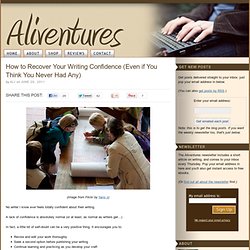
A lack of confidence is absolutely normal (or at least, as normal as writers get…) In fact, a little bit of self-doubt can be a very positive thing. Write Street: 10 Easy Steps to Becoming a Better Fiction Writer. The urge to write fiction seems God-given for some, a learned skill for others.

One thing is certain – it requires practice and a particular mindset. But, if you’re a beginner, where do you start? The following 10 tips will help kick-start your writing habit, whether you’re a complete novice, or perhaps a pro who has lost their way! 1. Step Away From the Car, Sir Slightly detach yourself from your surroundings. I'm a Writer - 6 Writers Secrets. Writers spend a lot of time inside the depths of their own heads.
I’m a writer, I know we can’t help it. No matter the size of our office, it is the inside of our mind where the majority of our work is done. Whether writing great copy or doodling with our own fiction, we are often left to our own devices, spoiled on solitude and self management. Though every writer is indeed an individual, I suggest there are at least 6 secrets every writer shares. 1) We fall behind on our deadlines or word count due to nothing but our own faulty management and then feel the looming pressure to neatly knot the loose ends. 25 Things You Should Know About Storytelling.
1.

Stories Have Power Outside the air we breathe and the blood in our bodies, the one thing that connects us modern humans today with the shamans and emperors and serfs and alien astronauts of our past is a heritage — a lineage — of stories. Stories move the world at the same time they explain our place in it. They help us understand ourselves and those near to us. Never treat a story as a shallow, wan little thing. 2. We love to be entertained. 3. Segmentation. 25 Virtues Writers Should Possess. 1.

A Wild And Unfettered Imagination This one goes up front: the bubbling turbid stew that comprises your brain-mind combo must possess an endless array of unexpected ideas. Your head should be an antenna receiving frequencies from the furthest-flung reaches of Known Creative Space. 25 Things Every Writer Should Know. An alternate title for this post might be, “Things I Think About Writing,” which is to say, these are random snidbits (snippets + tidbits) of beliefs I hold about what it takes to be a writer.

I hesitate to say that any of this is exactly Zen (oh how often we as a culture misuse the term “Zen” — like, “Whoa, that tapestry is so cool, it’s really Zen“), but it certainly favors a sharper, shorter style than the blathering wordsplosions I tend to rely on in my day-to-day writing posts. Anyway. Peruse these. Absorb them into your body. Let your colonic flora digest them and feed them through your bloodstream to the little goblin-man that pilots you. Feel free to disagree with any of these; these are not immutable laws. Buckle up. 1. The Internet is 55% porn, and 45% writers. Unmissable articles on writing. » 9 Ways to Find the Time to Write. Writing Your First Novel. You finish reading another great novel and daydream about being the hero or heroine in the story.
And sigh. "Some day," you promise yourself, "I'm going to write a novel of my own. " Maybe now is a good time. This article will give you the key steps to get started. Many folks are turning to thoughts of self-achievement, which may include writing a novel. Eight Secrets Which Writers Won’t Tell You. Image from Flickr by Lazurite This is not particularly relevant to the post, but I’m getting an awful lot of comments telling me, often a little snarkily, “it’s ‘THAT’ not ‘WHICH’”. 9 Editing Tips that Make Your Writing Sparkle. It’s often said that writing is rewriting. Banging out a quick first draft can be fun, but the real grunt work comes in revising your work. Here are nine editing tips that can help you polish your writing until it sparkles: 33 Ways To Stay Creative. 8 Unstoppable Rules For Writing Killer Short Stories.
6 Writers Who Broke the Rules and Got Away with It. Have you ever read a book and noticed the author has broken what we writers often hear of as “the rules”? My initial reaction is usually indignation: “Why can she get away with that, and I can’t??” The more I study the craft of writing, the more rules I hear about, and most of these are guidelines based on making a book reader-friendly. As much as I believe it’s good practice to avoid the common pitfalls of beginning writers, there are always exceptions to every rule.
Here are six commonly heard rules for writers, and six authors who’ve gotten away with breaking them. (By ‘gotten away with’, I mean being published, selling tons of copies, and in some cases, winning awards): Rule: Don’t write in First Person, Present Tense Audrey Niffenegger, The Time Traveler’s Wife: Niffenegger’s popular title is told by dual narrators from the first person point of view, in the present tense. Rule: Keep your novel under 100,000 words. 9 Editing Tips that Make Your Writing Sparkle. Fantasy: Getting Started. By Sandra C. Durham © 2003, Sandra C. A new tip for productivity. INSTRUCTIONS TO WRITTING YOUR EPIC. Writing.org - Advice for Freelance Writers.
11 Famous Writers Who Were Rejected Before Making It Big - BubbleCow - StumbleUpon. Eight Secrets Which Writers Won’t Tell You. 30 Skills for Writers. 7 Habits of Serious Writers — Aliventures - StumbleUpon. 17 Crazy Places to Get Jaw Dropping Headline Ideas. Headlines are bloody important. The best blog authors write irresistible headline and titles. Magazines with millions of subscribers fill every issue with juicy headlines. Top Gun copywriters spend hours brainstorming hundreds of headlines BEFORE they write. Why Fiction is So Hard to Write. I’ve been blogging for a little over three years. I’ve been writing fiction since … well, pretty much since I could write. My blog posts are read by thousands of people. 5 situations where it's better to tell than show in your fiction. 25 Things Every Writer Should Know - StumbleUpon. How to Recover Your Writing Confidence (Even if You Think You Never Had Any) The Four Essential Stages of Writing. Image by photosteve101 In last week’s post, 7 Habits of Serious Writers, I mentioned the importance of actually writing, plus the need to redraft.
Story Structure Series.