
Five Ws. The Five Ws, Five Ws and one H, or the Six Ws are questions whose answers are considered basic in information-gathering.
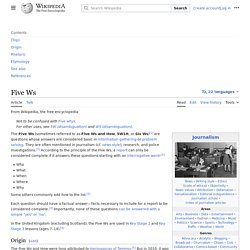
They are often mentioned in journalism (cf. news style), research, and police investigations.[1] They constitute a formula for getting the complete story on a subject.[2] According to the principle of the Five Ws, a report can only be considered complete if it answers these questions starting with an interrogative word:[3] 5 Whys. The 5 Whys is an iterative question-asking technique used to explore the cause-and-effect relationships underlying a particular problem.[1] The primary goal of the technique is to determine the root cause of a defect or problem.
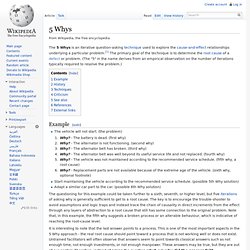
(The "5" in the name derives from an empirical observation on the number of iterations typically required to resolve the problem.) Example[edit] The vehicle will not start. (the problem)Why? - The battery is dead. The questioning for this example could be taken further to a sixth, seventh, or higher level, but five iterations of asking why is generally sufficient to get to a root cause. 3702921981.jpg (432×305) Google Afbeeldingen resultaat voor. 5-whys-form-300x225.jpg (300×225) Google Afbeeldingen resultaat voor. RCA-CMBasics-goal9.gif (826×375) 5why.png (484×297) Image001.jpg (769×380)
Toyota-Funnel.jpg (405×527) Fig5CmapSeasons-large.png (1806×1580) Five ws. US Map Chart Printout 5 W's: Graphic Organizers. Five W’s and a H that should come *after* every story (A model for the 21st century newsroom: pt3) « Online Journalism Blog. So far this model has looked at sourcing stories in the new media age, and reporting a news story in the new media age.
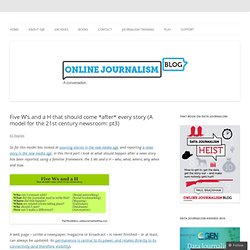
In this third part I look at what should happen after a news story has been reported, using a familiar framework: the 5 Ws and a H – who, what, where, why, when and how. A web page – unlike a newspaper, magazine or broadcast – is never finished – or at least, can always be updated. Its permanence is central to its power, and relates directly to its connectivity (and therefore visibility). Once out there it can be linked to, commented on, discussed, dissected, tagged, bookmarked and sent to a friend. That can take place on the original news site, but it probably doesn’t. Let’s look at conversations. But they’re only the start. Have you ever been to one of those meetings where there is a lot of talking – but no action?
There are some hugely important issues right now. Shouldn’t we be connecting? The Five W's (and H) approach. A few days ago, I was trying to explain some technical concepts to a friend.
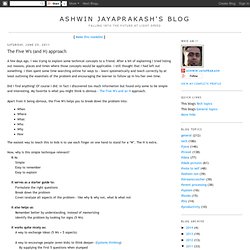
After a bit of explaining I tried listing out reasons, places and times where those concepts would be applicable. I still thought that I had left out something. I then spent some time searching online for ways to - learn systematically and teach correctly by at least outlining the essentials of the problem and encouraging the learner to follow up in his/her own time. Did I find anything?
Of course I did. Apart from it being obvious, the Five W's helps you to break down the problem into: See Tool. Design Research: Breathing Life into Your Projects. Prior to embarking on any design project, whether the end product is a website, a graphic or visual artwork, a lifestyle item or gadget, the most important and first step any designer should take is to do ample research.

Doing the research is relatively simple; it is the task of trying to understand and apply the research to benefit your project that is not easy. There are numerous methods to go about doing research. However, regardless of the method used to gather the research needed, it is a process that cannot and should not be avoided. Research can be characterised as purely the flesh and bone of a human body, without the life and soul within that drives it forward or to have a purpose. As Debbie Millman and Mike Bainbridge states in the article Design Meets Research. True Minimalism in Web Design. In this article I want to share a few basic tips to achieve minimalism in web design.

I will use a website I designed recently as an example, and then provide some other inspirational designs. The Five W’s of WAN Virtualization. Part 1: What is WAN Virtualization, and Who Should be interested in it?
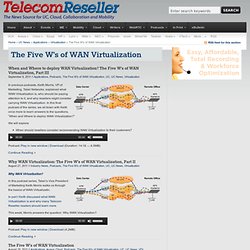
According to Talari Networks, “WAN Virtualization promises to revolutionize the economics of the enterprise Wide Area Network (WAN), making it affordable for businesses to deploy bandwidth hungry applications, VoIP, videoconferencing, virtual desktop infrastructures (VDIs), to enable private clouds and other modern technologies that support today’s remote office/telecommuter environment, and to add bandwidth and reduce monthly WAN spending while increasing network availability and application performance predictability.”
In this podcast series, Talari’s Vice President of Marketing Keith Morris walks us through the basics of WAN Virtualizatin.