
Human Rights Watch hrw.org. Resources for Human Rights Watch Partners. Contents Human Rights Watch believes that a vibrant international human rights movement is necessary to create significant and sustained improvements in human rights.
We consider strong partnerships with other nongovernmental organizations (NGOs) an essential tool for achieving impact, and close collaboration with other NGOs has been instrumental in many of our successes. Human Rights Watch aims to work with our partners in a manner that is mutually beneficial and we seek to assist partner NGOs whenever possible. The below document is intended to be a resource guide for Human Rights Watch's partner organizations, and includes information on potential funders, training and networking tools, security information, useful handbooks, and links to support organizations.
We hope that our partners find the below material useful in advancing your important work. The Human Rights Watch website, ( provides links to other sites for your convenience. Online Encyclopedia of Mass Violence. Natalie Pace: Modern Slavery. There was a time in America, 150 years ago -- on September 22, 1862 to be exact -- when it was chic to have a slave serving your dessert, or at hand to service your every need.
While slavery is no longer acceptable in the developed world, legally or socially, the sad truth is that it is still rampant -- hidden in the underbelly of society (all around the world) and woven into the supply chain of some of our goods. Human trafficking is a $32 billion industry with 20.9 million people trafficked annually, according to the International Labor Organization. One-quarter of the world's slave labor are children. United Nations Global Initiative to Fight Human Trafficking HUB. United Nations Development Programme.
Our world. Your move. End Child Hunger - Gandhi For Children — End Forced Child Labor. BRAC-
Homepage. OHCHR. Category:Concepts in ethics. Category:Ethics. This category puts articles relevant to well-known ethical (right and wrong, good and bad) debates and decisions in one place - including practical problems long known in philosophy, and the more abstract subjects in law, politics, and some professions and sciences.
It lists also those core concepts essential to understanding ethics as applied in various religions, some movements derived from religions, and religions discussed as if they were a theory of ethics making no special claim to divine status. The category also includes articles on non-ethics topics or fictional works or part of works that include a substantial ethical debate. Catégorie:Éthique. Une page de Wikipédia, l'encyclopédie libre.
Cette catégorie contient des articles relevant de l'éthique, mais elle contient également des articles sur des sujets non éthiques ou des œuvres fictives qui comprennent un débat éthique substantiel. Sur les autres projets Wikimedia : Éthique, sur Wikimedia Commons Voir aussi la catégorie Philosophie morale. Global Issues : social, political, economic and environmental issues that affect us all. Global Policy Forum. Global Voices Advocacy. The Peoples Voice. Greg Hunter· Economist Dr.
Paul Craig Roberts says, "The physical stock of gold in the West to meet delivery demand is diminishing rapidly. So, one day the Chinese will buy 100 tons of gold, and we won't be able to make delivery. That would crash the system. It would just pop. On the Federal Reserve money printing to prop up the economy, Dr. Vision for a Sustainable World. Council for Secular Humanism. Antiwar.com. Liste des pays qui ne possèdent pas d'armée. Costa Rica: un pays sans armée : Supprimer l'armée pour investir dans l'éducation et la santé. En quoi ce projet est-il singulier et créatif ?

Éditer Le Costa Rica est un des rares États à ne pas avoir d'armée. Vingt-huit pays indépendants du monde ne possèdent pas d'armée. Soit ils ont un accord de défense avec un pays tiers, soit ils possèdent de petites forces paramilitaires ou des gardes. L'insécurité galopante incite les habitants à s'équiper de coffres forts et armoires fortes du type de ceux que l'on peu trouver sur le site Quelle est la plus-value sociale du projet ? L'absence d'armée permet chaque année le financement de toutes les universités publiques du pays ainsi que de trois hôpitaux ; les habitants bénéficient d'une couverture sociale et d'un matériel médical moderne, tant et si bien que la mortalité due à des maladies bénignes a fortement diminué et que l'espérance de vie est devenue très forte.
Quel est le potentiel de déploiement de cette initiative ? Stop the War Coalition. Category:Humanitarian aid organizations. From Wikipedia, the free encyclopedia Subcategories This category has the following 13 subcategories, out of 13 total. Category:Ethics organizations. The Rachel Corrie Foundation for Peace and Justice. Council on Spiritual Practices - Code of Ethics.
Code of Ethics for Spiritual Guides [Preamble] People have long sought to enrich their lives and to awaken to their full natures through spiritual practices including prayer, meditation, mind-body disciplines, service, ritual, community liturgy, holy-day and seasonal observances, and rites of passage.
King Institute Home. Peace First... Interfaith & Peace Initiatives... Peace Tactics... Enough. COLLECTIVEINTELLIGENCE:Creating a Prosperous World at Peace. The Green Belt Movement. Combining microfinance, education, and health protection to end world hunger. Survival International - The movement for tribal peoples. The international Attac network. Working together to find lasting solutions to poverty and injustice. Indigenous rights. Indigenous rights are those rights that exist in recognition of the specific condition of the indigenous peoples.
This includes not only the most basic human rights of physical survival and integrity, but also the preservation of their land, language, religion, and other elements of cultural heritage that are a part of their existence as a people. This can be used as an expression for advocacy of social organizations or form a part of the national law in establishing the relation between a government and the right of self-determination among the indigenous people living within its borders, or in international law as a protection against violation by actions of governments or groups of private interests.
Definition and historical background[edit] Stunning Portraits Of The World’s Remotest Tribes Before They Pass Away (46 pics. Living in a concrete box with hot water pouring from the tap, a refrigerator cooling our food and wi-fi connecting us to the rest of the world, we can barely imagine a day in a life of, say, Tsaatan people.
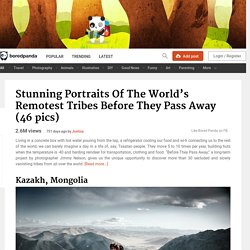
They move 5 to 10 times per year, building huts when the temperature is -40 and herding reindeer for transportation, clothing and food. “Before They Pass Away,” a long-term project by photographer Jimmy Nelson, gives us the unique opportunity to discover more than 30 secluded and slowly vanishing tribes from all over the world. Conférence "Regards sur les peuples autochtones" - Les Champs Libres - 24-05-2012. Uncontacted Tribes.org.