
THE BRAIN FROM TOP TO BOTTOM. Cranial Nerves. Can't remember the names of the cranial nerves?
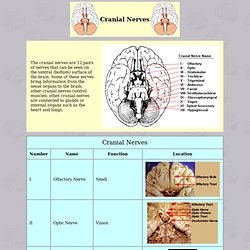
Here is a handy-dandy mnemonic for you: On Old Olympus Towering Top AFamous Vocal German Viewed Some Hops. The bold letters stand for: olfactory, optic, oculomotor, trochlear, trigeminal, abducens, facial, vestibulocochlear, glossopharyngeal, vagus, spinal accessory, hypoglossal. Etymology of Neuroscience Terms.
Home page. Cool And Freaky Audio Illusion (Best With HeadPhones) The Whole Brain Atlas. 11brain2axx__1231575167_0544.jpg (950×848) Mind Uploading: Brain Facts. What's the scale of things here?

The following lengths (from Posner p. 305) give approximate sizes for structures in the nervous system: 0.001 mm: synapses (tip of a connection between neurons) 0.1 mm: neurons (brain cell) 1 mm: local circuits (small networks of cells) 10 mm: maps (spatially organized topographic maps) 100 mm: systems (e.g., the visual system) 1000 mm: the central nervous system (including spinal cord) How many things are we talking about? Short answer: a LOT. Long answer: Per cubic millimeter (mm^3), there are about 10^5 neurons and 10^9 synapses. How fast does the brain work? Not very fast by computer standards.
How are memories stored in the brain? This is one of the great questions of neuroscience, and research has nearly converged on an answer. OK, so neurons and connections, is that it? The Basics of MRI. Love Deactivates Brain Areas For Fear, Planning, Critical Social Assessment. Love Deactivates Brain Areas For Fear, Planning, Critical Social Assessment Andreas Bartels and Semir Zeki of the Wellcome Department of Imaging Neuroscience, University College London have found using Functional Magnetic Resonance Imaging (fMRI) that love turns down activity in some areas of the brain in part so that we will not see flaws in the object of our affections.
However the key result was that it's not just that certain shared areas of the brain are reliably activated in both romantic and maternal love, but also particular locations are deactivated and it's the deactivation which is perhaps most revealing about love. Among other areas, parts of the pre-frontal cortex – a bit of the brain towards the front and implicated in social judgment – seems to get switched off when we are in love and when we love our children, as do areas linked with the experience of negative emotions such as aggression and fear as well as planning. Notes from the Undergrad. By Andrew Newburg | Yawn.
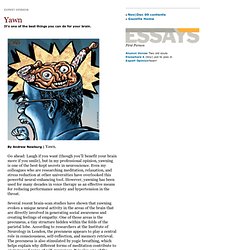
Go ahead: Laugh if you want (though you’ll benefit your brain more if you smile), but in my professional opinion, yawning is one of the best-kept secrets in neuroscience. Even my colleagues who are researching meditation, relaxation, and stress reduction at other universities have overlooked this powerful neural-enhancing tool. However, yawning has been used for many decades in voice therapy as an effective means for reducing performance anxiety and hypertension in the throat. Several recent brain-scan studies have shown that yawning evokes a unique neural activity in the areas of the brain that are directly involved in generating social awareness and creating feelings of empathy. One of those areas is the precuneus, a tiny structure hidden within the folds of the parietal lobe. Why am I so insistent? As a young medical student, I was once “caught” yawning and actually scolded by my professor. My advice is simple. History of Neuroscience.
Brain Explorer. Brain Atlas - Introduction. The central nervous system (CNS) consists of the brain and the spinal cord, immersed in the cerebrospinal fluid (CSF).
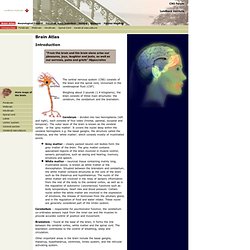
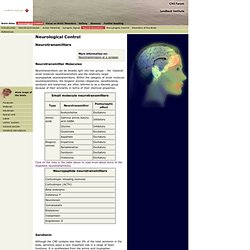
Weighing about 3 pounds (1.4 kilograms), the brain consists of three main structures: the cerebrum, the cerebellum and the brainstem. Cerebrum - divided into two hemispheres (left and right), each consists of four lobes (frontal, parietal, occipital and temporal). Neurological Control - Introduction. Neurological Control - Neurotransmitters. Neurotransmitter Molecules Neurotransmitters can be broadly split into two groups – the ‘classical’, small molecule neurotransmitters and the relatively larger neuropeptide neurotransmitters.
First map of the human brain reveals a simple, grid-like structure between neurons. In an astonishing new study, scientists at the National Institutes of Health (NIH), have imaged human and monkey brains and found… well, the image above says it all.

It turns out that the pathways in your brain — the connections between neurons — are almost perfectly grid-like. It’s rather weird: If you’ve ever seen a computer ribbon cable — a flat, 2D ribbon of wires stuck together, such as an IDE hard drive cable — the brain is basically just a huge collection of these ribbons, traveling parallel or perpendicular to each other. There are almost zero diagonals, nor single neurons that stray from the neuronal highways.
The human brain is just one big grid of neurons — a lot like the streets of Manhattan, minus Broadway, and then projected into three dimensions. This new imagery comes from a souped-up MRI scanner that uses diffusion spectrum imaging to detect the movement of water molecules within axons (the long connections made by neurons). “Before, we had just driving directions. 562185_431053760251906_1888684791_n.jpg (360×480)