
Pagans. Mastery of Life. The Rosicrucian Order, AMORC, is known internationally by its traditional and authentic title, the Ancient Mystical Order Rosae Crucis, from which is derived the acronym “AMORC.”
Free Ebooks on Rosicrucianism. The Rosicrucian Order is a legendary esoteric Order publicly documented in the early 17th century.
This hermetic Order is viewed among earlier and many modern Rosicrucianists as a "College of Invisibles" from the inner worlds, composed of great Adepts, aiming to give assistance in mankind's spiritual unfoldment. When compared to human beings, the consciousness of these Adepts is said to be like that of demi-gods. Several modern societies have been formed for the study of Rosicrucianism and allied subjects. Theosophy/Rosicrucian: Lecture I: The New Form of Wisdom. The New Form of Wisdom Schmidt Number: S-1532 On-line since: 4th July, 2002.
Becoming a Pagan. HyperDiscordia, Confusion for a New Generation. In this world, there are two kinds of people -- those who Get It and those who Don't.

The Temple of Mithras. Willow Creations. Barbelith. New-time religion. Jediism Home. Pagan Religion. The Universal Life Church is a legally recognized California church.
Since 1962, ULC has been ordaining ministers around the world. Our ministers are authorized to perform all peaceful rites and ceremonies of the church, including legal marriages (hand fasting). The Universal Life Church includes all peaceful people. We have a very simple doctrine: "Do only that which is right. " As long as it does not infringe on the rights of others, we understand that it is the right and responsibility of the individual to peacefully determine what is right. The Universal Life Church includes people from all spiritual traditions and paths.
Legends. Arthurian Resources. The Historicity and Historicisation of Arthur. Picatrix (The Aim of the Sage) of pseudo-Majriti (summary) Al-Majriti, Maslamati ibn Ahmad The Ghâyat al-Hakîm fi'l-sihr, or Picatrix, as it is known in the West, is an important Arabic magical text.
It is perhaps the largest and most comprehensive of the grimoires, or handbooks of magic. The attribution to the Andalusian mathematician al-Majriti (or al-Madjriti) (d. ca. 1004-7) is considered pseudo-epigraphic. The Latin translation dates to 1256 and the court of Alphonso the Wise, king of Castille, and exerted a considerable influence on Western magic thereafter. It is said that much of Ficino's astrological magic derives from the Picatrix (see I.P.Couliano, Eros and Magic in the Renaissance, University of Chicao Press, 1987, p. 118). E.M. Recent editions include: (Arabic) Pseudo-Magriti, Das Ziel des Weisen, Herausgegeben von Hellmut Ritter, B.G.
(German) "Picatrix" Das Ziel des Weisen von Pseudo-Magriti, Translated into German from the Arabic by Hellmut Ritter and Martin Plessner, London, The Warburg Institute, University of London, 1962. The Key of Knowledge (Clavicula Salomonis) Add. MS. 36674. Transcribed from British Library, Additional manuscript 36674.
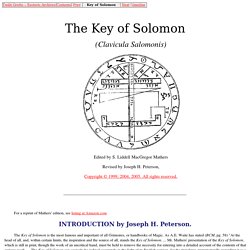
Key of Solomon, Book 2. The Key of Solomon (Clavicula Salomonis) edited by S. Liddell MacGregor Mathers. For a reprint of Mathers' edition, see listing at Amazon.com INTRODUCTION by Joseph H.
Lemegeton Clavicula Salomonis ('The Lesser Key of Solomon') The Lesser Key of Solomon This digital edition by Joseph H.
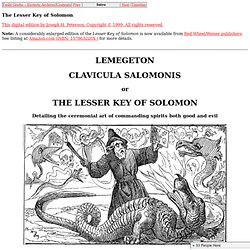
Peterson, Copyright © 1999. All rights reserved. Note: A considerably enlarged edition of the Lesser Key of Solomon is now available from Red Wheel/Weiser publishers. See listing at Amazon.com (ISBN: 157863220X ) for more details. Detailing the ceremonial art of commanding spirits both good and evil. LEMEGETON, Part 2 Theurgia Goetia. NOTE:All drawings are available on our CD.
Editor's note: Many of the spirits and sigils in this book are also found in Trithemius' Steganographia. For example, compare the eleventh spirit with Steg. Book 1, chapter XI. -JHP. Gollancz Mafteah Shelomoh - Clavicula Salomonis. This digital edition by Joseph H. Peterson, Copyright © 2000. All rights reserved. You will need a Hebrew font installed to read this. A Hebrew Manuscript Newly discovered and now described by. LEMEGETON, Part 3 Ars Paulina.