
Consciousness Freedom and the Right to Get High. Why do we, as children, want to spin in circles until we’re so dizzy we puke? Or push on our eyelids until we see colors and images? Or choke ourselves until we lose consciousness? Psilocybin and Personality. Psilocybe mexicana, a source of psilocybin Recent research suggests fascinating connections between the effects of the psychedelic drug psilocybin and personality traits related to inner experience. Personality appears to influence response to psilocybin and psilocybin can promote changes in personality , suggesting a reciprocal relationship. Further research in this area could lead to new insights into the basis of human personality and creativity . Can Psychedelic Drugs Help Us to Die Gratefully?
Scientific studies demonstrate that psychedelic drugs hold enormous potential as medicines to help us accept death and ease the dying process.
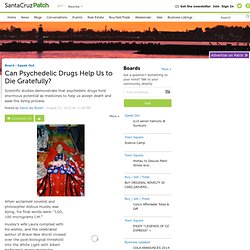
When acclaimed novelist and philosopher Aldous Huxley was dying, his final words were: “LSD, 100 micrograms I.M.” Huxley’s wife Laura complied with his wishes, and the celebrated author of Brave New World crossed over the post-biological threshold into the White Light with Albert Hofmann’s magic molecules nestled in the synapses of his brain. The inspiration for this final journey was based upon the work that early LSD researchers had done with terminally ill patients; however, the relationship between the psychedelic experience and the experience of dying, death, and rebirth is ancient, and likely began in prehistory.
Modern cultural links in art and music abound, and it’s no accident that the most celebrated psychedelic rock band of all-time is known as The Grateful Dead. It also improved communication between the patients and their loved ones. Neurosoup: Entheogens, Drugs, Consciousness Exploration, Spirituality. Self-portraits done to a different drug every day. Follow Bob on Tapiture Artist Bryan Lewis Saunders conducted a bizarre experiment.
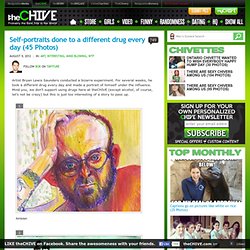
For several weeks, he took a different drug every day and made a portrait of himself under the influence. Gabriel Mizrahi: Straight Trippin' In his 1968 novel The Electric Kool-Aid Acid Test, Tom Wolfe proclaimed that researchers conducting experiments with LSD ("those big fat letters") were living in a "fantasy," and that:
Prehistoric Drug Use. I couldn’t pass up this opportunity to discuss the recent discovery of “prehistoric drug paraphernalia” found in a Caribbean island archaeological site dated to @ 400 BC.
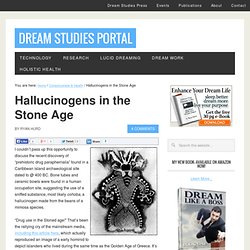
Bone tubes and ceramic bowls were found in a human occupation site, suggesting the use of a sniffed substance, most likely cohoba, a hallucinogen made from the beans of a mimosa species. “Drug use in the Stoned age!” Scientists believe "magic" mushrooms could effectively treat depression. After a brief spurt of interest in the late '60s, scientists in the drug development field abandoned research work on illicit drugs like LSD and "magic" mushrooms.
But over the past few years a few bold investigators have been stepping back up to the plate, convinced that some outlawed active ingredients could offer new pathways to treating some common ailments. Enter Professor David Nutt, a prominent and controversial researcher in the U.K. who has just published a new paper asserting that psilocybin--the active ingredient in magic mushrooms--could help treat major depression. Leda > The Plant Kingdom and Hallucinogens by Richard Evans Schultes. A wonderfully written book by the Father of Ethnobotany The plant kingdom and hallucinogens (part I) Ph.D., F.L.S. Richard Evans SCHULTES Curator of Economic Botany and Executive Director, Botanical Museum of Harvard University, Cambridge, Massachusetts, U.S.A. "These substances have formed a bond of union between men of opposite hemispheres, the uncivilized and the civilized; they have forced passages which, once open, proved of use for other purposes; they have produced in ancient races characteristics which have endured to the present day, evidencing the marvellous degree of intercourse that existed between different peoples just as certainly and exactly as a chemist can judge the relations of two substances by the reactions.
" Lewin The use of hallucinogenic substances goes far back into human pre-history. How Hallucinogens Play Their Mind-Bending Games: Scientific American - (Build 20100722150226) Hallucinogens Have Doctors Tuning In Again - NYTimes.com - (Buil. Nothing had any lasting effect until, at the age of 65, he had his first psychedelic experience.
He left his home in Vancouver, Wash., to take part in an experiment at Johns Hopkins medical school involving psilocybin, the psychoactive ingredient found in certain mushrooms. Psychedelic Research. The Lycaeum - Entheogen Definition. Definition of "Entheogenic" Quick Definition: mind altering, psychedelic, spirit inducing, shamanistic substance Some of you who stumble upon this website may be slightly puzzled by a word in our header that is probably unfamiliar to many: Entheogenic. Converted into a noun, the word becomes Entheogen, and the two terms have recently become quite popular among aficionados of botanically and chemically fueled visionary experiences.
Scientists suggest fresh look at psychedelic drugs. Ampakine. Ampakines are a class of compounds known to enhance attention span and alertness, and facilitate learning and memory.
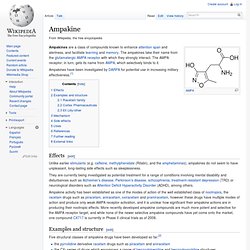
The ampakines take their name from the glutamatergic AMPA receptor with which they strongly interact. The AMPA receptor, in turn, gets its name from AMPA, which selectively binds to it. Ampakines have been investigated by DARPA for potential use in increasing military effectiveness.[1] Effects[edit] Unlike earlier stimulants (e.g. caffeine, methylphenidate (Ritalin), and the amphetamines), ampakines do not seem to have unpleasant, long-lasting side effects such as sleeplessness.
They are currently being investigated as potential treatment for a range of conditions involving mental disability and disturbances such as Alzheimer's disease, Parkinson's disease, schizophrenia, treatment-resistant depression (TRD) or neurological disorders such as Attention Deficit Hyperactivity Disorder (ADHD), among others. Examples and structure[edit] Racetam family[edit] Eli Lilly/other[edit]
Why Intelligent People Use More Drugs. The human consumption of psychoactive drugs , such as marijuana , cocaine , and heroin, is of even more recent historical origin than the human consumption of alcohol or tobacco, so the Hypothesis would predict that more intelligent people use more drugs more frequently than less intelligent individuals. The use of opium dates back to about 5,000 years ago, and the earliest reference to the pharmacological use of cannabis is in a book written in 2737 BC by the Chinese Emperor Shen Nung.
Opium and cannabis are the only “natural” (agricultural) psychoactive drugs. Other psychoactive drugs are “chemical” (pharmacological); they require modern chemistry to manufacture, and are therefore of much more recent origin. List of drug films. Entheogenesis, Shamanism, and Psychonautics. Drug Chart. Meth Addict. Citation: Hydrogenator.
"The Perfect Addiction: An Experience with Methamphetamine (ID 43655)". Erowid.org. Two new scientific studies reveal hallucinogens are good for your mental health. Acid trip 1.