

U.S. Underwrites Internet Detour Around Censors Abroad The effort includes secretive projects to create independent cellphone networks inside foreign countries, as well as one operation out of a spy novel in a fifth-floor shop on L Street in Washington, where a group of young entrepreneurs who look as if they could be in a garage band are fitting deceptively innocent-looking hardware into a prototype “Internet in a suitcase.” Financed with a $2 million State Department grant, the suitcase could be secreted across a border and quickly set up to allow wireless communication over a wide area with a link to the global Internet. The American effort, revealed in dozens of interviews, planning documents and classified diplomatic cables obtained by The New York Times, ranges in scale, cost and sophistication. Some projects involve technology that the United States is developing; others pull together tools that have already been created by hackers in a so-called liberation-technology movement sweeping the globe. The Invisible Web Then there was Mr. Mr.
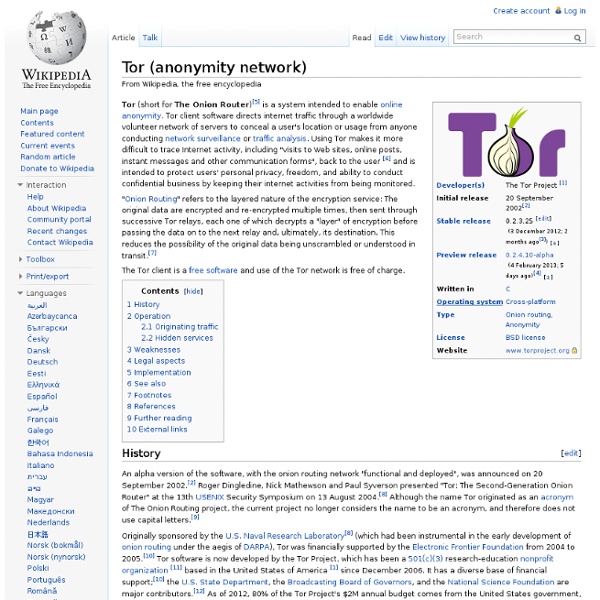
Tor Browser Bundle Tor Network[edit] Tor works by routing Internet traffic through several "onion" servers, obscuring the originating address. This naturally provides anonymity for other Internet programs that are configured to connect to it on the system, or even network. Applications can be directed to the Tor network through a SOCKS proxy at localhost on port 9050 as well as a HTTP proxy at localhost on port 8118. Reading the Tor documentation is highly recommended to prevent configuration mistakes that could compromise the user's anonymity. See also[edit] References[edit] External links[edit] Official website
Remove Skype Chat History for Single Contact Introduction I wanted to clear the Skype chat history for a single user, but Skype only allows you to clear the complete chat history, not a single user's contact history. I searched for 3rd party tools on the net but nothing worked for me on Windows 7 / Skype 4.1 At the beginning, I knew nothing about how Skype stored chat history and just entered my username and password to login and chat with friends. After spending a few hours asking Google many questions, I found that Skype was using the following SQLite database to store its messages. System Drive:\<Current User’s application data folder>/Skype/<Skype username>/main.db I tried to read it with SQLitespy, but it was a pain to find and clear messages each time. Using the Code First of all, I had to find a method to deal with an SQLite database file using C#. Reference System.Data.SQLite.dll (Located in C:\Program Files\SQLite.NET\bin\System.Data.SQLite.dll) to allow C# to deal with the SQLite database file.
Online Cash Bitcoin Could Challenge Governments, Banks Late last year, after WikiLeaks began releasing its trove of State Department cables, many individuals sought to show solidarity with the group by making a donation. They found, however, that many payment processors would not remit money to WikiLeaks, some say as a result of U.S. government pressure. PayPal even froze the group’s account so it couldn’t access funds already collected. “Hey, Visa, Mastercard, Paypal: It’s MY money,” media critic Jeff Jarvis tweeted at the time. Intermediaries as Choke Points Whether or not payment processors ought to be telling us how to spend our money online, the fact is they can. Online gambling and sports betting is perfectly legal in countries like the UK, Ireland and Australia, and a resident of the U.S. will have no problem reaching the websites of gaming sites from those countries. To transact online, you have to have an account with a third party like PayPal that you trust will follow your payment instructions. True Digital Cash
OpenNet Initiative The OpenNet Initiative (ONI) is a joint project whose goal is to monitor and report on internet filtering and surveillance practices by nations. The project employs a number of technical means, as well as an international network of investigators, to determine the extent and nature of government-run internet filtering programs. Participating academic institutions include the Citizen Lab at the Munk Centre for International Studies, University of Toronto; Berkman Center for Internet & Society at Harvard Law School; the Oxford Internet Institute (OII) at University of Oxford; and, The SecDev Group, which took over from the Advanced Network Research Group at the Cambridge Security Programme, University of Cambridge. Methods[edit] ONI uses several methods to test and document internet censorship in a country. ONI Principal Investigators[edit] The ONI principal investigators are:[1] Major Accomplishments[edit] ONI Asia[edit] Psiphon[edit] Censorship research reports[edit] Books[edit] See also[edit]
Wiki / Jobs You can select what type of results 80legs generates for you. Available options are: Unique and total count - 80legs outputs the # of unique matches and total # of matches for your content selection strings (i.e., keywords or regular expressions)Boolean array - 80legs outputs the two numbers above plus a 1 or 0 for each string, depending on whether or not that string was foundCount array - 80legs outputs the unique and total count plus the total count for each stringCode results - If you select to analyze content using code, result type will default to this option Here are some examples of each result type. The contents of the first page are 'test1 test1 test2 test3 test5'. test test1 test2 test3 test4 test5 test6 For 'Unique and total count' the output will be: For 'Boolean array' the output will be:
The Bitcoin Bubble | Bottom-up My friend Jerry Brito is one of the best-connected and most insightful observers of the Internet I know, so when he starts talking up an Internet trend , I pay attention. But after reading his case for Bitcoin, a new digital currency, I remain a skeptic. The article is worth reading in full, but here’s an important part of his case for Bitcoin: The web has also seen all-purpose digital currencies, from defunct dot-com bubble start-ups Flooz and Beenz, to the slightly more successful e-gold. Bitcoin is the first online currency to solve the so-called “double spending” problem without resorting to a third-party intermediary. It’s an intriguing concept, but the fundamental question about any currency is whether its value will be stable over time. The fundamental demand-side problem is that it’s not clear why anyone would want Bitcoins—which are, after all, just entries in a database—in the first place. But dollars have at least two advantages over Bitcoins.
Libertarianism Traditionally, libertarianism was a term for a form of left-wing politics; such left-libertarian ideologies seek to abolish capitalism and private ownership of the means of production, or else to restrict their purview or effects, in favor of common or cooperative ownership and management, viewing private property as a barrier to freedom and liberty.[6][7][8][9] In the United States, modern right-libertarian ideologies, such as minarchism and anarcho-capitalism, co-opted the term in the mid-20th century to instead advocate laissez-faire capitalism and strong private property rights, such as in land, infrastructure, and natural resources.[10][11][12] Etymology[edit] The 17 August 1860 edition of Le Libertaire: Journal du Mouvement Social, a libertarian communist publication in New York In the mid-1890s, Sébastien Faure began publishing a new Le Libertaire while France's Third Republic enacted the lois scélérates ("villainous laws"), which banned anarchist publications in France.
Bitcoin’s Collusion Problem | Bottom-up Yesterday I questioned whether we should expect demand for Bitcoins to be stable over the long run. Today I want to look at the supply side. A constrained supply of money is important to a currency’s stability. One of Bitcoin’s key selling points is that the number of Bitcoins issued will never exceed 21 million. But this promise isn’t credible. To understand why, we need to dig a little bit into how the protocol works. The Bitcoin peer-to-peer network can be thought of as a giant, shared accounting ledger. The system has a clever incentive system: each node is allowed to insert a fixed reward (currently 50 Bitcoins) for itself into the block it is working on. The limit is a social convention baked into the BitCoin software. If a group of nodes colluded to change the rules (say, awarding themselves 100 Bitcoins rather than 50 for “winning” a round), the result would be a “fork” of the Bitcoin network.
by raviii Dec 27